



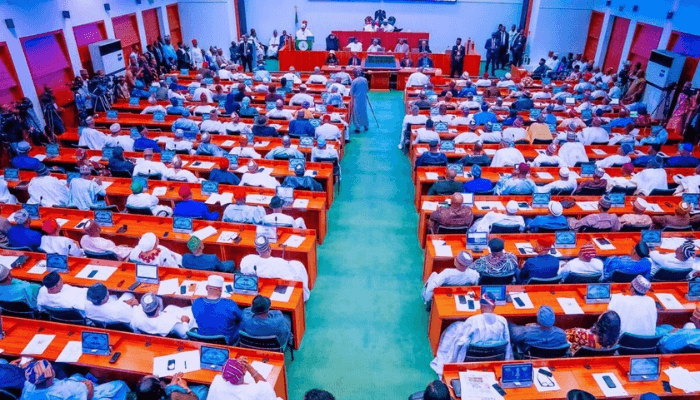
Nigeria’s House of Representatives is meant to be a theatre of debate, where the nation’s elected members battle ideas, sponsor bills, and speak for the people who sent them there. But a new report has revealed that a significant number of Representatives are not playing their part.
According to the Deliberative Barometer and Policy-Focus Productivity Report (NASS-DBPFR) released by the Erudite Growth and Advancement Foundation (ERGAF-Africa), at least 37 members of the House of Representatives failed to sponsor a single bill, motion, or petition, and did not contribute to debates during plenary sessions between June 14, 2023, and June 13, 2024.
In plain terms, for one full year, these lawmakers did not utter a word in Nigeria’s lower legislative chamber. The findings have raised concerns about representation, accountability, and the value Nigerians get from their democracy. While some argue that legislative productivity should not be measured by speaking in plenary alone, other political observers believe silence in the chamber is a worrying sign of disengagement.
Read also: Green Chamber: A silent shift: How Nigeria’s opposition is losing its voice at House of Reps

So, who are Nigeria’s “silent Reps”?
From the north-east, Adamawa produced two names on the list: Abubakar Baba Zango (APC, Yola North/Yola South/Girei) and Mohammed Inuwa Bassi (APC, Ganye/Jada/Mayo Belwa/Toungo). In Anambra, Nnabuife Chinwe Clara (YPP, Orumba North/Orumba South) also made the tally.
Bauchi had its own representative in Rabilu Bala (APC, Jamare/Itas-Gadau), while Borno’s Rabiu Abdulkadir (APC, Maiduguri Metropolitan) was similarly flagged.
From Gombe, the report spotlighted Yaya Bauchi Tongo (PDP, Gombe/Kwami/Funakaye). In Jigawa, silence seemed contagious, with no fewer than four lawmakers listed: Adamu Yakubu (PDP, Birnin Kudu/Buji), Ibrahim Auyo Usman (APC, Hadejia/Kafin Hausa/Auyo), Sani Nazifi (APC, Gumel/Maigatari/Sule Tankarkar/Gagarawa), and Madawaki Dahiru (PDP, Dutse/Kiyawa).
Kaduna’s Yahaya Suleiman Richifa (PDP, Soba) was also missing from the debates, alongside Kano lawmakers:

Adbulkadir Tijjani (NNPP, Dawakin Tofa/Tofa/Rimin Gado), Dankawu Idris (NNPP, Kumbotso), and Muazu Abdullahi Gwarzo (APC, Gwarzo/Kabo).
Katsina had Muhammed Aminu Ibrahim (APC, Malumfashi/Kafur), while Kebbi’s Umar Garba-Uba (APC, Ngaski/Shanga/Yauri) was noted. From Kogi, Ozigi Muhammed Tijani (APC, Okene/Ogori-Magongo) was among those who went unheard.
Lagos, Nigeria’s commercial hub, produced four “silent reps”: Badru Euitan Akanni Dolapo (APC, Lagos Island), Olabinjo Benjamin Adeyemi (APC, Ifako-Ijaiye), Olawande George (LP, Amuwo-Odofin), and Oluwaseyi Ayopo Sowumi (LP, Ojo).
From Nasarawa, Abubakar Sariki Dahiru (APC, Lafia/Obi) made the list. Niger had three: Abdullahi Idris Garba (APC, Kontagora/Wushishi/Mariga/Mashegu), Abubakar Abdul Buba Abubakar (PDP, Chanchaga), and Manudu Abdullahi (APC, Agaie/Lapai)
In Ondo, Adesida Abiodun Cornelius Aderin (APC, Akure North/Akure South) was reported silent, while Osun contributed Adetunji Abidemi Olusoji (PDP, Odo-Otin/Ifelodun/Boripe) and Omirin Emmanuel Olusanya (APC, Atakumosa East/Atakumosa West/Ilesa East/Ilesa West).
Read also: Nigeria: A tyranny of a powerful minority
Oyo was not left out: Akinmoyede Olafisoye Wasiu (APC, Akinyele/Lagelu) and Ojo Sunday Makanjuola (PDP, Ogo-Oluwa/Surulere) did not participate in plenary. Plateau had John Moenwul Dafaan (APC, Mikang/Qua’an Pan/Shedam).
Rivers State, famous for its fiery politics, also had two names on the roll call of silence: Goodhead Boma (PDP, Akuku Toru/Asari Toru) and Umezuruike Manuchim (LP, Port Harcourt I).
Sokoto was another hotspot. The report flagged Hassan Bala Abubakar (APC, Sokoto North/Sokoto South), Mani Maishinko Katami (PDP, Binji/Silame), and Yakubu Sani Alhaji (APC, Tangaza/Gudu).
Taraba’s Prince Ayuba Aboki Zaku Dampar (APC, Ibi/Wukari) was included, as were two lawmakers from Yobe: Fatima Talba (APC, Nangere/Potiskum) and Jakduwa Hassan Kaikaku (PDP, Bade/Jakusko).
Closing the list was Aminu Sani Jaji (APC, Zamfara Kaura-Namoda/Birnin Magaji).
For citizens, the revelations are sobering. In a country grappling with economic strain, insecurity, and a health system on the brink, many expect their representatives to be visible, vocal, and vigorous in pushing their interests.
The report’s findings suggest otherwise for these lawmakers, at least within the official record of plenary sessions.
Ibrahim Auyo said that the leadership demands up to N3 million to present bills, motions, and petitions on the chamber floor.
Auyo, who represents Hadejia/Auyo/Kafin Hausa federal constituency in Jigawa was recently queried by his constituents for not doing anything in the chambers.
In his defense, he alleged that legislators are made to pay between N1 million and N3 million to get their proposals passed, an allegation the leadership of the House has since denied, and demanded evidence from him, which he is yet to provide.
Read also: Let us rise up, meet expectations of Nigerians, Akpabio tells lawmakers
Behind closed doors, committees draft reports, lobby for constituency projects, and negotiate funding. A lawmaker may be quiet in plenary yet active in committee rooms or within their constituency
Still, perception matters. When Nigerians see their representatives fail to speak for a whole year, it undermines confidence in the legislative process. Even symbolic participation—sponsoring a motion, raising a petition—signals representation.
ERGAF-Africa’s report is likely to stir more debate on how to measure legislative productivity. Should it be by bills sponsored, debates contributed to, motions raised, or impact on communities? Or should Nigerians demand a combination of all?
For now, what is certain is that these 37 lawmakers have been put under the spotlight, their silence documented in black and white.





