Nigeria is now richer today than at any time in the last decade, but the citizens being governed are poorer, hammered by the steepest erosion of purchasing power, a condition that has led to a surge in widespread misery in Africa’s biggest oil producer.
Revenue collected by the government in the eight months to August 2025 rose to N20.6 trillion, according to a statement by the presidency. That’s almost the same value generated in the whole of 2024 at N21.7 trillion, and the fastest run ever on record.
But this growth in earnings has yet to translate to improved living standards for Nigerians, whose earnings have been crushed by a high double-digit inflation and an over 70 percent devaluation of the naira that has weakened spending power.
A wave of unprecedented misery has been let loose, with four out of 10 Nigerians now living below the World Bank’s $2.15 poverty line and the country leading in misery index among surveyed economies.

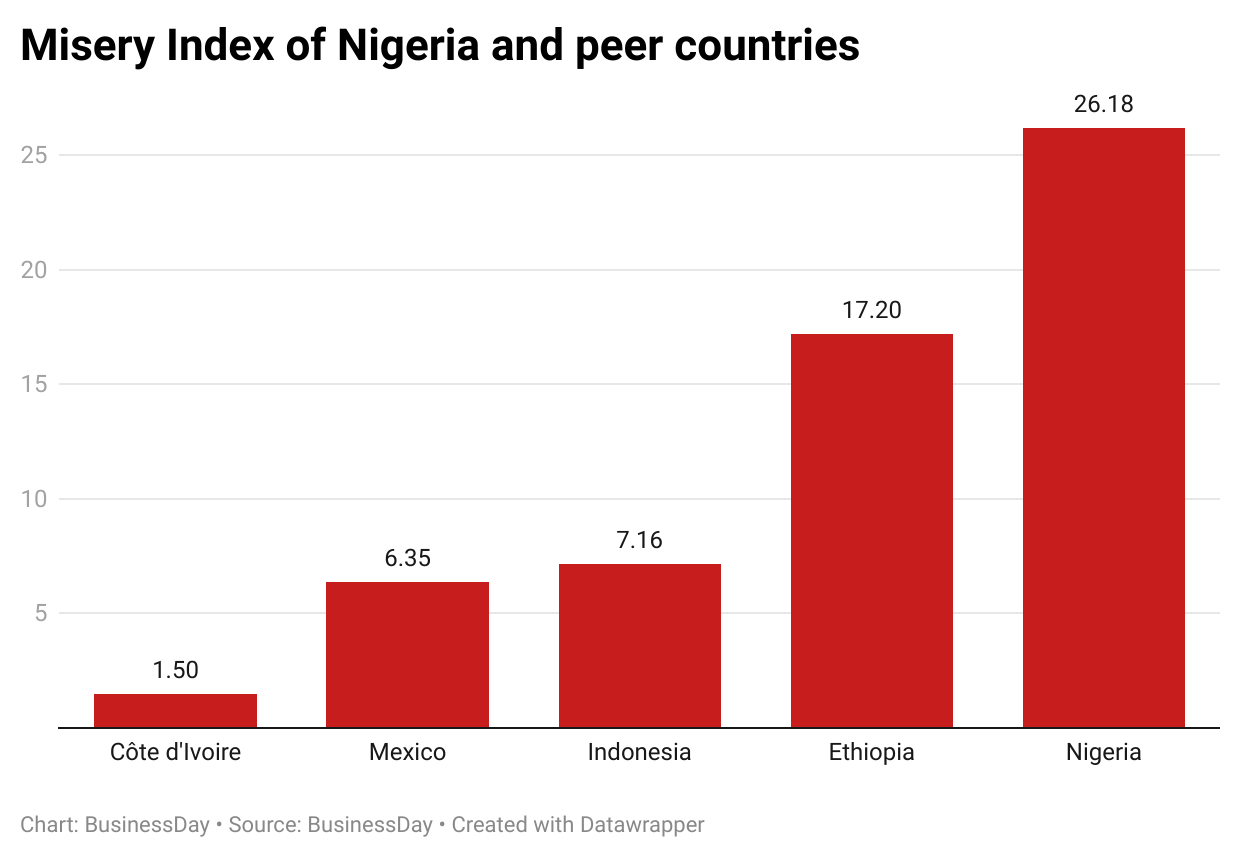
Data compiled by BusinessDay shows that Nigeria’s misery index, a combination of the unemployment rate and inflation, is significantly worse than that of its MINT peers – Mexico, Indonesia, and two top African economies that use the revised jobless rate methodology.
Africa’s most populous nation has an index of 26.18, meaning daily living costs remain crushing, and Nigerians feel little of the record revenue in their pockets; instead, they face higher hardship.
That’s not the case in Mexico and Indonesia, where the nations’ misery indices are considerably lower at 6.35 and 7.16, respectively. Peer countries in Africa, like Côte d’Ivoire and Ethiopia, also have lower rates compared to the continent’s fourth biggest economy.
“Nigerians are going through a readjustment period, and increased government revenues potentially translate into firmer structural stability and economic growth, which is positive for the populace,” Samuel Sule, chief executive officer of Renaissance Capital Africa, told this reporter.
“There is, however, a lag period, and this is likely where we are at this time.”

Nigeria has embarked on a strings of reforms, including phasing out costly fuel subsidies, floating the naira, an overhaul of taxes, and beefing up minimum paid-up capital for banks, among many others, in an effort to reposition the economy and increase its revenue base.
“Some of the recent reforms are redefining the economy and expanding the formalised component within it. This is medium-term positive and should be followed with increased government spending efficiency,” Sule said.
“The past trajectory would have led to an unsustainable fiscal position, which in turn would have led to a material impact on the entire economy.”
The economy has witnessed a noticeable stability following the reforms, but the citizens have had to pay for it, as 33 million are now at risk of an acute hunger crisis. The country ranked 110th out of 127 countries in the Global Hunger Index in 2024 – a level of hunger described as serious.
In a statement issued in July 2025, the International Monetary Fund (IMF) said the government needs to scale up the cash transfer system to support inclusive growth and lift millions out of poverty. But 11 months into the scheme, only one in three of the 15 million households targeted have received the transfers.
“Nigeria lacks an effective social safety net to cushion the impact of shocks on the most vulnerable,” the Washington-based lender said. “The share of revenue that goes to interest spending leaves too little for investment in people and infrastructure.”
Incentives, tax concessions to ease prices for Nigerians
For Muda Yusuf, the CEO of the Centre for the Promotion of Private Enterprises (CPPE), Nigeria needs to prioritise its spending and provide incentives for sectors such as agriculture, transportation, energy, manufacturing, and pharmaceuticals to ease cost pressures, stressing that improved revenue may not immediately lead to better living conditions.
Yusuf argued that Nigerians are facing a cost-of-living crisis that was powered by inflation, swings in the exchange rate, and high energy costs – a situation that’s now worsened by insecurity, especially in food-growing regions.
“The government needs to be more deliberate in terms of bringing down the cost of production by trading off some revenues in the form of tax waivers, breaks, or concessions,” the former director-general of Lagos Chamber of Commerce and Industry said.
“It’s not all the time we see a positive correlation between revenue increase and the welfare of the citizen, especially in the short term. Sometimes it’s even the opposite.”
Govt spending should be capital-focused, not recurrent
A robust revenue flow should lead to increased spending on critical infrastructure projects that would catalyse growth, as against bloating recurring expenditure with no “multiplier effect”, according to Matilda Adefalujo, economic analyst at Lagos-based consultancy Merristem.
Adefalujo explained that the rise in revenue doesn’t immediately translate to “more money in the pockets of the citizens”, emphasising that with the increase, “government now has more to spend on its plans in the budget”.
States, LGs urged to be more transparent
Nigerian sub-nationals – both states and local government now have more cash, thanks to the Federal Account Allocation Committee windfall that’s increased earnings, but rural poverty is climbing faster, with 75.5 percent of dwellers living below the poverty line, according to the World Bank.
Sub-nationals’ share of FAAC revenue has particularly seen a significant jump over the past three years. The combined revenue disbursed to the 36 states in the months through August 2025 soared to N4.08 trillion.
That’s far more than N3.58 trillion received throughout 2023 and accounts for 70.2 percent of the total N5.81 trillion last year, buoyed by an aggressive revenue mobilisation push, swelling oil receipts, and a windfall from exchange rate gains that’s gradually drying up.
The revenue distributed to the 774 local government councils also ballooned to N2.58 trillion in the period under review.
Samuel Sule, quoted earlier, noted that the largest beneficiaries of the rising revenue based on percentage growth are state and local governments, calling for more accountability and transparency in spending.