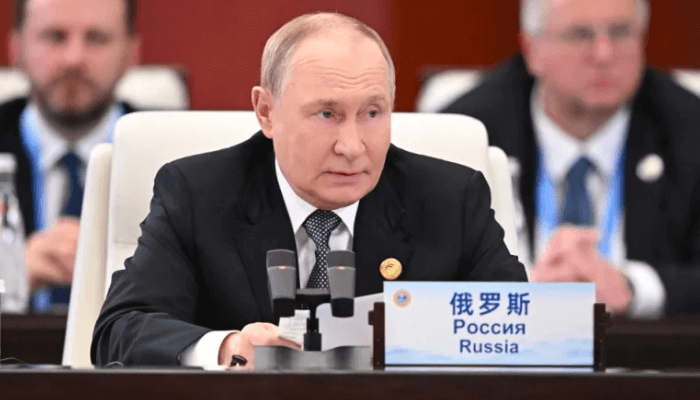
Vladimir Putin, the president of Russia has dismissed Western proposals to deploy international troops in Ukraine as part of future security guarantees, warning that any such forces would be treated as “legitimate targets” by Moscow’s military.
His remarks came on Friday at the Eastern Economic Forum in Vladivostok, just a day after 26 nations pledged at a Paris summit to contribute troops to Ukraine if a ceasefire deal is reached. The plan, led by France and Britain, envisages a “reassurance force” that would patrol Ukraine to deter further Russian aggression and help enforce any peace settlement.
Read also: Kremlin denies Trump claim of Russia-China-North Korea conspiracy
Emmanuel Macron the president of France, said the allies had formally agreed to provide support “by land, sea or air” once hostilities end, though he did not list which countries would be involved. Ukraine’s president Volodymyr Zelenskyy joined the Paris summit in person, while British prime minister Keir Starmer and other leaders took part remotely.

But the initiative has exposed fault lines. While European leaders want to demonstrate they can act independently of Washington, the United States—viewed as crucial to any credible security arrangement—has not committed. Donald Trump, who is spearheading talks with Putin, has raised concern among allies by appearing open to Russian narratives about the conflict. Following the Paris summit, Trump said he would soon speak directly with the Kremlin leader.
Read also: Russia slams German chancellor for calling Putin a ‘war criminal’
Putin, however, made clear that foreign forces are unacceptable. “If some troops appear there, especially now during the fighting, we proceed from the premise that they will be legitimate targets,” he said. He argued that their presence would undermine long-term peace, insisting instead that guarantees must address both Russia and Ukraine’s security.
The Kremlin reinforced that message. Spokesman Dmitry Peskov told reporters that the Paris proposal was “definitely not” acceptable. “We would recognise it as a threat to ourselves – the presence of international forces, or any foreign forces, or NATO forces on Ukrainian soil, near our border,” he said.
Read also: North Koreas Kim vows full support for Russia, discusses partnership with Putin

Moscow pointed back to the framework of peace talks held in Istanbul in 2022, which envisaged Ukraine adopting neutrality and renouncing NATO membership in exchange for security assurances from Russia, the United States, China, Britain and France. Western governments argue Russia has repeatedly broken past agreements, citing violations between 2014 and 2022 when Moscow-backed separatists fought Ukrainian forces in the Donbas region.
For Macron, the Paris summit was also about politics beyond Ukraine: a push to show that Europe can take the lead, even as Trump positions himself as chief negotiator with Putin. Whether the troop pledge becomes more than symbolism now rests on how far Washington is prepared to go—and whether Moscow and Kyiv can agree on the shape of peace in a war that has already redrawn the continent’s security map.