Berger Paints Nigeria Plc is emerging as one of the most cost-efficient players in Nigeria’s paint industry, with new figures showing the company is spending a smaller share of its revenue on production compared to peers Chemical and Allied Products Plc (CAP) and Meyer Plc.
The cost-to-sales ratio, a key measure of how much of every naira earned is consumed by production costs, has become a crucial yardstick for assessing financial stability in the sector.
For paint manufacturers, raw materials such as resins, pigments, and solvents often account for as much as 70 percent of expenses, leaving companies exposed to currency swings and imported inflation.
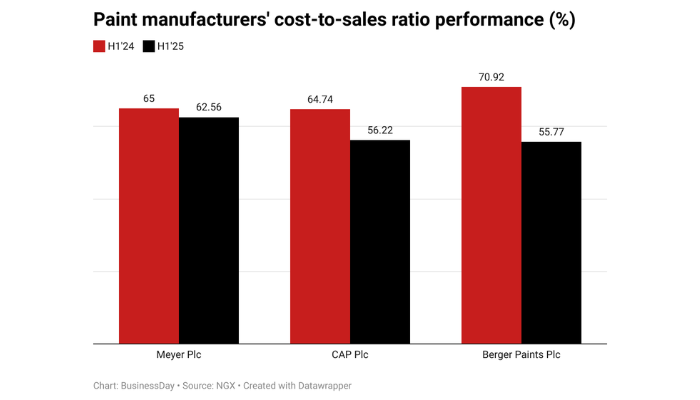
But Berger appears to be navigating these pressures better than its peers. Data from the Nigerian Exchange Group show the company’s cost-to-sales ratio stood at about 55 percent in the first half of 2025, compared to CAP’s 56.2 percent and Meyer’s 62.5 percent.

Analysts say this reflects Berger’s tighter cost discipline and stronger control over distribution expenses, even as all three firms face rising input prices.
Alaba Fagun, group managing director/chief executive officer, Berger Paints Nigeria Plc, during a courtesy and facility visit by the Minister of State for Industry, Trade, and Investment at the company’s branch, said, “While we maximize local sourcing, some raw materials are not available in Nigeria, and the high import tariffs on these materials significantly increase production costs.”
She appealed to the government for a reduction in import duties on essential raw materials not locally produced to lower production costs and enhance the competitiveness of Nigerian-made paints.
Across the industry, paint makers are grappling with a mix of challenges and opportunities. Rising construction activity offers demand support, but input costs tied to global oil prices and naira weakness continue to weigh heavily.
Read also: Berger Paints H1 profit rises 600% on strong revenue growth, cost efficiencies

According to the Central Bank Business Expectation Report for June, all the sectors expressed optimism about the macroeconomy in June 2025, with the Construction Sector recording the highest confidence by 51.4 percentage points.
The report said that despite the prevailing optimism, firms identified significant operational challenges, including high interest rates, insecurity, and an insufficient power supply, which could potentially moderate future growth.
Inflation, while still high, has eased from record peaks, and the naira has shown signs of stability after months of steep depreciation.
Nigeria’s headline moderated to 21.88 percent year-on-year in July, down from 22.22 percent recorded in June, data from the National Bureau of Statistics disclosed.
However, the naira has been largely stable and remained unwavering even in the face of global crises that saw emerging market currencies weaken against the dollar this year. Naira has been within N1500/N1550 per dollar bandwidth, boosting the earnings of businesses exposed to foreign exchange.
By the end of the month, the naira appreciated slightly by 0.14 percent as the dollar was quoted at N1,531.57 on Friday, the last trading day of the month, compared to N1,533.74 quoted on August 1, 2025, at the Nigerian Foreign Exchange Market (NFEM), according to data from the apex bank.
Firm’s Analysis
Berger paints
Berger Paints, the country’s second-largest listed paint maker, recorded a more modest improvement, with its cost-to-sales ratio edging down to 55.7 percent in the first half of the year from 70.9 percent in the corresponding period.
Among the three manufacturers, Berger Paints’ cost of sales fell to N3.43 billion compared to N3.56 billion, helping gross profit surge 88 percent to N2.72 billion.
As of June 30th, 2025, Berger Paints reported revenue amounted to N6.15 billion, with profit rising by 616.1 percent to N626 million from N87.5 million.
CAP Plc
CAP, Nigeria’s largest paint maker by market value, remains the industry leader in revenue but saw its cost-to-sales ratio drop to 56.2 percent from 64.74 percent.
This indicates that despite the company’s efforts to increase local sourcing, most of its production costs are channeled towards raw materials consumed, accounting for 83.6 percent of the company’s cost of sales.
In the period surveyed, CAP’s revenue rose to N20.1 billion from N5.6 billion, thereby bringing the company’s after-tax profit to N2.52 billion.
Meyer Plc
Meyer Plc, the smallest of the three, has struggled the most, with its ratio climbing above peers due to weaker pricing power and heavier reliance on imported raw materials.
The company’s cost-to-sales ratio rose 62.5 percent during the period.
Meyer saw its revenue rise to N2.03 billion from N1.32 billion, despite macroeconomic headwinds.