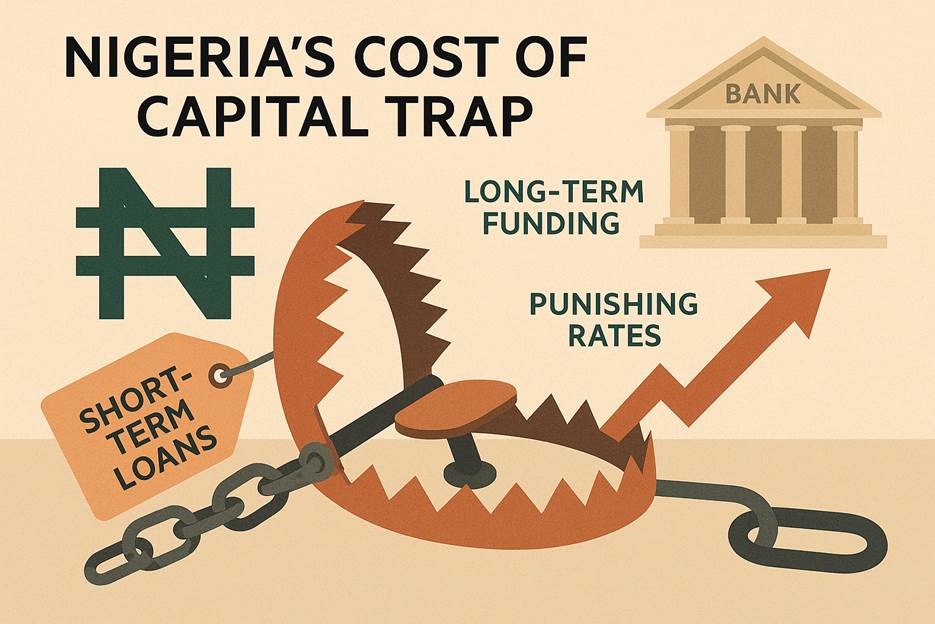
Nigeria has the people, scale, and drive to grow, yet its financial system lags behind. The gap is clearest in the cost of capital: businesses face short-term loans at punishing rates, while peers abroad can access long-term funding at stable prices.
The challenge is not a lack of entrepreneurs, but a system that cannot finance them on terms that sustain growth.
Bank recapitalisation and regulatory reforms are the latest efforts to strengthen lending capacity but structural weaknesses in markets, regulation, and infrastructure continue to limit investment and keep borrowing costs high.
Recapitalisation under strain

That mismatch has forced regulators onto the front foot. In March 2024, the Central Bank of Nigeria raised minimum bank capital to N500bn for internationally licensed banks, N200bn for national banks, and N50bn for regional lenders, with a two-year compliance window to March 31, 2026. The move was explicitly tied to the ambition of building a $1tn economy.
Yemi Cardoso, CBN Governor framed the push as building “stronger, healthier and more resilient banks” able to finance the economy over the long term. The goal was clear: recapitalisation would give lenders the depth to take longer-term risks.
But ambition collided with reality. The policy followed two sharp naira adjustments and inflation of 34.8 percent in December 2024, leaving balance sheets fragile though rebasing of the CPI has eased some pressure.
Earlier FX liberalisation in 2023 and another devaluation in early 2024 underscored how elusive stability remains. By contrast, U.S. inflation, hovering near 2.7 percent in mid-2025, kept credit conditions steady, highlighting Nigeria’s disadvantage.
“It is easier to get loans now,” said Yaya Kareem, who runs a small manufacturing firm in Ogun State, “but meeting up the borrowing cost is killing.”

Regulatory overlap
Building stronger banks is only one challenge; the regulatory maze is another. Nigeria’s financial system is overseen by the CBN, SEC, and other agencies.
The new Investments and Securities Act 2025 strengthened the SEC’s role, while suspicious-transaction reports continue to go directly to the NFIU via the goAML portal. These steps were intended to improve clarity, but overlapping oversight still breeds inefficiency.
As one finance executive put it: “Every layer of oversight comes with new templates, filings and audits. Those costs get priced into lending rates and issuance spreads, pushing up the cost of capital for everyone.”
These regulatory costs matter because even well-capitalised banks struggle to lend affordably. And beyond oversight, structural gaps in market infrastructure further limit access to capital.
Shallow markets and infrastructure gaps
Credit bureau coverage extends to just 13.9 percent of Nigerian adults, compared with 66.5 percent in South Africa, leaving most SMEs invisible to lenders. Collateral registries exist but are underused.
Even as equity markets surpassed N70tn in May 2025, the value shrank sharply in dollar terms. Pension funds, now around N24tn, remain heavily invested in government securities, limiting the flow of long-term capital to corporates. The bond market tells a similar story: more than 90 percent of new issuance is still sovereign.
Without market depth, companies rely on short-term instruments like commercial paper or shallow derivatives markets, where liquidity thins quickly. Market architecture is improving, but the pipes remain too narrow to channel savings into productive investment.
Digital finance’s limits
Earlier developments, such as the growth of digital payments platforms like Paga which processed N8.7tn of transactions in 2024 show that Nigerians are comfortable moving money digitally.
Yet payments infrastructure, while efficient, cannot replace deep credit and equity markets. The systems to transfer money work; the systems to invest it productively still lag.
The road ahead
Macro stabilisation must come first. FX unification in 2023 was a necessary, though painful, correction, with recapitalisation intended to restore banks’ capacity for long-term lending.
Regional experiences illustrate the stakes. Ghana reduced inflation to about 12.2 percent in July 2025 after restructuring its debt, creating room for lower rates. South Africa remains the regional benchmark, with deeper capital markets that channel savings into investment.
For Nigeria, the roadmap is clear if difficult: restore credibility to the yield curve through lower, stable inflation; expand credit information and enforce creditor rights so SMEs can access banking services; deepen market infrastructure from settlement systems to securities lending; and, within prudence, encourage pension funds to allocate more toward longer-term private risk.
Nigeria’s financial system is full of innovation, but it lacks depth. Recapitalisation and regulatory reform are steps in the right direction, yet they cannot bridge the cost-of-capital gap alone. What matters most is credibility: stable inflation, enforceable contracts, and trusted markets.
Only then can Nigeria’s entrepreneurial energy be matched by finance capable of supporting growth through economic cycles. Without these foundations, ambition will outpace access to capital, constraining businesses and leaving Nigeria’s growth potential unfulfilled.