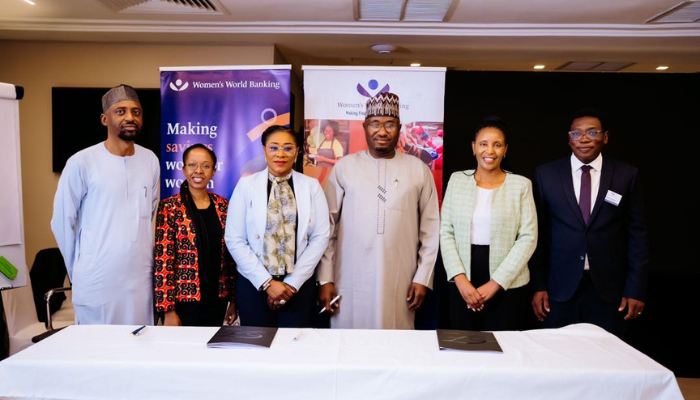
Women’s World Banking (WWB), in partnership with the Presidential Committee on Economic and Financial Inclusion (PreCEFI), has convened a stakeholders’ workshop to drive women’s digital financial inclusion (WDFI) in Nigeria.
The workshop forms part of Nigeria’s broader goal of building a trillion-dollar economy by expanding access to financial services for women. Participants from public and private institutions, including the Central Bank of Nigeria (CBN), Nigeria Inter-Bank Settlement System (NIBSS), National Insurance Commission (NAICOM), Nigerian Communications Commission (NCC), Bank of Industry (BOI), Deposit Money Banks, Microfinance Institutions, FinTechs, and Development Finance Institutions (DFIs), engaged in discussions on collaboration to advance women’s financial access.
Speaking at the event, Nurudeen Zauro, Technical Advisor on Economic and Financial Inclusion to the President, highlighted the alignment between PreCEFI and Women’s World Banking. He noted that both organisations prioritise designing financial services that respond to women’s realities and scale impact. He explained that the workshop was about aligning national and global strategies to accelerate progress towards Nigeria’s trillion-dollar economy target.
The initiative supports Nigeria’s target of achieving 95 per cent financial inclusion while addressing the existing 9 per cent gender gap in access to financial services. Stakeholders emphasised that women’s economic empowerment is vital for inclusive growth, poverty reduction, and long-term economic stability.

In her remarks, Uche Uzoebo, Chief Executive Officer of the Shared Agent Network Expansion Facility (SANEF), commended the convening. She stated that the partnership between SANEF and WWB will support wider penetration of agent banking, particularly in Northern Nigeria, to expand access for women.
Elizabeth Gathai, Regional Head for Africa at Women’s World Banking, reaffirmed the organisation’s commitment to supporting women in Nigeria. She said the country could play a leading role in boosting access to productive credit, cutting financial exclusion in the North, and adopting gender-intentional policies that close financial access gaps.
Other contributors at the workshop included Dr. Aisha Isa-Olatinwo, Director of Consumer Protection and Financial Inclusion at CBN; Dr. Rakiya Yusuf, Director of the Payment Systems Supervision Department at CBN; and Ngover Ihyembe-Nwankwo, Executive Director at NIBSS.
A key outcome of the event was the signing of a Memorandum of Understanding (MoU) between Women’s World Banking and SANEF to expand the reach and productivity of agent banking for women in Northern Nigeria. The agreement, witnessed by Dr. Zauro, represents a step towards implementing the government’s financial inclusion commitments and ensuring that women participate in the digital economy.