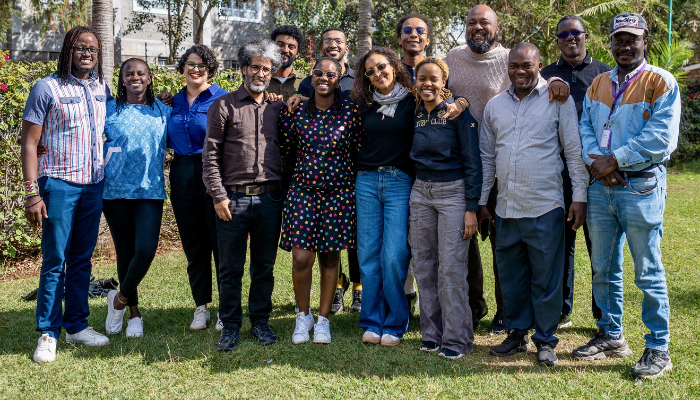
Nigerian filmmaker Ike Nnaebue has joined six other leading African directors in Nairobi for the NTD Documentary Lab, a weeklong program designed to use film to raise awareness about neglected tropical diseases (NTDs) that affect more than 1.6 billion people worldwide.
The initiative, organised by Documentary Africa (DocA) in collaboration with The END Fund, aims to produce a slate of short films that will amplify the fight against conditions such as river blindness, lymphatic filariasis, and schistosomiasis, which disproportionately impact poor communities across Africa.
“It has been a highly enriching experience and a fun and exciting discovery journey,” Nnaebue said. “Being in a space with such diverse, talented filmmakers — all committed to giving voice to overlooked stories — is both humbling and energising.”
The lab brought together directors from Nigeria, Kenya, Mali, Ethiopia, Tunisia and Burkina Faso, with the goal of developing films that showcase resilience and innovation in communities battling NTDs.

The organisers say the completed projects will be used to inform policy, inspire investment, and catalyse change ahead of the 2030 elimination target.
“The workshop brought together seven extraordinary African filmmakers to explore how they can reframe narratives around neglected tropical diseases,” said Yusuf Ahmed, senior associate director at The END Fund.
“While each filmmaker has a distinct narrative, they share a unified goal: to make NTDs visible and urgent. Together, these films will form a powerful mosaic of African leadership, inspiring pride, urgency, and investment in the fight.”
DocA’s Executive Director, Mohamed Said Ouma, said the filmmakers were selected for their ability to tell community-based stories with sensitivity and global reach.
“Our goal was to identify African storytellers whose creative vision and narrative style could sensitively amplify the underreported realities of NTDs,” he said.

“This lab is as much about cinematic craft as it is about social impact, and these directors bring the nuance and empathy needed to elevate community-rooted stories to national and global platforms.”
Participants spent the week in workshops, field visits, and collaborative sessions, exploring both technical craft and the ethics of representing vulnerable communities.
“It’s been a creative playground and a safe space for honest dialogue,” said Farah Souai, project coordinator.
“These filmmakers bring deep respect for cultural contexts and a nuanced understanding of diverse African experiences. They openly share their craft, challenge assumptions, and support each other’s visions. Having them shed light on NTDs — a subject too often overlooked — is powerful and necessary.”
The line-up includes: Ike Nnaebue (Nigeria), director of No U Turn, winner of multiple international awards including at Berlinale and AFRIFF; Zippy Kimundu (Kenya), co-director with Mira Nair of A Fork, A Spoon & A KNIGHT; Ousmane Z. Samassékou (Mali), director of Le Dernier Refuge, Grand Prix winner at CPH:DOX and Beza Hailu Lemma (Ethiopia), writer/director of Katanga Nation, winner of Silver Foal at FESPACO.
Others include Saitabao Kaiyare (Kenya), director of If Objects Could Speak, AMVCA winner; Ridha Tlili (Tunisia), veteran documentarian with five feature films and Michel K. Zongo (Burkina Faso), acclaimed for works on migration and Artistic Director of KOUDOUGOU Doc Festival.
Following the Nairobi sessions, the directors will continue developing their projects with production support from DocA and The END Fund.
The finished documentaries will premiere at major African and international festivals before being rolled out to classrooms, policy roundtables and digital platforms.
“Our ambition is that these films won’t just screen at festivals,” Ouma said. “They will live in classrooms, community halls, policy roundtables, and digital spaces, where they can inform, inspire, and catalyze change.”
For Nnaebue, the effort marks a continuation of his career-long mission to spotlight overlooked voices. “We are not just making films,” he said. “We are building a legacy of African voices telling African stories — stories that can move hearts, influence minds, and change lives.”