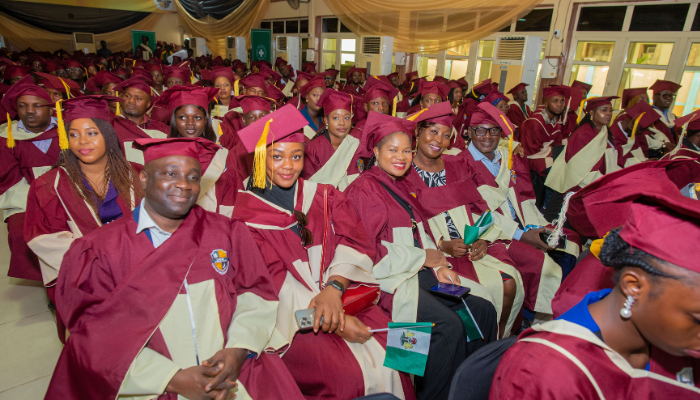
Nigeria faces a leadership gap and a growing youth unemployment challenge. Each year, many young people complete school but lack the skills, networks, and opportunities to work and lead effectively.
The QHSES Leadership Academy has developed a free model of training that combines safety, sustainability, and empathy to respond to this challenge.
In its 2024/2025 session, the academy graduated 643 students, a significant increase from 238 in the previous year. Interest in the programme also grew, with 4,082 applications received.
Only a quarter of the applicants gained admission, reflecting demand for accessible but rigorous opportunities. The graduating class represented 17 nationalities across seven countries, and 54 students finished with distinctions, split equally between men and women.

Nigeria records large financial and human losses each year due to unsafe workplaces and poor environmental practices. The academy responds with a philosophy called “Safetainability”, which blends safe thinking with sustainable living.
By equipping young people with leadership skills, technical knowledge, and empathy, the academy seeks to prevent workplace accidents and promote industries that protect people and the environment. “Clear thinking in a complex world is what we provide,” said founder Engr. Jamiu Badmos.
The academy runs a six-month programme divided into two semesters, including assessments, examinations, and group projects. Unlike many institutions, it charges no tuition. Despite its free access, the academy has obtained ISO 9001:2015 certification, accreditation from the American Council of Training and Development (ACTD), and endorsement from 15 professional bodies.
Badmos explained the motivation for the model: “I know what it feels like to lack money for school. Instead of blaming government, I chose to add value. This academy is that value.”
The institution has created Safetainability-4-Orphanage, which provides food, clothing, and mentorship for children without families. “Orphans are not less human,” Badmos said. “We want them to smile like every other child.”

The academy also supports students with disabilities. In the 2022/2023 class, ten visually impaired graduates completed the programme, reinforcing what Badmos described as proof that “disability is never inability.”
At the graduation ceremony, industry leaders highlighted the need for continuous learning. “Technology is moving us forward at great speed. AI is pushing us fast. The only way to stay relevant is to keep learning,” said Mojisola Olateru-Olagbegi, CEO of TWPC Tech, in her keynote address. She urged graduates to collaborate with governments and small businesses to build practical solutions.
Graduates shared similar experiences of determination. The best graduating student, Jeremiah Mrakpor, was initially not admitted. “As of the first semester, I was ranked 12th. But I gave it my all. With determination, I scaled through,” he said.
To secure long-term impact, the academy launched the Foundation for Excellence in Sustainability and Human Development (FESHD). The non-profit will coordinate the academy’s projects, including Safetainability-4-Orphanage and the SustainablePEOPLES Group. It will focus on leadership training, peer coaching, community partnerships, and summits on responsible business.
Badmos summarised the mission: “The real question is not how much money we make, but how many lives we touch. That is the measure of success.”