The trend, often described as ‘education tourism,’ has become a major strain on Nigeria’s foreign reserves.
The Central Bank of Nigeria (CBN) reported that in the first nine months of 2024 alone, Nigerians spent $1.8 billion on foreign education, a sharp 26.5 per cent increase compared to $1.44 billion in the same period of 2023. When combined with medical tourism, the figure swelled to $2.387 billion in just nine months. This relentless outflow highlights the urgent need for strong, credible local alternatives.
One institution that is proving Nigeria can indeed deliver world-class education at home is Pan-Atlantic University (PAU). With its School of Media and Communication (SMC) leading the way, PAU is offering students a blend of rigorous academics, practical training, and global-standard faculty, qualities that are convincing many to stay in Nigeria instead of seeking opportunities abroad.
For Adaobi Nwankwo, a Mass Communication undergraduate, the decision to enrol at PAU was deliberate.

“I wanted to deepen my understanding of how media shapes society. At SMC, we are not just memorizing theories, we are encouraged to investigate real societal issues and propose solutions. That research-driven approach, tied to impact, was exactly what I was looking for,” Nwankwo averred.
Her colleague, Tunde Babalola, shared a similar motivation. “One day, we are working in a simulated newsroom, the next day, we are producing content in a studio. It is that 360-degree approach to communication. I knew if I wanted to build a career in journalism and digital storytelling, this was the right place.”
For both students, the combination of world-class faculty, industry-linked learning, and ethical training made PAU a better choice than joining the swelling number of Nigerians seeking foreign universities.
The University’s distinction lies in its fusion of academic rigor with practical industry exposure. Unlike the overcrowded lecture halls in many public institutions, PAU’s small class sizes allow close interaction between students and lecturers. Facilities such as fully equipped studios, innovation labs, and digital classrooms give students hands-on learning experiences that mirror industry realities.
But beyond infrastructure, PAU invests heavily in faculty quality. Its teaching staff includes both respected academics and active practitioners, including journalists, filmmakers, communication strategists, and industry leaders who bring the real world into the classroom.

“It is not just about learning to write or broadcast. The school emphasizes ethics and leadership. You are shaped into a professional who understands responsibility in media practice,” Babalola noted.
For Nwankwo, the sense of community at PAU is just as important. “From faculty to fellow students, there is a strong culture of support and collaboration. It feels like family. You never feel like you are on your own.”
For professionals like Royal Ibeh, head of the technology desk at BusinessDay and fellow of the MTN Media Innovation Programme (MTN-MIP) Cohort 4 at PAU, the difference is even more striking. Having previously studied in a Nigerian higher institution, she vividly recalls the contrast.
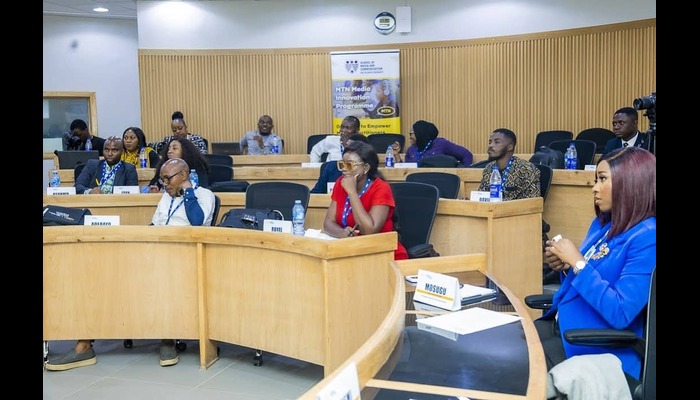
“In my old school, we had overcrowded classrooms. At PAU, the school is very conducive to learning. Classes are interactive, practical, and relatable. You can ask questions, debate, and even argue with your lecturers. It prepares you for real-life scenarios.
“The interactive nature of the classes encourages critical thinking, as professionals like herself are constantly challenged to analyze case studies, engage in debates, and apply concepts to contemporary media issues. Group projects and presentations foster collaboration while simulating real newsroom and corporate communication environments,” she explained.
Her testimony reflects the fact that PAU is committed to producing globally competitive professionals, yet grounded in local realities.
For Chinwe Michael, who is also a fellow in the MIP cohort 4, learning at PAU gives her a sense of what global education feels like.
According to her, the MIP training sparks soul-searching conversations about the future of journalism and the role each journalist must play in shaping it.
“MIP explores the future of journalism. From digital transformation lessons to storytelling across platforms, the program highlights the need for authentic, human-centered content in a fast-changing media environment,” she said.
Nigeria’s education tourism problem is not just about students leaving, it is about the resources drained in the process. The billions spent abroad each year could have been reinvested in local universities, faculty training, and research. Instead, the outflow continues to undermine Nigeria’s foreign reserves and deepen the naira’s vulnerability.
Beyond economics, the brain drain impact is profound. Students who leave often don’t return, leading to a loss of critical human capital. According to UNESCO data, Nigeria is among the top 10 countries sending students abroad, with the UK, US, and Canada as leading destinations.
Yet institutions like PAU are showing that if quality is assured locally, many students would prefer to stay, thereby reducing both financial and intellectual drain.
PAU’s success points to a model policymakers can study as they push for reform in Nigeria’s higher education sector. Experts argue that if universities nationwide invested in faculty development, modern infrastructure, and industry linkages, the tide of education tourism could be reversed.
“PAU proves that it is not impossible. Parents are not sending their children abroad because they hate Nigeria. They are doing it because they want quality. If local institutions can deliver world-class classrooms and faculty, the dollars will stay home,” said Ayo Jide, an education analyst in Lagos.
The federal government’s Renewed Hope Agenda identifies education as a cornerstone for national growth. By encouraging private sector partnerships, incentivising infrastructure development, and strengthening regulatory standards, Nigeria can scale the PAU model across more institutions.
For Nwankwo, Babalola, Ibeh and Michael, Pan-Atlantic University has already delivered what they might have sought overseas: rigorous academics, practical exposure, ethical grounding, and a supportive community.
“PAU gives you everything you would expect from a foreign degree, but here at home. It feels good to know you are growing without having to leave your country behind,” Ibeh posited.