|
Getting your Trinity Audio player ready...
|
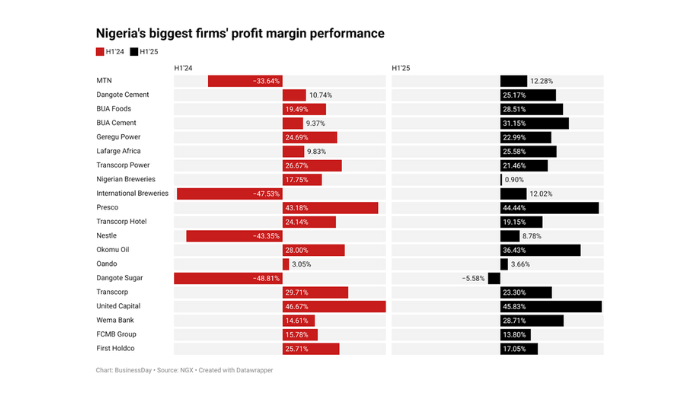
United Capital Plc and Presco Plc have emerged as the most profitable among Nigeria’s listed firms, leading the pack in profit margin performance for the first half of 2025, new data has shown.
Profit margin, a key indicator of how efficiently companies convert revenue into profit, has become an important benchmark for investors amid rising inflation, high interest rates, and foreign exchange volatility.
According to BusinessDay’s analysis of the 30 biggest firms, twenty firms surveyed collectively raked in an after-tax profit of N2.47 trillion in the first half of 2025, more than doubling the N1.15 trillion earned in the same period of 2024.
United Capital, an investment and financial services group, delivered one of the highest profit margins across the Nigerian Exchange, reflecting its lean operating structure and strong income from investment banking, asset management, and trustee services.

The company’s profit margin hit 45.8 percent, the highest among the surveyed firms, yet this represents a decline of 1.7 percent from last year.
Presco Plc came in second place with a 36 percent profit margin from 28 percent, majorly supported by surging crude palm oil (CPO) prices and strong operational fundamentals.
And in third place, Okomu Oil with 36.4 percent, followed by BUA Cement (31.2 percent), Wema Bank (28.7 percent), BUA Foods (28.5 percent), Lafarge Africa (25.5 percent), Dangote Cement (25.2 percent), Transcorp (23.3 percent), Geregu Power (22.9 percent), and Transcorp Power (21.4 percent).
Read also: CPPE blame high food prices on unresolved structural weakness
Others include Transcorp Hotel (19.2 percent), First HoldCo (17.1 percent), FCMB Group (13.8 percent), MTN (12.3 percent), International Breweries (12.02 percent), Nestle Nigeria (8.76 percent), Oando (3.66 percent), and Nigerian Breweries (0.9 percent).

These figures indicate that for every N100 in sales, the surveyed firms generated a profit of 10.45 percent, while the remaining 89.55 percent covered costs.
According to the National Bureau of Statistics (NBS), Nigeria’s Gross Domestic Product (GDP) grew by 3.13 percent (year-on-year) in real terms in the first quarter of 2025.
This growth rate is higher than the 2.27 percent recorded in the first quarter of 2024.
However, the International Monetary Fund (IMF) retained its position on its projection of a 3.4 percent expansion in the country’s real GDP for 2025 despite the change in methodology by the country’s bureau of statistics.
The growth in the economy’s GDP is reflected in the third quarter as the Nigerian private sector recorded its fastest expansion in output and new orders, as well as a notable easing in inflationary pressures, according to the latest monthly Stanbic IBTC Purchasing Managers’ Index (PMI) report.
The headline PMI rose to 54.0 in July, up from 51.6 in June, marking a three-month high and signaling a “solid monthly improvement in the health of the private sector.”
“Sharp and accelerated expansions in output and new orders were recorded in July,” the report noted. “In both cases, the increases were the fastest in three months. Panelists reported improving customer demand, in some cases due to softening inflationary pressures. The launch of new products was also a factor supporting growth.”