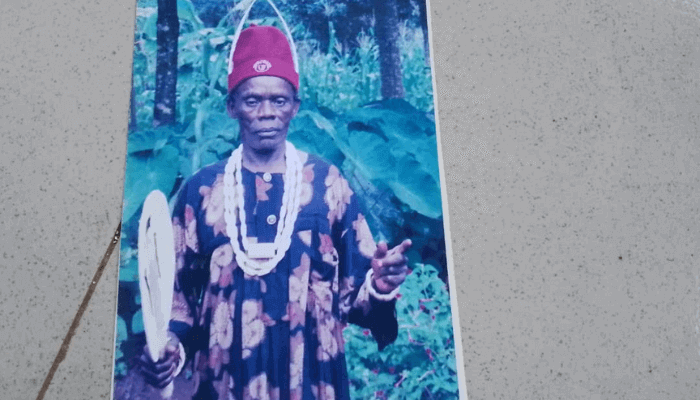
“The wind may scatter leaves of lore,
But not the roots that lie in yore.
For when a bard like Ọyima dies,
The sky remembers — and the song still flies.”

In this third and final part of our tribute to the late Life Ọyịma, we confront one of the most profound dimensions of his musical artistry: social commentary. His songs served as a moral MRI scan, diagnosing societal ailments with clarity and courage. Here, I dissect Life Ọyịma, the minstrel as a mirror and the lyrical lampoons and life lessons in his social commentary. “When truth is too bitter to be told plainly,” it is said, “the wise man sings it into the soul. And when the people refuse to see, the bard becomes a mirror, not to shame them, but to show them.” More than any other genre of his Ọjịlè anthology, this was where the bard held a mirror to society, not out of malice or mockery, but from a deep well of compassion, concern, and cultural duty. Ọyịma’s songs exposed the cracks in the communal calabash: alcoholism, marital breakdown, generational decay, careless speech, and the creeping moral collapse. He never shouted. He sang. And in singing, he struck deeper than a sermon could reach.
“Oyibo Eze Kai-Kai” – the bard’s lyrical lamentation on drunkenness (when the brew becomes bane) and social decay – condemns the unregulated sale of local gin – kai-kai -particularly by the fictional Oyibo Eze, whose brew had become a death potion. He didn’t preach abstinence, but called for moderation, showing how drunkenness empties homes and ends lives. Here, Life sheds his minstrel garb for the mantle of moral crusader. With humour-laced sorrow and lyrical protest, he sings not just about alcohol, but about a society slowly drinking itself into oblivion, cup after careless cup. But this was no blanket condemnation of drink. Ọyịma was far too discrete for such absolutism. What he decried was excess without restraint, liberty without limits, and the lethal consequences of unregulated indulgence. The titular character – Oyibo Eze – is not merely a woman dispensing kai-kai – the locally distilled gin – but a metaphorical figure, representing a larger social ill, that is, the easy availability of destruction disguised as pleasure. Her kai-kai flows without measure, but behind every gourd lies a ghost – a wasted soul, a shattered family, a promise drowned in poison. With this signature wit, Life transforms the mundane into a moral mirror. He invokes Oyibo Eze not as a caricature but as a cultural symbol of how commerce without conscience can wreck a community. In her, we see the vendors of vice, those profit from pain, who count gain in bottles even as they pour away generations. Through this song, Ọyịma paints the ruinous trail of kai-kai – young men staggering through streets, marriages collapsing under the weight of addiction, homesteads becoming hotbeds of domestic violence. The bottle, once used in libation to appease the gods, now becomes a weapon of self-destruction in the hands of the gods’ own children. In the end, Oyibo Eze Kai-Kai is more than a folk song; it is a village verdict, a philosophical parable, and a public health warning dressed in melody. It is Life Ọyịma at his most prophetic, proving again that the true bard does not merely chant what the people want to hear; he chants what they need to become. Like Socrates urging his followers to know themselves, Ọyịma uses his voice to plead with his people: Let not your thirst be your trap. For wine has a tongue that sells your secrets, and a hand that breaks your home. Thus, “Oyibo Eze Kai-Kai” is not just a song; it is an elegy to fallen dignity, a prayer for sobriety.
In “Ologbo” – the dance of waywardness at the slippery edge of moral cliffs – Life Ọyịma took no whip to the youth. He chose wisdom over wrath, concern over condemnation. With the mellow urgency of a father watching his child tiptoe toward a cliff, he sang not in anger but in anguish – a lyrical lament for a generation dancing dangerously on the edge of moral precipices, mistaking liberty for licence and freedom for folly. The titular “Ologbo” – the wayward youth – becomes both symbol and symptom: a restless spirit intoxicated by the sweet aroma of rebellion, yet blind to the poison in the perfume of promiscuity. Ọyịma’s criticism is gentle but firm, wrapped in parables that speak louder than rebuke. He does not caricature the youth as hopeless; rather, he mourns a culture drifting from its moorings – where elders are mocked, boundaries blurred, and consequence forgotten.
In Ọyịma’s philosophical lens, waywardness chiefly instantiated by promiscuous escapades, is not merely a social misdemeanour but a metaphysical misalignment – a disconnection from self, from ancestry, and from destiny. Through Ọjịlè, he offers not punishment but a path back – a rhythm of remembrance, where the young might trace their steps home through the footprints of ancestral values. Here, he sang of a generation dancing on moral cliffs, seduced by recklessness, losing their way in the name of modernity. He extended a hand, not a hammer, turning to youth culture – not with contempt but compassion. His message: “He who strays far from the village flute may forget the dance, but not the rhythm in his blood.” In Ologbo, Life Ọyịma sings not just of youthful deviation, but of redemptive return, a call to conscience, a call to come home. The younger generation is portrayed as dancing on a slippery slope, chasing pleasure with no thought of consequences. But the tone is not moralistic condemnation. Rather, it is lament wrapped in lyric, like the mourning of a father who sees his children veering into danger and pleads with song instead of scolding. He sees a generation lost in imitation, where cultural identity is traded for borrowed glitter; young men who, in chasing fast money, forget slow wisdom; young women who mistake attention for affection. Life Ọyịma does not curse them; he calls them back, with rhythm, not reproach.
“Papa Nkiru” – a marital tango in folk verse – unveiled the cracks in domestic harmony – a sobering look at the tensions between husband and wife. Life Ọyịma dons the robe of a domestic philosopher, turning the familiar bickering of a husband and wife into a folk opera of moral lessons, marital missteps, and mutual misjudgments. In the song, marriage becomes a mirror – cracked, fogged, yet revealing – reflecting not just a couple’s quarrels but the deep truths about human expectations, communication failures, and the tragicomedy of mismatched unions. Through careful storytelling, Ọyịma asked: how do we lose love after finding it? Here, Life peels back the layers of marital life – a subject often hushed in public but brewing in private. The song explores the emotional, psychological, and relational ruptures in domestic life. Papa Niru, the central character, becomes a symbol, not just of one man, but of many men broken beneath the weight of unrealized dreams, emasculated by economic hardship, or lost in translation between tradition and modernity.

Ọyịma does not take side; he sings both the man’s confusion and the woman’s frustration. His gift was holding both together in compassionate tension, reminding society that a failing marriage is often a symptom of a failing system – a broken economy, a shifting culture, an eroding moral base. Through Papa Nkiru, Life brings marriage – not as a romantic ideal, but as a cultural institution – into the court of public discourse, thus urging reflection and reform. The beauty of Life Ọyịma’s narrative lies not in taking sides, but in holding the stormy sides of marriage in tension, dramatizing the age-old dance of accusation and counter-accusation that plays out in homes across the land. The song does not end in resolution — and that is the point. Ọyịma leaves us in the messiness, nudging us to reflect rather than to judge, to seek wisdom before walking the path of matrimony. Life Ọyịma’s genius lies in how he weaves humour into hardship, melody into moral, song into sermon. “Papa Nkiru” is not just about one man and his discontent — it is about the fragility of marital peace, the dangers of unresolved conflicts, and the importance of choosing wisely, loving deeply, and growing deliberately in the crucible called marriage.
Ultimately, “Papa Nkiru” is a folk tale dressed in domestic robes, a lyrical lamp held over the shadows of broken homes. It is a song that teaches us not to wait until love turns into lamentation, or until the bedroom becomes a courtroom. It challenges couples to communicate, compromise, and cultivate, and young people to choose not just with emotion but with discernment. Life Ọyịma, the bard of Ezikeoba, knew that homes make or mar a people. In “Papa Nkiru”, he sang not merely to entertain, but to reorient a generation groping in the dark corridors of marital illusion, urging them to light the lamp of reason, duty, and emotional intelligence. Indeed, “Papa Nkiru” remains one of his finest testaments to the power of folk music to critique culture, caution society, and cultivate wisdom, wrapped in the unassuming garment of song.
In “Ire Ezu Ike”, Life Ọyịma took the proverbial ember and blew it into a flame of prophetic fire. “The tongue is fire,” he sang – not as metaphor, but as revelation, echoing ancient wisdom that stretches from Biblical proverbs to Igbo ancestral philosophy. In this searing composition, Ọyịma did not merely caution against gossip or slander; he delivered a lyrical indictment of reckless speech and the damage it wreaks in families, communities, and even nations. The title itself – “Ire Ezu Ike” – translates beyond literal meaning to signal a spiritual truth: when the tongue refuses to know its boundaries, it becomes an arsonist in the homestead of peace. Words, Ọyịma teaches, can cut deeper than swords, spread faster than disease, and destroy more thoroughly than flood or fire, especially when loosed in anger, envy, or ignorance. But Ọyịma’s genius lies in his ability to blend moral gravity with melodic grace. He didn’t scream; he soared. He didn’t moralise; he mesmerised. His rhythms rose like warning bells, each stanza a reminder that speech is not neutral; it builds or it breaks, heals or harms, plants or poisons.
In a society where loose talk has kindled feuds, sundered homes, incited riots, and tarnished legacies, “Ire Ezu Ike” stands as a timeless anthem of restraint. Ọyịma urges that the tongue must be bridled with wisdom, guided by empathy, and seasoned with silence when necessary. He understood that a single sentence, spoken without care, can trigger consequences generations must carry. And so, he sang like a prophet of old, warning that those who set no guard over their lips risk burning down the very world they claim to love. In Ọjịlè fashion, he invoked folktale, parable, proverb, and parable — all in a bid to remind us that in the battle between speech and silence, sometimes silence is the greater wisdom.
Across these four songs, Life Ọyịma plays multiple roles: critic and comforter, poet and philosopher, mirror and midwife. He holds the mirror up to society not to shame it, but to spur it toward healing. He does not mock the wounded; he sings them into introspection. Through these, he became the conscience of Ezikeọba, using melody to rebuke, rhythm to reprove, and rhyme to recall what we are forgetting. In these songs, Ọyịma is at his most courageous. He speaks hard truths gently, indicts decay musically, and calls for reform rhythmically. He becomes not just a singer, but a social conscience with a chorus.
In true Ezikeọba and Igbo tradition, his art was never for mere entertainment. It was didactic, diagnostic, directive. His lyrics were syllables of social surgery. His metaphors were medicinal. His refrains rang like town criers calling the conscience back home. What makes Life Ọyịma iconic is not just his command of rhythm or rhyme, but his moral authority rooted in cultural fidelity. He understood his world – not as a detached observer but as a son of the soil, a man whose artistry sprang from the same well that nurtured Ezikeọba ancestral wisdom. Through Ọjịlè – his chosen genre – Ọyịma became a griot of the soul, reminding us that a society that forgets its singers has already started forgetting itself.
Of course, no tribute to Life Ọyịma would be complete without acknowledging the quiet giant who documented and preserved this musical legacy for future generations – Chief Polycarp Okechukwu Eze. Chief Eze, a cultural archivist in his own right, bent backwards to ensure that not just Life Ọyịma, but the entire oral tradition of Elugwu-Ezike – including Oshagenyi Azegba, Ọjịlè musical groups, and other folk performance genres – were recorded in audio and video formats. He took upon himself the noble task of turning ephemeral performances into eternal archives. Were it not for his foresight and labour, much of Ọyịma’s voice would have died with him. But today, the melodies live – digitized, stored, studied, and shared – thanks to a man who knew that to save a culture, one must first save its voice. Little wonder, Chief Eze was considered worthy to be bestowed with a Life Achievement Award as ‘Ọnwa Omenaala Igbo, CIS-UNN’ by the Centre for Igbo Studies, University of Nigeria Nsukka during its Maiden International Conference in 2023. To Chief Polycarp Okechukwu Eze, Ezikeọba owes a debt of gratitude. He did not just record songs; he preserved memory, identity, and heritage.
In every community, there are three categories of men: those who speak, those who sing, and those who summon the soul. Life Ọyịma did all three. What do we make of a man who sang love without lust, marriage without myth, wisdom without pride, and truth without venom? We call him Life, the one who plucks life’s bitter and sweet notes and strings them into harmony. In a world where many artists sing for attention, Ọyịma sang for awakening. He was not driven by fame but by fidelity to truth. Not by applause, but by allegiance to conscience. He was the voice of the people, the bard of Ezikeọba, the griot whose gourd of wisdom never ran dry. Life Ọyịma was not merely a cultural performer. He was a transmitter of ancestral truths, a dibia of lyrics, a sage with strings, a man whose melodies mirrored morality. From Ezikeọba to the wider Igbo world, his songs became oral homilies, emotional archives, and cultural correctives.
Now that his voice has been stilled, we must not forget the sound. For a society that forgets its bards has started forgetting itself. His memory must not just be eulogized; it must be echoed, studied, and preserved. Life Ọyịma may have departed, but his music refuses to be buried. His folk songs are now cultural heirlooms, his voice etched in Ezikeọba oral memory. His ability to blend entertainment with enlightenment, humour with homily, made him a bard in the league of icons — a griot whose work deserves academic, archival, and public honour. He sang not for applause but for awakening. He was not a performer but a prophet. Not merely a singer, but a sage whose stage was life itself. He sang us – our fears, our flaws, our faith, and our follies. In a time when many artists sing of self and vanity, Ọyịma sang of community, morality, tradition, and truth. He was, and will always remain, the voice of Ezikeọba conscience — the one who sang what others whispered, who dared where others ducked. He held up a mirror and invited us to look, laugh, and learn. May his name be remembered not only in dirges but in archives, anthologies, researches, and academies. Let his music become a tool of education, a treasure of heritage.
For Life Ọyịma sang us – and now, he sings with the ancestors. Good night, Life Ọyịma – bard of our hearts, voice of our conscience, philosopher of our hearths. May your eternal rhythm never cease in the chambers of our memory.
“Ọjịlè is not just what he did – it was who he was.”
A singer of seasons. A seer in sound. A sage with strings.
“When a bard like Ọyịma dies, the earth keeps still;
But his words, like rivers, keep running downhill.”
Jinadoore, Atama Ọjịlè.
Your tongue spoke fire.
Your drumbeat throbbed truth.
Your voice – is still with us.