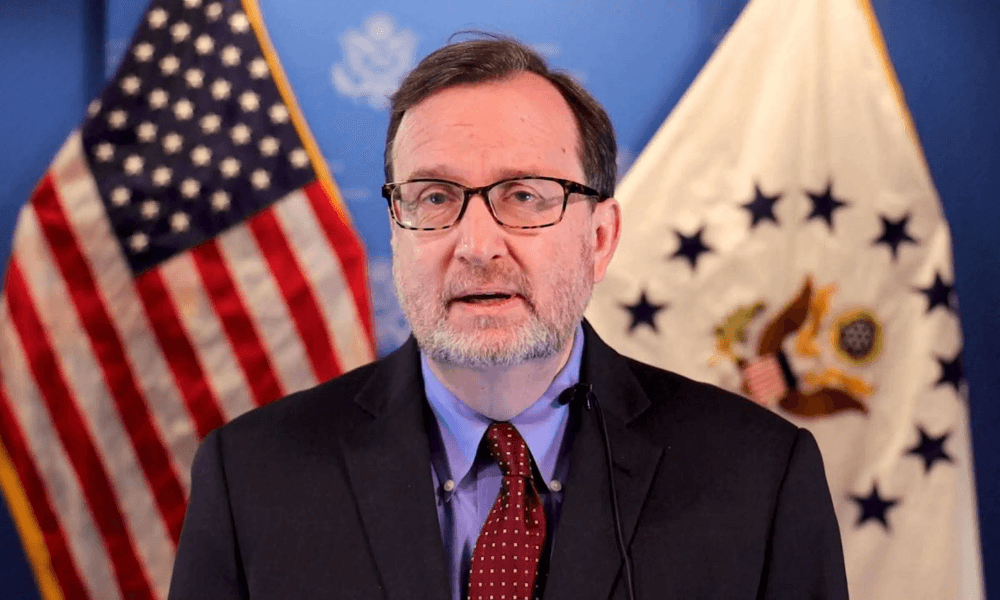
Richard Mills, United States Ambassador to Nigeria, has explained that the new visa rules affecting Nigerians are part of efforts to strengthen America’s security framework.
Speaking alongside Mohammed Idris, the Minister of Information and National Orientation, at a Press Briefing in Abuja, Mills clarified that the new visa measures announced by the U.S. Mission are not punitive but part of a broader global effort to enhance security, improve service delivery, and ensure compliance with US Immigration laws.
“I had a productive discussion with the Minister of Information and National Orientation about U.S. visa laws and how best to communicate the importance of compliance to Nigerians,” Mills said.
The ambassador reiterated the relationship between the United States and Nigeria, stating that the US remains open to Nigerians traveling for study, business, tourism, medical care, and family visits.

However, he noted that travelers must follow visa rules.
“The United States values its relationship with Nigeria and the connections between our two countries.
“U.S. visas play a role in maintaining these ties. Both governments expect visitors to follow immigration laws”, Mills added.
He cautioned that misuse such as overstaying or submitting false information can lead to serious consequences, including deportation or a permanent travel ban.
“If you overstay your visa, you may face deportation and be barred from returning to the U.S.—something we hope Nigerians can avoid”, he said.

Mills encouraged applicants to be truthful and follow procedures, stressing that compliance is essential to maintaining trust between the two nations.
On the recent changes in visa processing, Mills explained that the updates are part of broader US security efforts.
He said the U.S. now requires more detailed background checks, including access to Nigerian criminal records, to properly verify applicants.
“There were security issues we needed to address in the visa process,” Mills said.
He also noted that the Nigerian Government is working on ways to improve identity verification.
Additionally, the ambassador pointed out that the same expectations apply to student visa holders.
“If you miss classes or leave your program without informing your school, your visa may be revoked,” he warned.
Mills advised Nigerians to consult the U.S. Embassy website for accurate information and support.
Mohammed Idris, Minister of Information and National Orientation, commended the US Embassy for taking proactive steps to directly engage with the Nigerian public and provide clarity on its visa policies.
He noted that such dialogue is important in building mutual understanding.
“This reinforces the need for regular collaboration between both countries so that Nigerians are well informed about matters that affect them,” he stated.
Idris acknowledged that Nigerians are among the most frequent travelers to the United States, emphasising the importance of transparent and accessible communication regarding visa procedures.
“Nigerians are highly mobile and travel across the globe, particularly to the U.S. It is essential that they receive timely and accurate information to guide their travel decisions,” he said.
He reaffirmed the Ministry’s commitment to working closely with the US Mission to ensure that the public is educated and aware of any consular developments.
“I appreciate the spirit of partnership between Nigeria and the United States, especially the Embassy’s efforts to keep Nigerian travelers well informed about visa and consular services,” he added.
Addressing concerns that the revised visa policies may be discriminatory, Idris dismissed such claims, stating that the changes were not designed to punish Nigerian citizens.
“Prior to this meeting, I had discussions with Ambassador Mills, who assured me that the new measures are not punitive in nature. They are designed to improve service delivery between both nations,” he said.
The Minister reiterated the US Government’s stance on the importance of respecting immigration laws and urged Nigerians to represent the country positively abroad.
“Just as we expect foreigners in Nigeria to respect our laws, Nigerians traveling abroad must also uphold the laws of their host countries. It’s important that we maintain our reputation by demonstrating respect, responsibility, and patriotism wherever we go,” he added.
Both officials emphasised the importance of public awareness to ensure Nigerians clearly understand and comply with the new visa regulations.
It will be recalled that the US Government recently introduced stricter visa requirements for Nigerian applicants by revising its reciprocity schedule.
Under the updated policy, the validity period for specific non-immigrant visas—such as B1/B2 (business and tourism), F (student), and J (exchange visitor) has been reduced to three months, with only single-entry access permitted.