|
Getting your Trinity Audio player ready...
|
This year alone, I have written four different articles on the country’s fading education sector, or what is left of it. The sad part is that with each passing day, month, and year, the sector continues to sink further into a dark pit as the country’s managers remain indifferent to education. I am passionate about education, as any right-thinking Nigerian should be, which is why I will continue to advocate for better management of the sector. I am worried about how the sector is being handled and the far-reaching implications it has for the future of the country.
Are we not setting the country up for failure?
Nigeria is the only country in the world I know – and I have lived, worked in or travelled across the globe – that continues to mess up its future and, in some weird way, believes that it would somehow someday magically become a great nation.
It is simply mind-blowing the crass disregard that the nation’s leaders or managers have for education, and by implication its youthful population. Just when you think the managers cannot cause further damage to education and the country’s youth population, they come up with some shenanigans that will jolt your already jaded nerves.

WAEC’s designed mass failure
That is the case with the ongoing hogwash at the West African Examinations Council (WAEC) over the release of the 2025 WAEC results. What should have been a straightforward release of examination results has again been bungled and turned into an irritable circus by the examination body. It would appear that WAEC is determined to outdo the Joint Admission and Matriculation Board (JAMB), which in May this year made a complete mess of its own tertiary institutions’ placement examinations. JAMB’s poor handling of its examinations and the release of the results led to the unfortunate death of one of its candidates.
Last week, WAEC released the results for the 2025 West African Senior School Certificate Examination. The results showed that circa 800,000 candidates or 38.32% of the 1,969,313 students who took the examination about three months ago failed to obtain the required credits needed to gain admission into a university. Put differently, over a million WAEC candidates failed the examination. The implication of that is that WAEC has put the brakes on the educational progress of over a million young Nigerians. Those candidates who ‘failed’ would need to resit the examinations. Money has to be sourced by many to register for the exams, straining already stretched finances for many families.
Stakeholders have said the results were the worst in 10 years. Expectedly, the results generated widespread criticism and complaints, prompting the examination body to conduct a review. Following the complaints and criticisms, WAEC immediately shut down its result checker portal. “WAEC hereby informs the general public that the result checker portal @waecdirect.org is temporarily shut down due to technical issues,” the body said.
WAEC and JAMB: the Siamese twins

This is déjà vu; Nigerians have seen the drama before, as recent as three months ago. It was a similar script JAMB followed when it released its results and there were widespread complaints over the results. The playbook ran thus: an examination was shoddily conducted; the results were released; there was mass failure; students and parents complained; JAMB suddenly remembered there were reported “glitches” during the examination, necessitating a review of the results; the glitches in the system were conveniently blamed on service providers engaged by JAMB; and following the review, a brand new result was released, which bolstered the pass rate.
WAEC, not prepared to be outdone by its sister examination body, has acted out a similar script. An equally shoddily conducted examination. In one instance during the examination, students wrote exams late into the night while some were forced to use lanterns in exam halls to finish their papers. Conducting examinations in such conditions could only lead to one outcome: failure. So, really, it should not come as a surprise to Nigerians. WAEC has also flaunted the almighty “glitch” as a reason for the review of the released results.
Hear what the examination body said in a statement to Nigerians: “As part of our efforts to curb examination malpractice, the Council embarked on an innovation (paper serialization) already deployed by a national examination body. It is also worth noting that this is in line with best practices in assessment. The paper serialization was carried out in Mathematics, English Language, Biology, and Economics. However, an internal post-result release procedure revealed some technical bugs in the results.” There is only one outcome after this review: the pass rate will improve noticeably. Not many were surprised when the outcome of the review showed a marked uptick in the pass rate from 38.32% to 62.9%.
When will our leaders take education seriously?
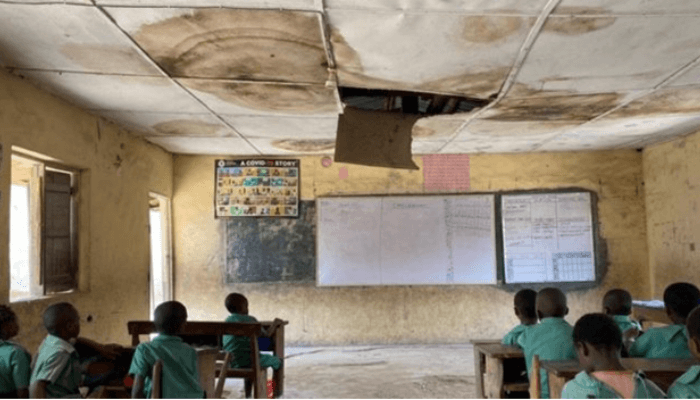
This latest saga, while unfortunate, is symptomatic of the deep rot in our educational system and highlights the neglect of the dynamic youth population, supposed leaders of tomorrow, by the country’s managers. Yearly allocations in the budget to the education sector remain abysmal both at the federal and state levels. These poor allocations have led to unimaginable rot in the sector: collapsed infrastructure; poor and dated curricula; ill-motivated educators, particularly teachers; inadequate or poorly trained personnel; nonexistent laboratories; outdated teaching methods; and many other maladies.
Rather than fix the problem, the government ceded the sector to private players who have since commercialised every aspect of education in the country. Today, quality education comes at a huge cost, which effectively precludes over half of the population who struggle to cope with daily living. Nigeria leads the rest of the world in the population of out-of-school children at about 20 million or 15% of the world’s total. This is disturbing. Not to our leaders, it would seem.
Government as driver of education sector
Across the world, governments play a leading role in education in recognition of its critical role as the pivot of economic growth and development. For this reason, governments remain the major source of funding for the sector while also acting as regulators to ensure education is available, accessible, and affordable. This, unfortunately, is not the case in Nigeria. The sector is led by private sector players and, as such, is largely profit-driven.
Should we be angry when outsiders disregard our certificates?
The recent flip-flopping by the two critical examination bodies, JAMB and WAEC, calls into question the integrity of this year’s examinations conducted by the two bodies. And beyond that, it calls into question the integrity of the examinations conducted by these bodies and the results they release. This is not portraying us in a good light; it is certainly not helping our image at all as a country that is serious about challenging the rest of the world in education, science and technology, and other key sectors of the economy.
We often are riled when our certificates are considered substandard and rejected outside the country. Or when our graduates, including Master’s and PhD degree holders, are compelled to write TOEFL, SAT, and other assessment examinations by Western countries, including commonwealth nations, to help them assess our competence in English Language – these nations know that English is our official language, yet they insist on the assessments. It is situations like the JAMB and WAEC exam-result sagas that feed such actions.
While one would love to chalk off JAMB and WAEC difficulties as isolated incidents that would not happen again. The reality dictates otherwise. As long as our leaders continue to treat education with levity, issues like this will continue to occur. We cannot wish them away.
The examination bodies claim to be technology-compliant and innovative. But these glitches raise serious doubts about such claims. And if truly they are technology-compliant, the technology deployed must be the older, less functional versions.
The solutions
There is really one solution, and it is quite obvious. The government must take education and its youth population seriously, and must start to invest in them. The usual rhetoric and grandstanding will not help us at all, and our economic managers need to act now to save the country.