…Where street urchins, pick-pockets hold sway
… No-go areas at night
…Yet it provides economic, social opportunities for some
The ubiquitous pedestrian bridges in Lagos were built to check incessant deaths on highways across the state.

These bridges, over time, have been turned into many things by all manner of people.
While in many locations they serve as commercial centres where all manner of wares are displayed and transactions made.
In many other locations, they have been abandoned for street urchins who have converted them into their den to rub innocent pedestrians.
In many places across the state, many of the bridges are deserted at night as pedestrians prefer to dash across the road to walk on them (the bridges) for fear of being attacked.
Over the years, the pedestrian bridges in Lagos gained notoriety as a trading hub for petty traders, who often occupy a large segment of the bridge, thereby making it difficult for pedestrians.

However, the culture seems to be shifting away from its usual commercial hub into a community of a sort for many of Lagos’ destitutes.
Read also: Abuja pedestrians ask government to remove traders, beggars from bridges
A make-shift community of able-bodied men and women who daily occupy the bridges seeking arms in the day and rest at night.
For many of these occupants, the pedestrian bridges offer comfort both in the day and at night.
Just as it offers protection from the cold at night or bad weather, it also provides a suiting service apartment for young men and women seeking to ‘ease’ bodily stress.
Little wonder that it’s fast becoming a common thing in and around Lagos to find young girls moving around with unwanted pregnancies without any identifiable father.
This new notoriety being hatched on Lagos’ pedestrian bridges presents an urgent need to checkmate the growing number of homeless people in Nigeria’s economic hub.
While issues of homelessness are a common challenge in any megacity like Lagos, allowing it to go unchecked poses a bigger challenge with dire consequences to Lagosians as a whole.
“To describe some pedestrian bridges in Lagos as disgusting settlements for destitute, drug addicts, petty criminals, et al is a painful admission on my part,” Moses Lawal, a Lagos resident, told BDSunday.
According to him, the occupants of the bridges usually have a way of getting back to the bridge after being forced out by the government.
“Despite the intense efforts of the commissioner for environment at ridding them of the menace, these people always find a way to worm their way back.
“These guys not only deface the environment, they also pose serious security concerns, especially at night,” Lawal said.
According to him, their presence on the bridge often forces pedestrians to avoid the bridge for fear of being attacked at night or being emotionally blackmailed to give what they didn’t plan.
“People are sadly forced to take the risk of crossing highways, rather than using the pedestrian bridges,” Lawal said.
Corroborating what Lawal said earlier, another Lagos resident who resides along the Lagos-Badagry axis of the state, told BDSunday that the government enforced a “no trade, no sleep” rule on the pedestrian bridge at Mile 2.
“About two or three months ago, KAI people arrested people for selling and sleeping on the bridge here in Mile 2. The government even engaged some local people, probably from the NURTW in Mile 2, to make sure these people don’t return to the bridge,” Sylvester Nnaji told BDSunday.
Read also: Lagos clears louts on Oshodi pedestrian bridges
According to him, the initiative was effective as nobody was allowed to trade or sleep; not even wait on the bridge without being challenged by somebody.
However, a few weeks later, the men enforcing the rules disappeared from the spot, and both the traders and the illegal occupants of the bridge returned to take possession of their valued spot.
Nnaji also narrated a similar experience he noticed at First Gate, where both male and female occupants converged on the bridge all day long with make-shift tents serving as shields from the sun in the day, and cold at night.
“What I have noticed at First Gate is that boys and girls sleep together on the bridge, and every morning, somebody with a cane usually goes there to wake them and also collect something that looks like rent from them,” he said.
Utilisation of pedestrian bridges in Lagos
The government often spends millions of tax revenue to construct and maintain these structures across the state.
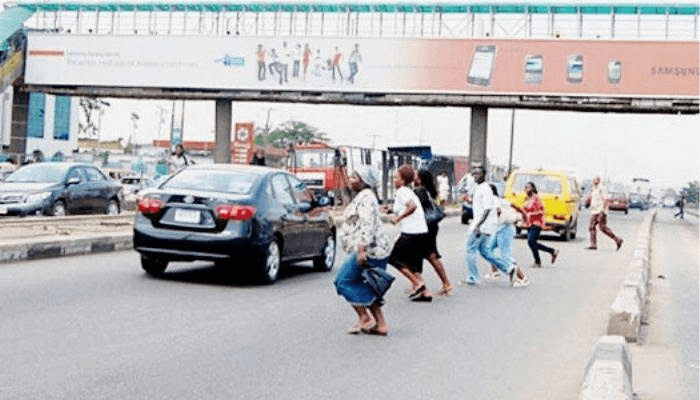
While pedestrian bridges are intended to ensure safety, many Lagosians now opt to dash across highways instead of utilising the bridges.
Many of the pedestrian bridges across Lagos were newly constructed to provide convenience for commuters, especially at places with BRT terminals and could be said to be in the best of shape.
However, many Lagosians find excuses with the location of the bridges, as some do not align with the organic bus stops created by commercial bus drivers, which also points to the need for a holistic evaluation of the structural design and how the bridges are sited.
Others simply avoid pedestrian bridges for personal reasons, often associated with safety on the bridge, especially at night.
While the situation on Lagos’ pedestrian bridges could be termed as ‘crude life’, the question many Lagosians are seeking an urgent answer to is: Can the bridges ever again serve the original purpose for which they were built?
Read also: Bus terminals: Months after demolition of houses pace of work slow in Lagos communities
And, if they were to regain their original purpose in serving as a better alternative for Lagosians who dash across the expressway, another question that arises would be: how can that be achieved?
“Yes, the bridges can be and must be, because a whole lot is at stake. Tenacity and public enlightenment/engagements are the key,” said Lawal.
He added that the government should engage the public in its enforcement drive to deepen cross-sectoral participation in dislodging illegal occupants on Lagos bridges.
“Since occasional raids of these occupants have proven to be an ineffective deterrence, the government should get public engagement in the enforcement.”
According to him, a reward-based whistleblower policy and a dedicated standby response unit should be created to address the challenge and bring some level of sanity back to public spaces and road infrastructure across Lagos.