



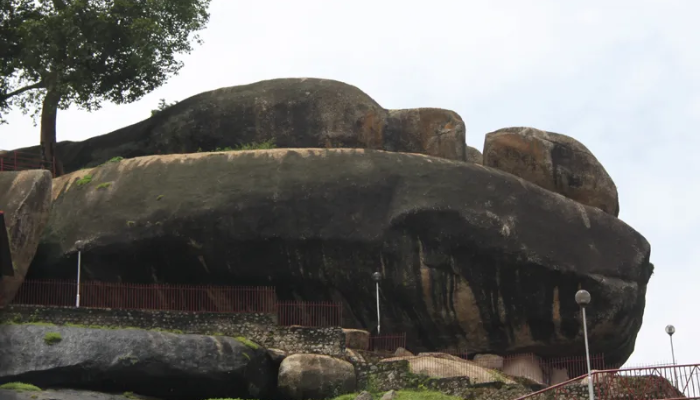
In the heart of Abeokuta, where the whispers of history echo through ancient granite, Olumo Rock has risen anew — not merely as a geological marvel, but as a living monument of memory, pride, and promise. Last radiant Thursday morning, Governor Dapo Abiodun stood before the towering outcrop to commission the newly renovated Olumo Rock Tourism Complex, unveiling a transformation that promises to reshape Nigeria’s tourism narrative and breathe new life into Ogun State’s cultural and economic landscape.
The rebirth of a monument
Olumo rock is not just a rock. It stands as a guardian of the heritage of the Egba people – a castle, which sheltered people during the internecine inter-tribal wars, a place of worship, and a power of survival sculpted by time. It has attracted pilgrims, tourists, fun-seekers, cultural activists, and wonderers of astral decks ever since decades. But in the recent years, the rock seemed to lose its charms, dulled by neglect and lack of investment by successive administrations. Today, that has been reversed.
A visit to the complex after the innovation a day after the commissioning elicits a passion of nostalgia – the renovated edifice is a pleasurable mix of modernity and tradition. There is a galleria that is decorated with pictures of great men of Nigeria, which makes one reflect. A gazebo provides shelter, and a quiet place. There is the restaurant that leaves with continental and local delicacies, and there are shops full of adire, the indigo-dyed cloth that tells the language of the Yoruba culture more tellingly. Accessible by means of elevators that take visitors up the heights of the rock, climbing the rock is not encumbered nor compromised because a standby generator ensures constant and seamless access – ascent and descent. The whole place buzzes with fresh energies, and relays the essence of its birthplace.

Free entry, open hearts
To commemorate the new beginning, Governor Abiodun announced that all people should have free access to Olumo Rock until the end of September – a move that is both generous and strategic. It is not just a promotional strategy – it is an invitation of a culture. With the financial obstacles eliminated, the state is inviting not only the citizens but the tourists as well, to learn the magic of their roots once again.
“This is not just about infrastructure,” the governor declared. “It is about reviving memory, rekindling pride, and reaffirming our cultural roots.” As a matter of fact, the gesture is also an appeal of opening arms to tourism not as an amenity but a common experience; a journey into a psyche of a people.
Tourism as a catalyst for transformation
Renovation of Olumo Rock is not just a facelift, but by extension it is a quintessence in the greater quest of Ogun State to orientate tourism as key strategic plank in its ISEYA Development agenda. Well-developed tourism is a strategy of building momentum. It provides job, investment, cultural exchange, and community development.

The affected area can already be seen in Abeokuta. Tour guides now take visitors wanting to know more and see the crevices and stories in the rock. White amala and egusi are served up in steaming pots by local chefs and served to happy diners as well as ofada rice which is indigenous to the Egba people. Craftsmen come out to exhibit their wares and the chatter of business resonates.
It has severe economics. They are creating jobs – not only inside the complex but in the hospitality and transport sector too. The number of small businesses is also coming on very well with bristling and effervescent tourists. Surely, the attention on adire is rejuvenating an art which is cultural and presenting local craftsmen and women and opportunity to stave off poverty and usher in prosperity.
Adire: Indigo filaments of self-definition
The most magical aspect of the complex is the enchanting adire decor. Being a time-honoured fabric with its complicated designs and significant meaning, this element is much more than a souvenir; it is an indigo-stained fairytale. Every work speaks of heritage, craft and genuineness.
The cultural education and economic empowerment is the core of the complex lifted to the limelight by the way they are promoting adire. Artisans, most of them women, at the local level get a new source of market and a new sense of purpose. As it becomes more visible and has an appeal because of its increasing demand, adire making is now a growing industry, which has provided employment and has given a craft that would otherwise have gone extinct a chance to survive.
The galleria: A living archive
Go into the galleria and you enter a gallery of greatness. The walls are adorned with portraits of the leaders of Nigeria, great artists, freedom fighters and they all represent pages of the history of the country. It is a holy ground of reflection and a looking back and forth of the past and the present.
This visual narrative reinforces the idea that Olumo Rock is not just a relic, but a living monument. It continues to inspire, to teach, and to connect.
Cultural diplomacy and national identity
Cultural tourism is important in such a diverse country like Nigeria as it helps in the unity. Such a place as Olumo Rock provides a common area of telling stories, talking and a common ground of appreciation. They remind us that we are part of one another because we must always remember that there is a history that connects us.
The gesture brought about by Governor Abiodun also earns Ogun State a leadership role as regards cultural diplomacy. This investment chooses to preserve and restore heritage to make a statement to the rest of the world that Nigerian heritage is not lost, it is being reinvented.
Challenges and the road ahead
However, similar to any big achievement, there are always some obstacles. A lot of vigilance and vision will be needed to maintain the effect of the renovation. The Commissioner for Culture and Tourism, Hon. Sesan Fagbayi assured that “the government will implement sustainable tourism practices, infrastructure maintenance, community engagement and ensure robust security measure to preserve its natural and cultural heritage for future generations”
More than these assurances, maintenance has to be careful, good access-ways, efficient lifts and maintained structures are the determinants to long term survival. Security has to be strong. With the flow of people on foot traffic, there should also be precautions to guarantee the safety of the visitors. Marketing has to be strategic. The means of promotion will define the site visibility and attractiveness not only on a local but also on an international level.
And last but not least, there has to be the involvement of the community. The local stakeholders are supposed to be active participants rather than passive beneficiaries. Their comments and additions can make the experience of any visitor enhanced and culturally authentic.
Voices from the ground
The change is already being felt by the people of Abeokuta. According to Mrs. Adeola Sobulo, who runs a selling spot in the complex, Olumo Rock is part of their soul. Now, all the people can visit here and observe why Abeokuta is special. “What the governor has done is better than giving us cash. Our businesses will surely will surely thrive more now,” she enthused.
Tourists are paying attention to the new deal. Chinedu, a visitor from Lagos who brought in his nephews and nieces on vacation from Germany says, “I have visited this place before but this time around it feels different. They not only improved facilities and the place has become more welcoming and the children are excited.”
A Model for national replication
The new-look Olumo Rock’s renovation story can be replicated as a guide by other states. Nigeria is rich in cultural and natural assets—from the Osun-Osogbo Sacred Grove to the Zuma Rock in Niger State. With strategic investment and community-driven planning, these sites can become engines of economic growth and cultural preservation.
Just envision a scenario where each state in Nigeria will have its own Olumo Rock, where the heritage is not a secret, but a place of pride; where tourist attraction is not considered as something secondary.
A rock made to roll
Olumo Rock is permanent in terms of its physical presence but not so as far as its impression is concerned. Through its current transformation, it is now a dynamic power – it tickles the heart, minds, and economies. The vision of Governor Abiodun has transformed one of the treasured monuments and we cannot forget that the past is not always about the past, but it can be the cornerstone of the future.
As visitors ascend its ancient steps or ride its modern elevators, they are not just climbing a rock – they are ascending into a story of resilience, pride, and possibility. And for the people of Ogun State, that story is just beginning.





