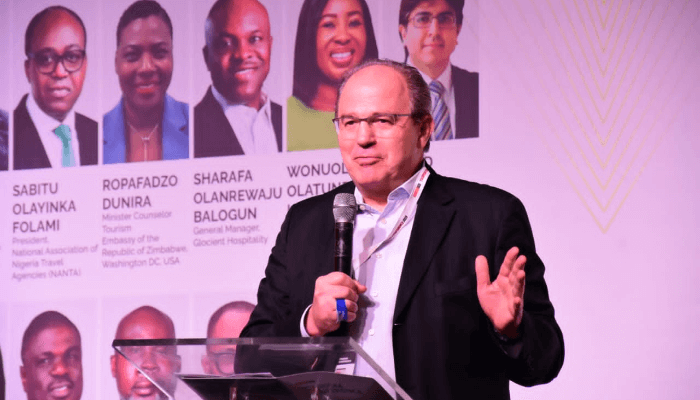
With over three decades experience in the hospitality industry, across major global brands and continents, Karl Hala is worth listening to.
His rich and knowledge-based industry insights and skills at weathering through challenges, yet delivering results in the different hotel brands and destinations has served were top among the reasons participants at the just-concluded BusinessDay Tourism Conference offered him listening ears.
At the conference, now in its second edition, which held at Eko Hotel and Suites, Victoria Island, Lagos, Hala, who is the group general manager of Continental Hotels Group, insisted that tourism is the lowest hanging fruit for economic development, while its hospitality subsector is the fastest route to achieving that.
“The hospitality and tourism industry is not just an economic sector; it is a national amplifier,” Hala echoed from the podium as a guest speaker at the conference.

Speaking from the frontline and narrowing his insights to Lagos Continental Hotel and Abuja Continental Hotel, which he manages under Continental Hotels Nigeria, Hala, an Austrian-born global hospitality expert, explained that the two five-star hotels in Lagos and Abuja, offer over 1,000 rooms, amid world class facilities including state-of-the-art Convention Centres, and hosting guests from across the world daily.
From the successful running of the two hotels, what Hala sees is very clear: “When a guest feels welcome, safe, and inspired — they become an ambassador for Nigeria”.
Hala, who felt honoured at the conference— not just as a hotelier or a speaker — but as someone who deeply believes that Nigeria is not only rising but ready to lead, insisted that Nigeria is not what the world thinks it is.
“And that is our greatest opportunity,” he told the distinguished guests, partners, colleagues, and passionate believers in Nigeria’s potential at the tourism conference.
Unraveling the potential, Hala, in his speech, delved into the untold story of the country.

With the ancient Nok terracotta art, powerful kingdoms like Benin and Oyo, and over 250 ethnic groups, each with rich customs, music, crafts, and languages, he posited that Nigeria is the real cradle of humanity.
But he frowned the country is sitting on tourism gold, yet still choosing to wear a borrowed crown.
“We look to Turkey, Egypt, even South Africa, admiring their visitor numbers and glossy tourism ads. But let us be real — Egypt and Turkey have faced years of unrest, yet still lead Africa and the Middle East in tourism inflow,” he noted while further querying the above.
He posited that the answer lies in the fact that the above cited countries own their narrative. “They have branded their heritage, elevated their culture, and sold a compelling story to the world”.
For Nigeria to own her narrative and build a resilient and thriving tourism industry, the Continentals Hotels Nigeria group general manager noted that Nigeria has to escape from the ‘perception trap’.
“Our biggest barrier is not insecurity. It is not infrastructure. It is perception,” he explained.
“People hear Nigeria and think risk. But I say: Nigeria is energy, hustle, creativity — and vibe”.
“Where else do you find a nation where tradition and tech walk hand-in-hand, where a Fulani herdsman’s cattle can be geo-tagged, and a Nollywood director is shooting films on a mobile phone? He asked.
Where else does every day feel like a celebration of culture, connection, and resilience? He asked again.
The rationale for owning the narrative for him is simply because data does not lie.
According to him, tourism contributes just 4.5 percent of GDP in Nigeria; compared to 8.6 percent in South Africa, and 9.2 percent in Kenya.
“Imagine what is possible if we tap into just 10 percent more of our potential,” he said.
To own the narrative, he thinks that Nigeria should take advantage of the potential of her youth population, which he described as the real superpower.
“Now let me tell you a secret: Our youth is Nigeria’s unknown superpower.
“Over 60 percent of our population is under 25. That is not a statistic — it is an army of dreamers, doers, coders, chefs, guides, entrepreneurs, artists and so on.
“We need to train them not just to follow jobs — but to create industries. From culinary tourism to adventure travel, from digital nomad hubs to heritage restoration — the future is theirs”.
Apart from engaging the energetic youth populace, Hala recommended other approaches to growing tourism to sustain the Nigerian economy as being witnessed in many countries today.
His recommendations include inclusive tourism models such as: Community-owned lodges in Osun or Cross River; local guides trained in eco-tourism in Taraba; cultural festivals in Zaria, Enugu, Ibadan that are marketed globally; and smart partnerships between hotels, tech, and youth platforms.
However, he did not forget the place of people, culture and infrastructure in sustainable tourism growth.
The above are the three pillars for growth.
Making a case for people as the first pillar, he explained that you need to be intentional at training people, upskilling and empowering them in order to get the needed manpower to run and grow the tourism industry.
“Let’s stop waiting for foreign models and build African solutions for African dreams. Our people must own tourism, not just serve in it”.
For the culture pillar, he noted that heritage is not just art in a museum.
“It is music in our streets, stories in our palaces, food on every corner. Celebrate it, digitize it, and export it”.
On infrastructure, he pointed out that Nigeria needs better roads, airports, policies and competitive VISA regulations to grow her tourism industry.
“But we also need better thinking. Invest in experiences, not just buildings. Imagine a tourism innovation hub in Lagos, a culinary institute in Calabar, a heritage trail from Ife to Kano”.
He charged all the participants and tourism stakeholders across Nigeria to commit to training harder, act bolder and dream bigger in order to own the narrative and tell the world not just that Nigeria is open for tourism, “but that we are the future of travel”.
“We are not the underdog. We are Africa’s heartbeat. And the world needs to feel it,” he enthused in his conclusion of the well-applauded speech at BusinessDay Tourism Conference 2025.