If you took a tricycle through Shomolu-Bariga this week, the pulse of Lagos’ printing-press industry or walked through the dense crowds at Balogun Market, it would be difficult to claim that Nigeria’s private sector is in a growth phase. Yet, that is precisely what the data suggests.
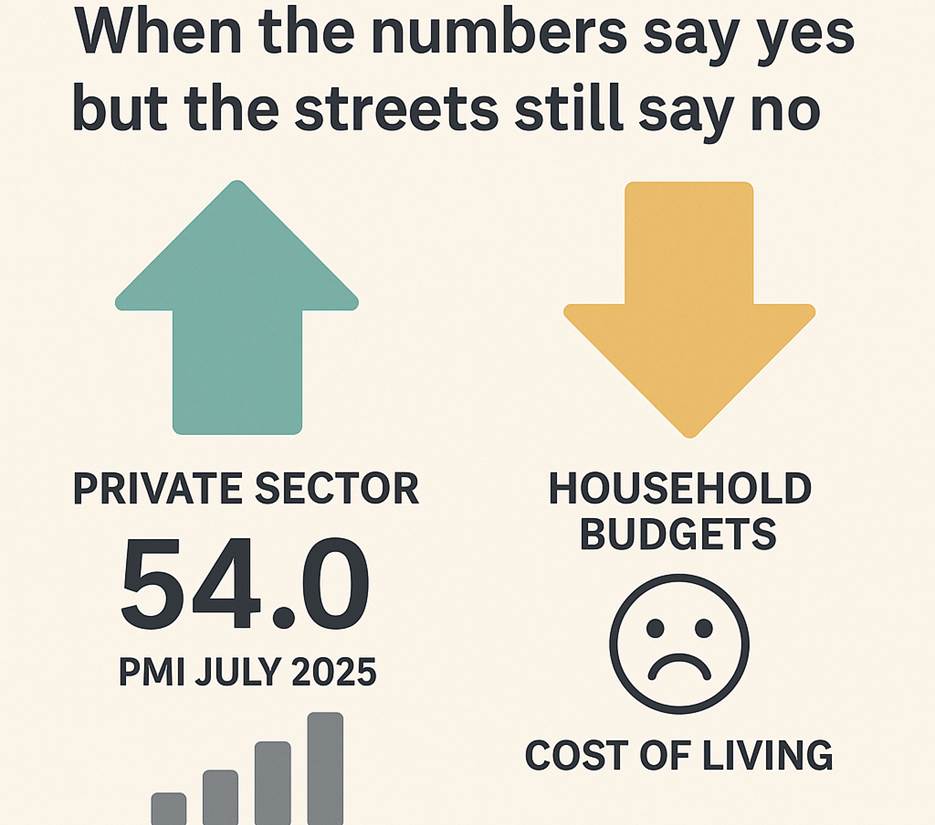
According to the latest Purchasing Managers’ Index (PMI) compiled by Stanbic IBTC Bank and S&P Global, business activity expanded in July 2025, rising to 54.0, its highest level in three months. The PMI, a composite index based on new orders, output, employment, suppliers’ delivery times and inventory levels, considers anything above 50.0 a sign of expansion.
On paper, the signs are encouraging. Companies are reporting stronger demand, higher order volumes, and marginal improvements in supplier delivery times. For manufacturers and service providers, this is the sharpest uptick in new business since early 2024. Employment is also on the rise, posting its most notable jump since the last quarter of 2023.
But while the macroeconomic indicators may suggest recovery, the mood on the streets tells a different story.

Growth, but not for everyone
The PMI’s optimism has not yet trickled down into household budgets. Input costs, though stabilising, remain elevated. And while some firms have adjusted wages, the increases are largely defensive aimed at cushioning transport inflation, not sharing in profitability.
In most sectors, real wages remain flat, even as businesses replenish stock and report healthier output.
“There is a disconnection between what the macroeconomic numbers are saying and what the people are feeling,” said Muda Yusuf, director of the Centre for the Promotion of Private Enterprise. “The average Nigerian is not feeling the impact of this growth because it is concentrated within formal sectors that often exclude the informal economy where most people earn their living.”
This divergence growth in formal business activity versus stagnation in household consumption is more than a statistical quirk. It speaks to the fragility of Nigeria’s economic recovery and the unevenness of its distribution. Companies are adapting; households are absorbing.

What’s powering the growth?
A closer look reveals that private-sector expansion is being driven by internal efficiency, not external stimulus. With limited fiscal space and cautious monetary policy, businesses have had to innovate to survive.
Many are turning to local sourcing, streamlining operations, and leveraging digital platforms to reach cost-conscious customers.
This self-directed resilience is noteworthy. But it also underscores a deeper tension: Nigerian businesses are recovering faster than Nigerian households. The PMI does not fully account for micro-enterprises or informal labour sectors where economic pain is still acute.
In retail corridors and informal clusters, vendors are seeing more foot traffic but smaller transaction sizes. Consumers are buying fewer items per visit.
Essential goods remain expensive. The inflation rate may have slowed, but the base remains high, a reality not lost on workers earning the same salary as last year, but paying more at the pump and in the market.
The opportunity and the gap
With output price inflation now at a 26-month low, firms technically have greater latitude to ease prices. Some are doing so offering bundle discounts, flexible payment options, or stock-clearing sales.
But these changes are episodic, not systemic. The gap between macro expansion and micro hardship persists.
Still, this moment offers an opening.
“There’s still potential,” noted a senior African economist at a leading international bank. “Nigeria’s economic fundamentals are improving, and if reforms are sustained, this business momentum could translate into broader household gains though it will take time.”
If policymakers can harness the current business momentum through targeted support for MSMEs, improved credit access, and reliable power infrastructure the private sector could become the engine for a broader recovery.
But left unchecked, the present trajectory may reinforce inequality: a growing formal sector atop a struggling informal base.
A turning point or a temporary lift?
Whether July’s strong PMI is the beginning of sustained recovery or simply a seasonal blip remains to be seen. But it signals potential. Businesses are responding to demand, not policy, a sign of entrepreneurial strength in a context often defined by uncertainty.
What comes next will depend less on whether the numbers rise again in August and more on whether that growth is shared. Until then, the keke rides and market stalls of Nigeria will remain a more honest barometer than any survey.