For decades, Nigeria’s roads have told the story of a nation dependent on secondhand cars. Known locally as Tokunbo, these imported vehicles, usually worn, fuel-hungry, and high-maintenance, have long been the default choice for millions.
In an economy still largely driven by oil, gas, and agriculture, transportation is essential for continued development. Still, demand for transportation has consistently outpaced supply in both urban and rural areas.
In 2023, the US International Trade Administration estimates that Nigeria’s annual demand for vehicles is 720,000, while local production is only 14,000. This means that hundreds of thousands of vehicles, primarily used vehicles, must be imported each year, resulting in little benefit to the local economy.
This heavy reliance on imported used vehicles also contributes to the prevalence of high-emission vehicles, as those imported to Nigeria do not meet minimum emissions regulations in the countries from which they are exported.


“The result of this dependency is not only high levels of pollution but also high costs; the import of used vehicles costs the country an estimated $8 billion each year,” RMI and Sustainable Energy for All (SEforALL) stated in a report.
Today, Nigerians face mounting pressures. Following the removal of petrol subsidies in 2023, the average cost of Premium Motor Spirit (PMS), popularly known as petrol, has surged to over N700 per litre, pushing transportation and logistics costs to record highs. For ride-hailing drivers and small business owners alike, the pain at the pump is not just inconvenient; it’s unsustainable.
At the same time, the broader economy is strained. In June 2025, the inflation figure reached 22.22 percent. Food prices continue to climb, the naira remains under pressure, and unemployment, especially among young Nigerians, has made affordable mobility and stable income even more urgent.
In this context, the country’s longstanding reliance on imported used cars is beginning to feel more like a trap than a solution. However, that story may be shifting.

“The domestic auto industry in Nigeria is ripe for change, not only to encourage growth in this segment of the economy, but also to improve access to transportation and, through solutions like electric vehicles (EVs), reduce CO₂ and air pollution emissions,” RMI stated.
“However, while the numbers soared, so did the costs borne by everyday Nigerians, repair bills, fuel expenses, and the environmental toll of outdated engines.”
SAGLEV, the company behind Nigeria’s first electric vehicle (EV) assembly plant, nestled in Lagos, is challenging the long-standing economics of Tokunbo by offering clean, cost-efficient mobility made in Nigeria.

A turning point for Nigeria’s auto economy
In 2023, Nigerians imported a staggering N1.063 trillion worth of used vehicles, a 226.46 percent increase from N325.05 billion in 2022, the country’s statistics bureau noted.
However, while the numbers soared, so did the costs borne by everyday Nigerians, repair bills, fuel expenses, and the environmental toll of outdated engines.
Also, there is an additional public health toll associated with Nigeria’s current dependence on imported vehicles. With a minimum EURO 4 standard and a 12-year age limit on imported vehicles, most vehicles exported to Nigeria are far below the required emissions standards in the markets that originally produced them.
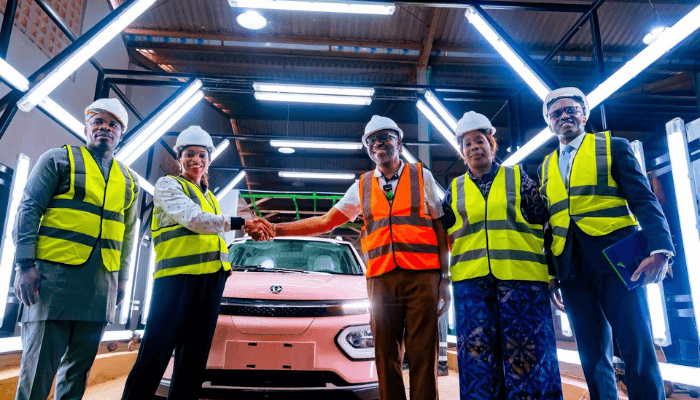
Gbenga Faleye, founder of SAGLEV, at the tour of the company’s assembly plant by senior government officials and the African Development Bank (AfDB), believes it’s time to turn that tide.
He said, “A used car from Japan adds almost no value to Nigeria.” “We may collect import duties, but what about jobs? What about technical training? What about cleaner air?”
“EVs have only 40 moving parts,” Faleye explains. “Petrol cars have over 4,000. That’s 50–60 percent savings in maintenance. No oil changes, no spark plugs, no exhaust issues. And most Nigerians don’t know this.”
Building cars and a cleaner future
SAGLEV’s factory currently runs a single shift capable of assembling 2,500 vehicles per year, with plans to scale up to 10,000 annually, the company said. The vehicles are built under a technical partnership with Dongfeng Motor Corporation, Asia’s second-largest automaker and a long-time supplier to the Dangote Group.
From the outset, SAGLEV embedded after-sales service, technician training, and parts supply into its business model. “We delayed launching for years just to get it right,” Faleye said.
Still, challenges persist. At the time of a recent plant tour by senior government officials and development leaders, including Akinwumi Adesina, AfDB President, and Jumoke Oduwole, Minister of Industry, Trade and Investment, five containers of EV parts remained stuck at the port due to delays in digital customs clearance.
“Many clearing agents don’t know how to use the electronic portals,” Faleye said. “We have customers who have paid 20 percent deposits, waiting on cars we can’t finish assembling yet.”

The government signals growing support
Oduwole, Nigeria’s Minister of Industry, Trade and Investment, lauded the plant’s ambition and design, citing that the Nigerian government is beginning to align policy with industry needs.
“This is what domestic industrialisation looks like,” she said. “It’s affordable, sustainable, and has the potential to support ride-hailing drivers, small businesses, and even exporters.”
She pointed to the Nigeria First Policy under President Bola Tinubu, which prioritises local investment. A unified digital system, the National Single Window Project, is also in the works to streamline port processes by 2026.
Likewise, the National Automotive Design and Development Council (NADDC) has released Nigeria’s first National Occupational Standard for EV maintenance, a document set to guide technical colleges and universities in training a new generation of EV technicians.
“This document is now the guide for technical colleges and universities,” Oluwemimo Joseph Osanipin, the Director General of NADDC, said. “It will ensure we train a new workforce to support EVs nationwide.”
A pan-African vision
Adesina, president of the African Development Bank, echoed this optimism. Touring the facility, he praised the quality of engineering and noted the gender diversity in SAGLEV’s workforce.
“The global EV market is expected to reach $59 trillion in the next 20 years, he said. Nigeria must not be left behind.”
He also pledged AfDB support for infrastructure and capital access, noting the critical role of power in driving EV adoption. “We’ve already helped connect over 28 million Africans to electricity, and we will continue to invest, especially here in Nigeria.”
Lagos as a gateway for EV exports
Kausara Bada-Ambrose, the Commissioner for Commerce, Cooperatives, Trade, and Investment in Lagos, pointed to the state’s ambition to support the growth of entrepreneurs and manufacturers alike.
According to her, Lagos is giving local manufacturers a gateway to export. “The future is in our hands, and Lagos will help lead the way.”
Meanwhile, SAGLEV’s journey is far from over, as the factory hasn’t even had a grand opening yet. “Our real work is to create jobs, clean the air, reduce imports, and reshape the future of mobility in Africa,” Faleye said. “This factory is not just building cars; it is building Nigeria’s future.”