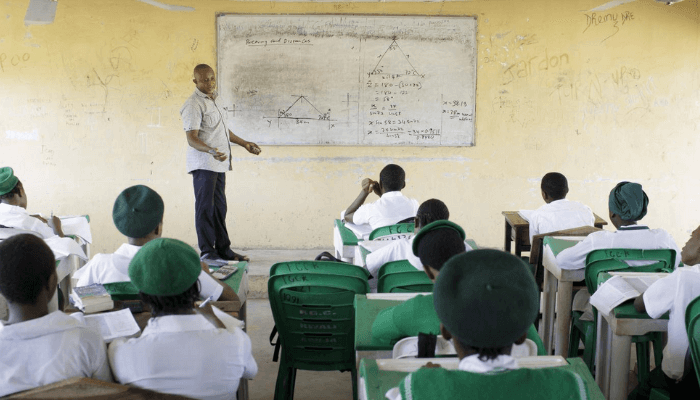
Emenike Ogbuja, a primary two pupil in a school owned by a religious organisation in Ejigbo, a suburb of Lagos State, suddenly began avoiding school.
His grades also dropped. Disturbed by this sudden development, his father decided to have a one-on-one chat with his son.
Emenike told his father that the school hired a new teacher, the wife of the pastor, who was never trained.
The woman was totally ignorant of how to handle the children under her care, so she resorted to bullying. This pushed Emenike to the church on Monday mornings rather than school.

The case of Emenike depicts what many children may be going through in the hands of unqualified teachers across Nigeria.
Read also: Osun Govt deploys 1,750 Imole Corps teachers to schools, APC kicks
Several private schools, especially basic schools, engage the services of unqualified teachers as a result of economic hardship.
At an Oke-Afa school in Oshodi/Isolo Local Education Authority, a young man, who is awaiting admission into the university, was seen teaching primary four pupils in one of the private schools.
Similarly, many schools visited at Okota and Itire axis of Lagos State have unqualified teachers handling primary and secondary school classes.

A school owner told BusinessDay that it is more economical to engage passionate but non-TRCN registered teachers than qualified ones.
A BusinessDay survey discovered that some of the teachers’ training centres even use unqualified teachers to teach the teachers who will in turn educate the children.
Iyabo Nnokam, a school owner in Rivers State, while giving an insight into the surging use of unqualified teachers in most private schools, said some schools employ unqualified teachers because they cannot afford the salaries of the qualified educators.
This, she said, is borne out of the excruciating economic situation prevalent in the country.
“The status of parents in relation to school fees is another reason for involving non- qualified teachers in order to meet up with daily expenses/salaries,” she noted.
However, Nnokam emphasised that there are non- qualified teachers who are trained on the job and who eventually become better than certificate holders with no experience.
“There are also non-qualified teachers with more passion than the qualified ones. I think most schools look into the ability of the teacher to deliver than the certificate,” she said.
Competence vs certificates
This also calls to mind the issue of competence and certification in the country’s education system. Many have expressed worries that Nigerians are more concerned about certificates than competence and service delivery.
Gift Osikoya, a teacher with a foreign school in Lagos, emphasised that the word ‘unqualified’ as used by TRCN is subjective.
“It’s important to note that ‘unqualified’ in this context often refers to teachers who do not meet the minimum professional requirements set by the TRCN, such as the National Certificate in Education and a bachelor’s degree in education, among others. They also might not be registered with TRCN,” she said.
Osikoya, however, reiterated that the figures vary depending on the region and the specific type of private school.
“In the South-West region, approximately 70 percent of private school teachers were found to be unqualified. Some reports even suggest this figure could be as high as 90 percent in some parts of the region,” she noted.
Read also: New teachers recruitment policies boost education standard, says Oyo SUBEB chairman
She disclosed that some of the reasons for the engagement of unqualified teachers include to maximise profits, lack of proper monitoring and supervision, high unemployment rate, and lack of pedagogical competence, among others.
“Many private school owners, especially those operating low-cost schools, prioritise profit over quality. Unqualified teachers are often paid much lower salaries, making them a more ‘affordable’ option.
“Inadequate oversight from state ministries of education and other regulatory bodies allow some private schools to operate without adhering to standards,” she noted.
In addition, Osikoya said, “The high rate of unemployment in Nigeria can lead individuals without formal teaching qualifications to seek employment as teachers as a last resort.
“Even if someone has a degree in a subject area, they may lack the specific pedagogical skills and training required to effectively teach and manage a classroom.”
Discussing the impact of unqualified teachers to learning outcomes, she emphasised that unqualified teachers have negative impacts on students’ academic performance, their ability to meet academic potential, and their overall future prospects.
Meanwhile, some stakeholders are worried that the government is prioritising regulating private schools while the public ones are unchecked.