



….How low start‑up costs and high market demand drive profitability, attract investors.
Goat farming in Nigeria is fast becoming a highly profitable venture.
With rising demand and relatively low input costs, goat farmers are now embracing this once-overlooked livestock business, drawn by its high returns and growing market potential.
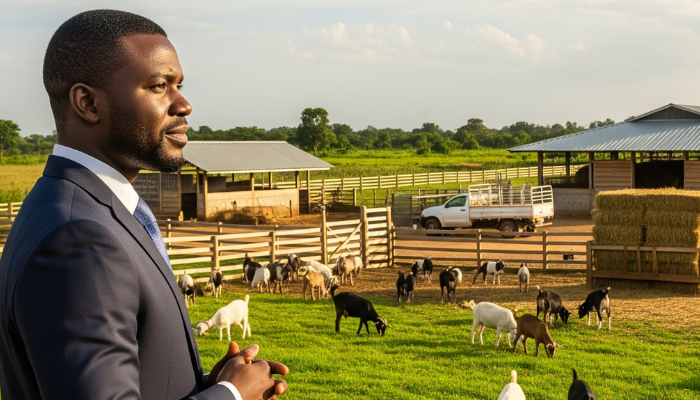
Among them is Michael Nwani, a Canada-based agropreneur who runs one of the largest goat farms in eastern Nigeria.

Spread across approximately 8 acres, his farm is a testament to his passion for agriculture and his commitment to contributing to Nigeria’s food security.
“My desire is to give back to my country, boost food security, and profit from the business,” Nwani said.
“Nigeria is blessed, and as a giant of Africa, we must go back to our roots and build it,” Nwani said. “
According to World Bank data, Nigeria imported about $1.33 million worth of goat meat in 2022—a figure that signals not only robust market demand but also a vast, untapped opportunity for local investors.
Goat farming, often described as a money‑spinning business, is profitable because it requires relatively low input while offering high yields.

“Goat farming is a money‑spinning venture if managed properly,” said Michael Ozoje, a professor of animal breeding and genetics at the Federal University of Agriculture, Abeokuta.
“Goats are hardy and disease‑resistant. Unlike pigs, they are globally accepted as a household delicacy. They have a high prolific rate, with a twinning rate about 40 percent higher than most other livestock,” Ozoje noted.
The sheep and goats association of Nigeria (SHEGOFAN) also highlighted the several uses of goats which makes it a profitable venture.
“Goats reproduce faster than cattle, their milk is more nutritious than that of cattle, while their skin is used as a source of leather, making them an excellent choice when it comes to market availability and profitability” Wahab Salami, SHEGOFAN’s president noted.
Ozoje explained that the animals’ resilience keeps operational costs low. “One thing that makes them inexpensive to manage is their ability to turn rough forage into rich protein,” he noted.
“They thrive even under harsh or unpredictable weather. And because their feed doesn’t compete with human food supplies, their potential for profitability is even greater,” Ozoje explained.
Farmers in the field share similar experiences. Abubakar Tijjani, a goat farmer in Sokoto State, northern Nigeria, told BusinessDay that he has never seen a livestock venture as easy to manage or as rewarding.
“They rarely fall ill, and you don’t have to break the bank to feed them because they can eat almost anything—from forages to cassava peels and maize husks,” he said.
“Depending on your budget, you can start with as low as N500,000 and with as few as two or five goats,” Tijjani added.
In a recent post on X, Insider Africa described goat farming as “an agribusiness with low input costs, a huge market and high return on investment.”
How to make it big in goat farming
Maintaining proper hygiene and standard housing is essential for boosting yields and reducing livestock mortality, experts say. Overcrowding and poor ventilation, on the other hand, are a recipe for disease outbreaks and serious losses.
“Goats are highly susceptible to damp environments,” Ozoje warned.
“When constructing their pen, always ensure the floor is elevated and sloped and. This allows rainwater and urine to drain off easily, keeping the area dry,” he noted.
He also added that hygiene shouldn’t stop at construction. “Never feed goats wet grass. It can expose them to harmful bacteria. Prioritize dry, clean feed, ensure good airflow in their pens, and keep their surroundings clean. These simple steps can prevent major health issues,” Ozoje said.
New Generation Farms, an agribusiness platform, emphasizes that breed selection, timely vaccination, and balanced nutrition are key pillars of successful goat farming.
For beginners and small-scale farmers, they recommend the West African Dwarf goat—a hardy breed known for its disease resistance and ease of management.
“If you’re raising goats for meat, consider Galla (Somali), Maradi, or Boer goats,” advised Timothy Shekwolo, CEO of Timmy Integrated Farm Services. “For milk production, go for Saanen, Alpine, or Nubian breeds. They’re top performers in dairy output.”
Financial implications
The cost of constructing a goat pen is relatively low compared to other livestock.
“It requires wood, bamboo, and corrugated sheets to construct an elevated goat pen,” said a Kebbi State goat farmer.
“With just N1.2 million, you can construct a 100-capacity goat pen within a week. However, it is advisable for beginners to start with as few as 2 to 5 goats,” he noted.
“An elevated goat pen keeps the pen from dampness, prevents water-logging during the rainy season, and protects them from pests,” the farmer added.
“With constant deworming and good hygiene practices, their survival rate is 90 percent,” he said.
Other farmers highlighted the cheap feed cost.
“They do not require much. You can prepare their feed from locally sourced materials like cassava peels, maize husks, and dried, ground leftovers,” Tijjani noted.
The cost of buying your goat stock ranges between N30,000 and N100,000 depending on their age (3, 6, or 9 months, and 1 year).
“It is, however, advisable to start with 6-month-old stock due to their closer age to maturity and the fact that they have been properly weaned,” Tijjani added.
Goats reproduce bi-annually, and their maturity spans between 12 to 18 months depending on the quality of feed and key management practices.
“At maturity, local breeds can be sold between N50,000 and N280,000, crossbreeds between N450,000 and N750,000, while exotics go for N1 million to N 1.8 million depending on their size, breed, location, and season of the year,” Tijjani noted. “These prices are however subject to change,” he added.
Current status of goat farming in Nigeria
In 2023, Nigeria consumed approximately 365,000 metric tons — or 3.6 billion kilograms — of goat meat, according to Statista. Yet only 30 percent of this demand was met by local supply.
“The rest is imported largely from Sudan, Niger, Chad, and South Africa,” the report notes.
Despite being a net importer, Nigeria has an active export scene. Dala Goat Farms, Heritage Farms, Golden Hooves, and Oke-Afa Farms stand out as major players in the country’s goat meat exports.
According to the 2022 Agricultural Census Report by NBS, out of the 40.2 million agricultural households, about 16 million or 41.2 percent are engaged in goat farming.
Collectively, they hold an estimated 124 million goats, mostly raised by small-scale farmers.
How to close the gap
The current supply deficit in goat production presents a clear opportunity for investors to step in and bridge the gap.
“It is important to see goat farming not just as a source of livelihood, but as a viable enterprise to boost productivity,” said Ozoje.
“Australia, the world’s leading livestock producer, has invested heavily in this sub-sector over time. Nigeria can do the same,” he added.
The Smallholder Sheep and Goat Farmers Association of Nigeria (SHEGOFAN) continues to advocate for capacity-building and structural support.
“Stakeholders should make ranches available for small ruminant farming, especially goats,” said Salami.
“Goat farming is a major employer of labor, but to unlock its full potential, we must prioritize proper training, access to subsidized inputs, and credit facilities,” he added.





