|
Getting your Trinity Audio player ready...
|
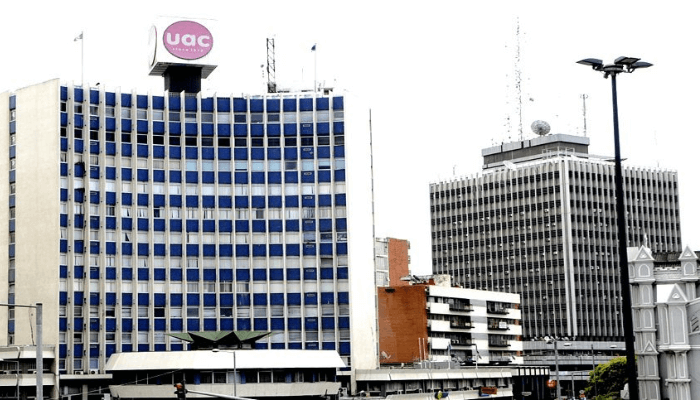
UAC of Nigeria Plc recorded a 22.9 percent decline in its after-tax profit to N7.36 billion in the first half of 2025, down from N9.54 billion in the same period of 2024, as higher finance costs eroded gains from operating efficiencies.
According to the company’s financial statement released on Wednesday, the Group’s revenue rose by 33 percent to N110.41 billion from N83.25 billion in H1 2024, driven by double-digit growth across all key business segments, including animal feeds, paints, and packaged foods.
Gross profit climbed 51 percent year-on-year to N28.26 billion, supported by a better product mix and cost management initiatives.
Read also: UAC acquires CHI Limited from The Coca-Cola Company

Operating profit rose sharply to N12.59 billion from N6.66 billion in the prior period, an 89 percent increase, highlighting improved margins and scaled operations. Operating income was also bolstered by gains from asset disposals and other non-core income streams, including a N556.7 million profit from asset sales and N676 million in other income.
Pressure from costs
Despite strong operational metrics, UAC saw a notable rise in its cost and expense base in the first half of 2025, driven by inflation, foreign exchange volatility, and expanded operations. Cost of sales jumped 27 percent year-on-year to N82.15 billion, reflecting higher input prices and increased production volumes across key segments such as animal feeds and packaged foods.
Selling and distribution expenses surged 37 percent to N7.02 billion, as the Group ramped up logistics, marketing, and sales support to match growing demand. Administrative costs rose 30 percent to N9.99 billion, largely due to higher personnel costs, energy bills, IT infrastructure upgrades, and legal fees. Staff compensation alone reached N9.28 billion, including share-based incentives and long-term bonuses.
Net finance cost swung negative at N3.62 billion, compared to a net finance income of N7.82 billion in H1 2024. The reversal was primarily due to a significant drop in exchange gains from N9.37 billion in H1 2024 to a loss of N78.4 million and a more than twofold rise in interest expenses to N6.18 billion, reflecting elevated borrowing and funding costs.

Profit before tax fell to N11.10 billion from N14.95 billion, a 26 percent decline, due to the steep rise in finance costs.
The Packaged Food & Beverages segment led in profitability, contributing N6.94 billion to profit before tax, followed by Paints with N3.78 billion. However, the Quick Service Restaurants (QSR) segment continued to operate at a loss of N779 million, weighed by rising input costs and operating overheads.
Consequently, earnings per share dipped to 238 kobo from 304 kobo recorded in H1 2024.
UAC’s total assets stood at N161.5 billion as of June 2025, up from N157.7 billion at year-end 2024. The company recorded a 10.8 percent growth in retained earnings to N53.17 billion, helping lift total shareholders’ equity to N72.76 billion, compared to N66.41 billion in December.
The company maintained strong cash holdings, with cash and cash equivalents rising to N46.81 billion from N40.6 billion at the start of the year. Inventories, however, dropped by 11 percent to N48.84 billion, reflecting improved inventory management.
Read also: UACN, others fuel market rally by 0.53% as week opens
Net cash generated from operating activities improved to N10.84 billion in H1 2025, up from N8.39 billion in the same period last year. Despite higher tax payments and capital expenditures, the Group saw a net increase in cash of N6.26 billion during the period.
Investing activities yielded a net cash inflow of N1.39 billion, largely due to proceeds from asset disposals. However, financing activities resulted in a net outflow of N5.97 billion due to loan repayments, interest expenses, and dividend payments to both shareholders and minority interests.
UAC of Nigeria Plc’s share price closed at N73 on Tuesday, marking a year-to-date (YTD) gain of over 102 percent. This sharp rally reflects growing investor confidence in the company’s long-term value potential.