The global landscape
The global landscape is marked by geopolitical fragmentation, economic nationalism, and a retreat from foreign aid. In early 2025, both the U.S. and U.K. announced further cuts to their foreign assistance budgets, following earlier reductions. Across Europe, aid is also being redirected as governments turn inward to address domestic pressures and defence spending. Meanwhile, global tensions, from the Russia-Ukraine war to the Middle East crisis, continue to fuel volatility in supply chains, energy prices, and financial markets.
But amidst this upheaval lie unique opportunities for Africa. With its vast youthful population, abundant natural and green capital, and rising innovation, the continent holds solutions to some of the world’s most urgent challenges. Through deeper regional integration, stronger intra-continental trade, and value-added industrialisation, Africa can seize the moment to chart a path to lasting economic resilience and prosperity on its own terms.
Africa—The economic powerhouse
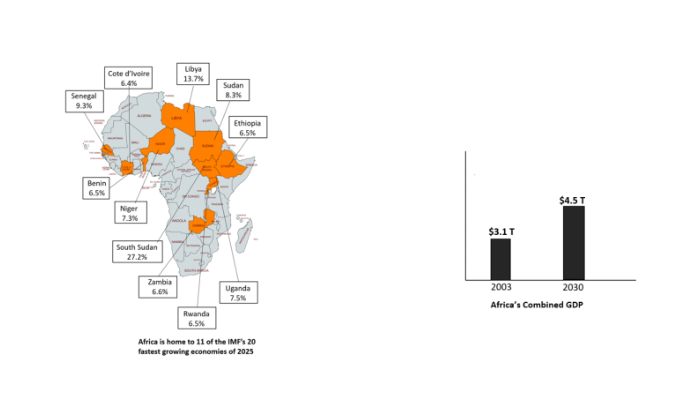
Eleven African countries feature on the IMF’s 2025 list of fastest-growing economies. Urbanisation and a growing middle class are driving demand, while youthful innovation reshapes productivity. Unlike ageing populations elsewhere, 63 percent of Africans are under 25—the youngest globally. By 2030, Africa will be home to over 375 million youth, forming a dynamic labour force and talent pipeline to fill skill gaps worldwide.
Realising this promise requires sustained investments in quality education, digital literacy, and skills development aligned with industry needs. Human capital is not a social issue; it is one of Africa’s greatest strategic assets.

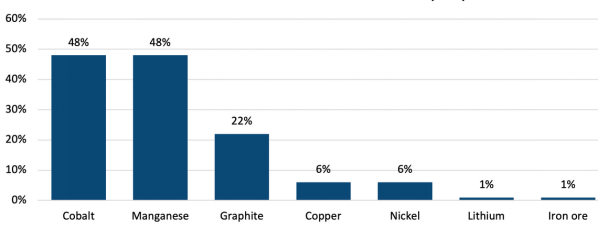
Although home to nearly 20 percent of the world’s population, Africa accounts for less than 4 percent of global emissions—but it is one of the most vulnerable regions to climate change. Paradoxically, the continent is a potential green superpower, endowed with 10 TW of solar capacity, 350 GW of hydro, 30 percent of the world’s mineral reserves (including rare earths essential for electric batteries), and 8 percent of global gas reserves.
Source: In On Africa
Africa has 60 percent of the world’s uncultivated arable land: vital for food security, agro-industrialisation, and more. Its vast natural ecosystems, including mangroves, peatlands, grasslands, and rainforests, serve as carbon sinks. They provide a strong foundation for high-quality, nature-based carbon credits. This can unlock access to carbon markets and green finance to bridge infrastructure gaps and drive economic transformation.
Africa should take a leading role in driving a just, equitable, and pragmatic energy transition: one grounded in transparency, supply chain traceability, and the core principles of sustainable development.
With over 650 million mobile users, more than the US or Europe, Africa is the world’s fastest-growing mobile market, home to over 1,000 fintechs and thriving EdTech, HealthTech, and AgTech sectors. Digital innovation is enabling the continent to leapfrog outdated legacy systems common in more advanced economies.
The African Continental Free Trade Area (AfCFTA) is the world’s largest free trade zone by membership. According to the World Bank, it will boost continental income by $450 B by 2035. If properly harnessed, it could be a game-changer for the continent. Leveraging the AfCFTA will position Africa as a strong trading bloc capable of negotiating better investment terms to finance critical infrastructure.

Africa must deepen regional integration and boost intra-continental trade and investment to build self-reliance and resilience. Currently, intra-African trade accounts for less than 20 percent of total trade, and intra-African investment just 5–17 percent of inward FDI. Strengthening these internal economic ties would reduce dependence on external markets and enhance the continent’s ability to weather global shocks.
Industrialisation and value addition are imperative. Moving beyond raw material exports to prioritise high-value manufacturing and mineral processing will diversify economies, create jobs, and foster inclusive, sustainable growth.
The execution imperative
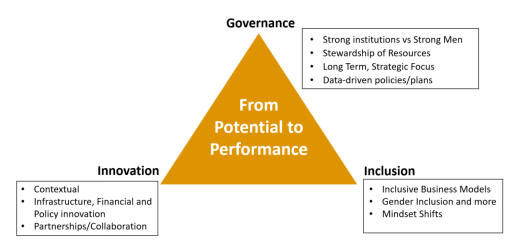
Africa’s promise is undeniable. But potential alone does not deliver results. It’s time for execution, time to shift from potential to performance. Unlocking Africa’s promise and potential requires bold and deliberate action, and three strategic imperatives must drive the continent’s next phase of development.
I. Governance that delivers
Good governance is the foundation of effective stewardship, ensuring that resources are managed responsibly and decisions serve long-term public interests. Policymakers and regulators must strengthen governance systems and align incentives to unlock value. Strong institutions, anchored in judicial independence, regulatory autonomy, and public accountability, are the bedrock of resilient economies. Regulatory clarity, the sanctity of contracts, and policy consistency reduce risk, lower transaction costs, and enable scale.
Closing the gap between governments and citizens through active engagement makes governance more inclusive, accountable, and effective. In Africa’s context, effective governance is a competitive differentiator because it directly addresses the structural barriers that constrain growth: weak institutions, fragmented policy, and investment uncertainty. Good governance mitigates risk, builds investor confidence, and ensures public resources are deployed productively. It curbs corruption, strengthens public trust, and improves service delivery: pillars of social and macroeconomic stability.
II. Innovation that solves local problems.
Innovation is already central to Africa’s development trajectory and must remain so. Across the continent, entrepreneurs are solving real-world challenges with ingenuity and scale, from fintech and decentralised energy systems to smart logistics, blended finance, and digital health solutions. To unlock more innovation and drive exponential growth, investments in talent and skills must be matched with investments in digital and physical infrastructure.
Policy innovation is also gaining momentum. Frameworks such as Nigeria’s Start-up Act and South Africa’s Carbon Tax Act (2019) show how agile regulation can support entrepreneurship and sustainability. But sustaining this momentum requires continued investment in research and development, as well as data-driven policymaking. Technology offers powerful tools for collecting and leveraging data for planning and to inform policies that are both forward-looking and fit-for-purpose.
Collaboration facilitates innovation, and so partnerships at all levels will be crucial in moving Africa forward. There is significant scope for deeper collaboration between the public and private sectors, where aligned incentives can accelerate infrastructure development, improve service delivery, and deepen economic transformation. There’s also a need for more collaboration between regulators and operators with a stronger appreciation of shared interests and objectives. Partnerships between academic institutions and industry will help commercialise research and patents, support the deployment of homegrown technology, and reduce reliance on imported solutions. It will also help build a robust skills pipeline and ensure innovation remains grounded in the local context.
When these ecosystems work in sync, they do more than generate economic development; they build institutional resilience, foster inclusive innovation, and create shared value across society.
III. Inclusive development as a growth lever
There can be no sustainability without inclusion. In Africa, where inequality is more pronounced than in many other regions, exclusion is not just a social concern; it is a fundamental risk to economic stability, business continuity, and long-term growth. Widening income disparities and inequality weaken social cohesion and fuel social unrest, crime, and corruption. They also suppress domestic demand and limit productivity by sidelining the majority from meaningful economic participation.
Inclusion is not just the right thing to do; it’s a growth strategy. When people have access to finance, land, education, and digital tools, they become active economic agents, starting businesses, generating income, consuming products, and contributing to tax revenues. Inclusive economies are more dynamic, resilient, and innovative. They unlock the full potential of the population, drive demand-led growth, and expand the talent pool that fuels enterprise and innovation.
Real change begins with a mindset shift. Governments and businesses must move beyond seeing inclusion as charity or compliance and recognise it as a source of competitive advantage and a pillar of long-term sustainability. The costs of maintaining the status quo are high, but the return on inclusion is higher—stronger institutions, more stable markets, loyal customer bases, deeper talent pools, and more adaptive and purpose-driven companies.
Businesses should embed inclusive thinking into business models, not as an afterthought but as a strategic driver. This means designing products and services that serve the many, not the few; investing in underserved communities and entrepreneurs; and building diverse teams that reflect the markets they serve. These are not just acts of responsibility; they are pathways to scalable growth, social stability, and shared prosperity.
Conclusion
The global system is reordering, and African leaders must act decisively and collectively to seize the moment. Collaborative, inclusive, and long-term-focused governance is critical. We have a great window of opportunity, and execution is key.
Ivana I. Osagie, CEO PWR Advisory