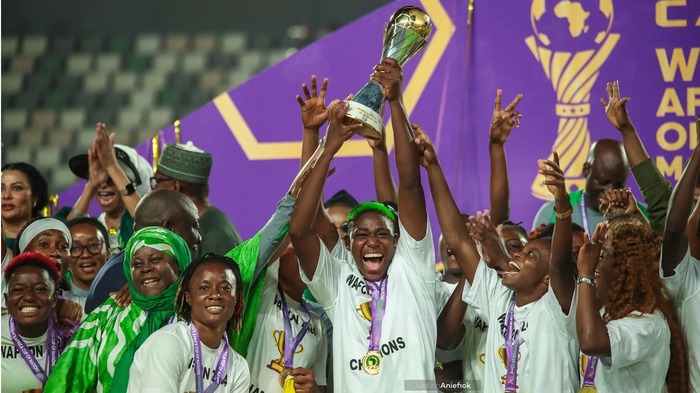
Nigerians across the country have been celebrating the dramatic victory of the Super Falcons in Morocco on Sunday. For their consistent victories in 10 of the 14 continental championships, the team is undoubtedly the most successful football team in Africa. President Tinubu did well by rewarding the Falcons and the technical crew with huge cash and apartment gifts, as well as bestowing the national honour of OON on them. But in the midst of these celebrations and a brief moment of national pride, has it occurred to Nigerians that the Falcons team members are mostly from a few states of the federation in just about two geopolitical zones—the South East and South West? There may be a sprinkle of players from the South-South, but the whole of the northern parts of the country is unrepresented in the women’s team and sparingly represented in the men’s team.
Why are the Super Falcons and Super Eagles players not selected from every part of the country, and why are Northerners not protesting against this apparent marginalisation? Why have people like Senator Ali Ndume and former presidential adviser Hakeem Baba-Ahmed, who are always speaking out against any act of marginalisation or injustice against the North, been silent about this unfair treatment of the people of Northern Nigeria? Why is the Federal Character Commission (FCC), the federal agency responsible for fairness, justice, and equity in public service employment, quiet about the apparent lopsided lineup of the Super Falcons and the Super Eagles? Is the North not part of Nigeria? It’s because the nation has come to a rare consensus that in sports, competence and talent should trump diversity.
Take a look at the lineup of the Super Falcons.
Goalkeepers:

Chiamaka Nnadozie currently plays for Paris FC; Tochukwu Oluehi currently plays for Eastern Flames in Saudi Arabia; and Linda Jiwuaku is a young goalkeeper who earned her first senior national team call-up at 17. Among the defenders are Osinachi Ohale, who plays for Pachuca in Mexico; Oluwatosin Demehin, who plays for Stade de Reims in France; Michelle Alozie, who plays for Houston Dash in the US; Ashleigh Plumptre, who plays for Al-Ittihad Ladies in Saudi Arabia; and Akudo Ogbonna, who plays for Remo Stars Ladies.
Read also: Tinubu honours Super Falcons with national awards, $100,000 each, houses
The midfielders include Deborah Abiodun, who plays for the University of Pittsburgh in the US; Halimatu Ayinde (FC Rosengard in Sweden); Christy Ucheibe (SL Benfica in Portugal); Jennifer Echegini (Juventus Ladies in Italy); Rasheedat Ajibade (Atletico Madrid in Spain); and Toni Payne, who plays for Sevilla FC in Spain. Our strikers are also talented players who play for reputable international clubs. They are Asisat Oshoala (Bay FC in the US, six-time African Player of the Year); Esther Okoronkwo (Henan FC in China); Uchenna Kanu (Racing Louisville in the US); Gift Monday (Costa Adeje Tenerife Egatesa in Spain); Ifeoma Onumonu (Utah Royals in the US); Chinwendu Ihezuo (Pachuca in Mexico); Chinonyerem Macleans (Lokomotiv Moscow in Russia); and Rinsola Babajide, who plays for Roma in Italy.
Our football administrators are aware that Nigeria can only continue to dominate Africa in women’s soccer if they focus only on hiring talented and skilful players, even if they’re from one village. Put differently, the sole criteria for inclusion in the team are excellence and competence; there’s no room for quotas, slots, and federal character. I am sure that there are many young girls in the North who have been inspired by the Falcons and would want to play football, but they are held back by religious and cultural factors. This is why the Falcons are made up of young girls from areas where such factors do not exist.
But if the Super Falcons are so successful because they were selected solely on competence, skills, and talents, why can’t we adopt these criteria in all aspects of our national life? Why don’t we just insist that only the best, most talented, and most competent persons should work in the public service? Even where it’s absolutely necessary that we have federal character, why don’t we insist that only the best should come forward to take up available positions? Of what benefit is a government if the officials are employed from different parts of the country, but they end up delivering a weakening economy, mounting foreign debts, and insecurity? What if we have a federal cabinet, for example, made up of only 20 ministers selected from 15 states, but it is capable of delivering over 10% yearly economic growth, job creation, and decline in crime rates? Will that be acceptable to Nigerians?

The private sector has long realised that diversity does not necessarily deliver set goals. Successful businesses place a premium on the talent and skills of their employees rather than where they come from. Every high-performing business organisation has what is known as a ’talent pool’’ made up of the most talented and competent members of staff. They are selected based on set criteria like leadership qualities and contributions to the commercial and non-commercial objectives of the company. Ethnicity and state of origin are not part of the criteria. It’s from the talent pool that the top leadership of the company is selected whenever there’s a vacancy up there.
Similarly, to join either the Super Falcons or Super Eagles, the coaching and technical crews consider the player’s technical skills, tactical awareness, physical attributes, mental toughness, teamwork and communication, adaptability, discipline and work ethic, experience, attitude and behaviour, injury history, and potential for growth. There is no room for ethnicity, tribes, and religion. But to join the public service in Nigeria, the first consideration is the candidate’s ethnic group, state of origin, religion, and relationship or affiliation with an influential politician, emir, Oba, or Obi. The candidate’s skill set, competence, talents, aptitude, and attitude are not important, and this partly explains why the service has difficulties in delivering on set goals.
Etim, a retired banker, is the publisher and editor-in-chief of Policy and Politics.