The narrative on nation building and the Nigerian media are two inseparable parts of any national dialogue.
For journalism scholars, practicing journalists and the media industry as a whole, the task of nation building is a national call that demands urgency.
First, in the pre-colonial era where the media was a vanguard in the struggle for independence.
Then came the post-colonial era where the media again became the vanguard in the struggle for democracy, especially the fight against military intervention in the country’s democratic processes.

The battles for independence and military intervention in democracy were fought vigorously by the progressives, with the media as a viable partner-in-crime.
However, the struggle for nation-building and good governance is an ongoing conversation that regularly calls media professionals to task.
It was on the back of this that the Nigerian Guild of Editors (NGE), spotlighted the challenging roles of the media in bridging Nigeria’s current socio-ethnic diversities.
The NGE in celebrating one of Nigeria’s foremost journalists, considered the title: ‘Journalism and the Challenge of Nation-Building in a Multi-Ethnic Society.’
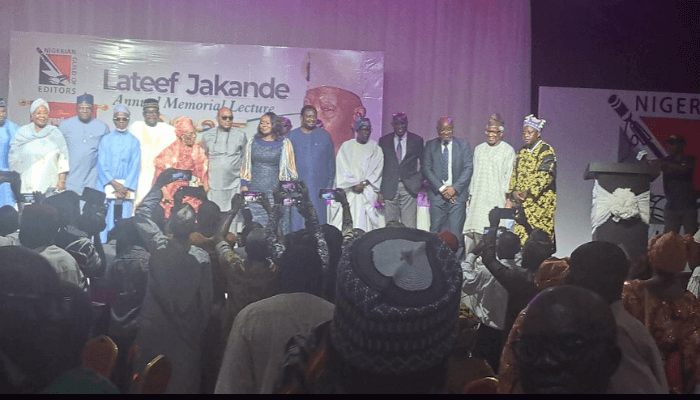
For the Guild, it was a moment to gather media professionals – men (though we say there is no woman in the newsroom); the conversation was for journalists and other professionals in the media industry critique the role of the media in nation-building, especially in a multi-ethnic society like Nigeria on the back of the roles played by Lateef Jakande, the first executive governor of Lagos.

The annual Lateef Jakande Memorial Lecture now in its 3rd edition had no better keynote speaker than Bala Abdulkadir Mohammed, the current governor of Bauchi State – himself a one-time journalist like the late former governor of Lagos.
Mohammed, who was represented by Aminu Gamawa, chief of staff, Bauchi State governor, started his conversation with a quote by Chuba Okadigbo, a former Senate president thus: “If you are emotionally attached to your tribe, religion, or political leanings to the point that Truth and Justice become secondary considerations, your education is useless. Your exposure is useless. If you cannot reason beyond petty sentiments, you are a liability to mankind.”
According to Mohammed, the lecture is not just an avenue to honour Jakande — journalist, public servant, and patriot. But, to renew a purpose: the purpose of journalism in the service of nation-building, especially in light of the richly diverse but often divided Nigerian society.
The immortal power of the press
According to Mohammed, the history of Nigeria is in many ways the history of its journalism. This is because long before Nigeria gained her independence, the media laid the foundation for the country’s freedom from colonialism.
He argued that men like Herbert Macaulay, Nnamdi Azikiwe, and Anthony Enahoro did not just write editorials — they stirred national consciousness. According to him, Azikiwe’s West African Pilot bore the profound motto: ‘Show the light and the people will find the way.’
“Others followed: Bisi Onabanjo, Sa’adu Zungur, Bob Ogbuagu, Mokwugo Okoye — names that should not merely be remembered, but taught in every school of journalism. These were journalists who became leaders, not by switching careers, but by extending their service from the newsroom to the nation.
“Indeed, there is hardly any profession better suited to train future public servants than journalism. For the journalist is trained to listen, to investigate, to challenge power, and above all — to serve the public interest,” Mohammed argued.
Speaking directly to the role journalism can play in good governance; Mohammed said that Jakande’s journalistic values became governance values: simplicity, honesty, accessibility, and efficiency. According to him, Jakande governed with the pen still in his heart, even if not in his hand.
Journalism under fire: Then and now
According to Mohammed, journalism will always be under fire as the 4th estate of the realm. This is so because the Nigerian press has endured and resisted oppression in many forms. “Under colonialism, it fought for independence. Under military rule, it fought for democracy. Under both, it paid dearly.”
However, the Bauchi State governor believed the threats the media faced today are different but no less insidious. According to him, the digital age has opened the floodgates of information — and misinformation. He opined that social media has democratized speech but also diluted truth. While artificial intelligence (AI) now creates headlines without appropriate checks.
“We must never forget the dark years when newspapers were proscribed, and journalists detained. African Concord (1992), Champion Newspapers and Vanguard (1990), The Guardian (1994), and The Sunday Magazine (1995) — all silenced temporarily, but never conquered. It was a time when pens were confiscated, but not courage. A time when truth was a dangerous act — but it was acted upon, nonetheless.
“And then, there is the corrosive influence of big money. Politicians, corporations, and special interests now compete to own narratives, not just policies. Editorial independence is constantly under siege, and the temptation to trade truth for access is greater than ever,” Mohammed said.
Journalism’s role in nation-building
Journalists occupy a critical space in the society even though their office does not come with tenure like the elected politicians; yet media professionals have a constitutional role of serving and acting as watchdogs. “Let me be clear: journalism is not just about reporting events. It is about shaping the nation’s soul.
“In a multi-ethnic society like ours, where language, religion, and geography too often define identity, the media must help create national consciousness — a consciousness that values justice, merit, and shared destiny.
“We must not merely be a federation of ethnicities. We must be a nation of citizens. This requires cultivating national ethos: values that transcend our differences. Respect for life. Rule of law. Dignity of labour. Truth over tribe,” Mohammed said.
In concluding his thoughts on the role of the media in nation-building, Mohammed offered five possibly propositions, which are:
Defend the Rule of Law: The moment a society begins to ignore judicial decisions; it is on the path to lawlessness. No nation can survive selective justice. The media must call out every instance where court orders are flouted — not because of who is involved, but because of what is at stake: the soul of the republic. And when conflict brews, let dialogue — not denial — be our first response.
Demand Credible Leadership: Journalists must question every candidate, scrutinise every promise, and highlight integrity over popularity. Elections should be contests of ideas, not identities. Leadership must never be reduced to entitlement.
Champion National Reconciliation: Nigeria must confront its past. We can no longer sweep historic grievances under the rug. A Truth and Reconciliation Summit, led in part by the media, could help heal our wounds.
Promote Civic Education and Language Inclusion: Encourage — not mandate — the learning of Nigerian languages outside one’s own. Understanding each other is the first step to loving each other.
Begin With Housekeeping: The media must fix its own broken windows. Exploiting interns, hoarding opportunities, turning a blind eye to corruption within — these must stop. The pen must remain clean to remain powerful.
Paper discussion
In the discussion of the keynote presentation by Bala Mohammed, some leaders of the profession including Femi Adesina challenged media professionals to promote and live by the ethos of the profession, especially on the back of the celebrant’s dedication and selfless service, first as a journalist and later as the first executive governor of Lagos State.
Emeka Izeze, former managing director/editor-in-chief, The Guardian, called for objective reportage, while reiterating that government cannot function effectively without journalism.
He challenged the media to always play its role as the nation’s watchdog and conscience without compromise.
Izeze noted that the media was becoming too close to the institutions and public office holders whose feet were supposed to be held to fire, adding that such undue relationship may have resulted in lowering of standards.
Joseph Adeyeye, managing director/editor-in-chief, The Punch, said media role in nation-building was not recognised enough. Hence, he advocated for a strong, independent and free media
Adeyeye also called for the training and retraining of leaders within the media industry.
Funke Egbemode, former president, NGE, also called for training within the larger media industry, saying that journalists must deepen in-house training.
Eze Anaba, 17th president of the NGE, earlier in his welcome address, said the Guild would continue to celebrate Jakande and the things he stood for in the journalism profession.
According to him, the lecture is part of a broader national dialogue on how journalists can contribute meaningfully to building an inclusive and cohesive society.
“As journalists you represent a unique and strategic position. We have the power to influence narratives, shape opinions, and promote national values,” Anaba said.
Sinatu Aderoju Ojikutu, former deputy governor of Lagos State from 1992 to 1993, in a goodwill message said journalists are very cerebral. “Today is very spirit-lifting for me. That I’m in the midst of people that I read; that makes my days.”
She also disclosed that her tenure of working with Jakande was more fulfilling than her tenure as the deputy governor of Lagos State.
“What people cannot do for eight years, Baba made it possible in four years.”
According to her, journalists are expected to speak truth to power, and charged Bayo Onanuga, the presidential spokesman, to inform the president about the things happening across the country, and not what the president would want to hear.