The Islamic Development Bank (IDB) has begun work on its first-ever Country Engagement Framework for Nigeria’s power sector, marking a significant shift in how the lender plans to support the country.
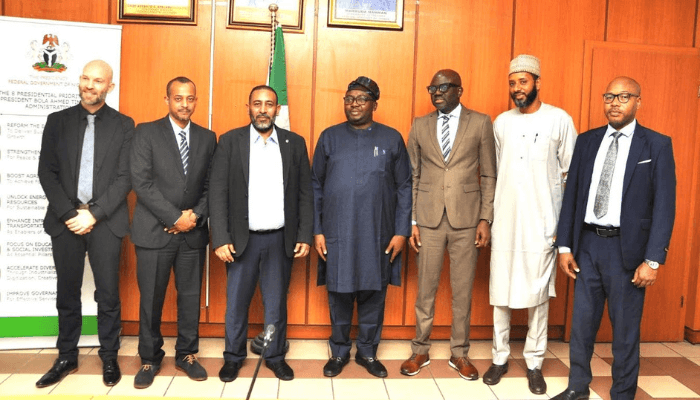
This was revealed on Wednesday during a courtesy visit by officials of the Jeddah-based multilateral institution to Adebayo Adelabu, the minister of power.
The framework, once completed, will guide the bank’s long-term support to Nigeria’s energy transition and infrastructure development, shifting from a project-based to a program-based intervention strategy.
Speaking during the visit, Alagi Gaye, who led the IDB delegation, said the institution is looking to deepen its investment in Nigeria’s power infrastructure.
While the bank currently holds a $2 billion portfolio across several sectors, including transport and education, Gaye emphasised that the new framework will align with Nigeria’s sectoral policies and regulatory landscape, particularly in power, where access gaps remain a problem.

Read also: Nigeria’s power sector under threat, as vandals feast on infrastructure
Adelabu welcomed the development, noting that Nigeria’s power sector remains in dire need of investment and reform.
He stated that improving the power supply is a key priority for President Bola Tinubu’s administration.
The minister also highlighted the Electricity Act of 2023 as a key enabler of liberalisation in the sector and pointed to ongoing initiatives like the Presidential Power Initiative (PPI), a $2.3 billion agreement with Siemens Energy to overhaul the national grid.
He added that the pilot phase, which saw the delivery of 10 transformers and 10 mobile substations, has already contributed to improved grid stability.

Adelabu also mentioned the planned “Super Grid” project aimed at addressing redundancy and wheeling capacity issues, with support already secured from the World Bank and the African Development Bank.
On distribution challenges, the minister acknowledged persistent inefficiencies despite privatisation.
He said the federal government, which retains a 40 percent stake in DisCos, is actively seeking strategic partnerships to improve operations and bridge Nigeria’s huge metering gap. Only six million meters have been deployed out of the 13 million registered users.
Read also: Nigeria’s power crisis deepens as Geregu, Transcorp gas debts hit N216bn
To address this, the government has launched the Presidential Metering Initiative (PMI), which targets the importation of two million meters annually over the next five years.
Adelabu also briefed the delegation on the “Mission 300” programme, which focuses on deploying mini-grids and solar home systems to electrify remote communities. He noted that while the push for renewables aligns with climate goals, Nigeria’s focus is driven more by practical needs than emission targets, given Africa’s minimal global carbon footprint.
He welcomed the IDB’s interest and urged the bank to review feasibility studies for proposed projects, describing the institution as a credible partner in transforming Nigeria’s power sector.