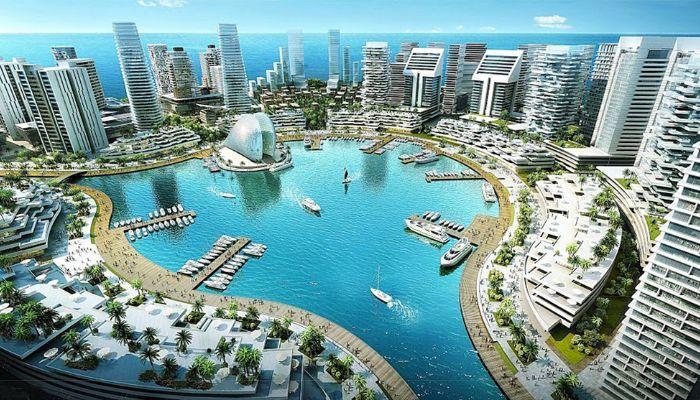
Eko Atlantic City, described as the most ambitious city in Nigeria so far, is a massive urban development sitting on reclaimed land from the Atlantic Ocean, adjacent to Victoria Island in Lagos.
The city is designed to be a self-sufficient and sustainable city, with ambitious goals for population, jobs, and economic impact. Eko Atlantic is a high-end destination with high-end infrastructure, targeting big-ticket investors and high net-worth residents.
The city presents exciting numbers that speak more to its investment potential than residential opportunities. The entire development, which stretches 10 square kilometres with an 8.5-km long sea wall to protect it from the Atlantic Ocean, is projected to house, at least, 250,000 residents with about 150,000 others commuting to it daily.
The city is also expected to generate over 400,000 jobs and contribute significantly to the Nigerian GDP, with estimates reaching $1billion.

However, despite significant progress, development has been slower than initially anticipated, with high land costs and a perception of exclusivity impacting its growth. This, perhaps, explains why 6.5 million square meters of land have been reclaimed so far and the sea wall stands at 6.8 km out of a total planned length of 8.5 km.
Read also: Investors’ guide to tapping Nigeria’s tax credits
The city boasts the best of basic infrastructure, including utility connections and access to two large marinas that have been put in place. Its transportation systems are aimed to support its large-size population. The city will have its dedicated road network, as well as a light rail system that connects the different neighbourhoods. The transportation system is designed to reduce traffic congestion and promote sustainable mobility.
The city, patterned after Manhattan in New York City, is expected to become Nigeria’s most sought-after destination for its high-end infrastructure, prestige and well-planned layout as reflected in an eight-lane boulevard, 13 internal bridges, underground cables, and green footprints defined by over 200,000 trees.
The city’s water treatment capacity is in 2 phases with a capacity of 60,000 square metres per day, and a planned capacity of 100,000 square metres per day for all phases.

In recent time, investor interest has increased significantly in the city with private developers, institutions, including banks, oil and gas, and telecom companies are flocking to the city, taking position, and constructing high-rise residential and commercial buildings.
This, according to a new report on ‘The State of Lagos Real Estate Market’, is the reason land prices in the city have gone up from N180 million in 2000s when it was launched to N2 billion per plot.
The report, launched recently by the Roland Igbinoba Real Foundation for Housing and Urban Development (RIRFHUD), notes however that the land price increases in the city is a reflection of the general land market trend in Lagos.
“This evolution is most vividly illustrated by the consistent and often exponential appreciation of land prices,” Roland Igbinoba, RIRFHUD’s President, explained, citing Ibeju-Lekki, where a plot was available for as low as N500,000-N1.5 million in 2013, before major development hubs like the Lekki Free Trade Zone began.
Read also: Coronation platform repositions investors as decision makers
He added that land value surged to between N5 million and N10 million by 2018 as significant infrastructure projects commenced and, by the first quarter of 2025, the same land commanded prices between N25 million and N40 million, representing a potential 40-fold increase in value over a decade.
Similarly, plots of land in Lekki Phase 1, which were priced at N10 million – N15 million in 2005, are now valued at over N400 million – N500 million, while land prices in Eko Atlantic, which stood at N180 million per plot in the early 2000s, have also escalated to over N2 billion today.