|
Getting your Trinity Audio player ready...
|
…Says “90% of Nigeria’s forest depleted”
…Netzence contributing technology to unlock 2 billion dollars of nation’s forest — Sani
Vice President Kashim Shettima, on Monday, lamented Nigeria’s inability to develop its forest resources, warning of dire economic consequences, unless urgent steps are taken to arrest the decline.
The vice president, while comparing Nigeria with other countries’ gains on global opportunities, said the country risks missing out if it fails to act decisively.

He added that a look at “Vietnam shows it earn over $15 billion yearly from forest exports. Brazil’s Amazon contributes 15% of their GDP from forests alone. Ethiopia has generated 350,000 jobs through reforestation and value chains. Nigeria should not only replicate these successes but lead Africa’s forest industrialisation.”
This is as Sadiq Sani, the Founder/CEO of Netzence sustainability limited (Netzence), gave the country an assurance that it would be using technology to unlock the over two billion dollars of potentials in the forest sector.
Read also: Nigeria loses $2bn to agroforestry neglect
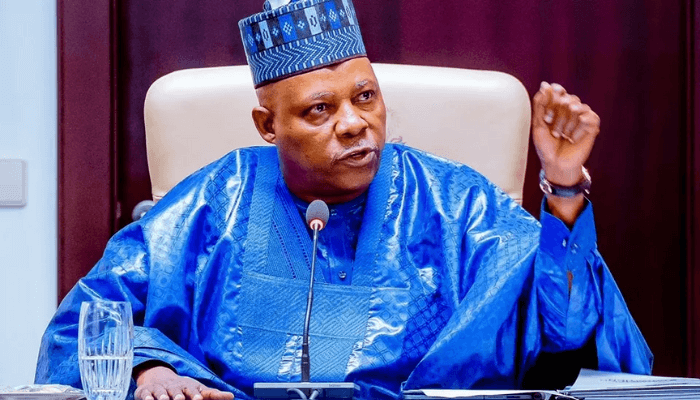
Shettima gave the warning while declaring open the Nigeria Forest Economy Summit 2025 with the theme: “Sustainability of Nigeria’s Forests: Unlocking the $2 billion potentials for economic and financial inclusion” at the Presidential Villa, Abuja.
According to him, “more than 90% of Nigeria’s original forest cover has been depleted, and over 400,000 hectares lost annually. This is not just an environmental crisis; it is an economic emergency.”

Shettima, who was represented by Ibrahim Hadejia, applauded the summit organised by the Presidential Committee on Economic and Financial Inclusion(PreCEFI) Secretariat, charging organisers on the need to explore ways to address the challenge.
He stressed that the country is at a crossroads and that neglecting forest resources directly impoverishes the nation and its people
“We cannot underestimate the importance of our forests. They are a treasure trove of biodiversity, timber, medicinal plants, and other valuable products that underpin agriculture, trade, health, climate resilience, and finance. Yet this vast potential remains largely untapped.
“Ignoring this challenge is not an option. Our forests’ depletion threatens economic stability, livelihoods, and our global trading position. The European Union’s upcoming regulations forbid imports from products sourced on lands deforested within five years.
“Nigeria risks losing access if we do not embrace sustainable forest management now”, he noted.
Shettima called for innovation and inclusion, saying, “Embedding financial services in forest-based livelihoods will improve credit access, savings, insurance, and digital tools — crucial for the 30 million Nigerians who remain financially excluded, especially women and girls.”
He envisioned a future where “eco-industrial parks dedicated to bamboo, shea butter, medicinal plants, and carbon verification emerge as economic pillars,” further urging, “Let us turn trees into trillions and forests into futures. This summit must be remembered not as just another policy dialogue, but as a turning point where we invest, innovate, and industrialize our forest economy for sustainable national progress.”
Sadiq Sani, Founder/CEO of Netzence, disclosed that his company is contributing to providing technology to unlock over two billion dollars from the nation’s forestry.
According to him, “Netzence is contributing to providing the technology needed to unlock the potential of our $2 billion for Nigerian forestry. Our goal is to provide technology that allows us to measure emissions—the greenhouse gases (GHG) in our environment—and see how we can realise carbon credits for the environment as well. That is our fundamental aim through our proprietary technology CloseCarbon.”
On how to achieve it, Sani said: “We are using our technology built for the forestry environment. We’re currently building models regarding forest composition and decomposition.
“This lets us understand emissions and greenhouse gas levels in the forestry environment, and also the amount of carbon credit it can realize. We are combining our technologies to build models that give us a true picture of emissions and their value in that environment.”
Fielding question on whether there is any form of partnership between Netzence sustainability limited and the Federal Government, the CEO, who is also one of the panelists at the summit said, “Absolutely, we are currently working with the Federal Government across the presidency and several ministries, like Federal Ministry of Livestock Development and Ministry of Environment, plus agencies under Ministry of Environment etc.
“Together, we analyse the composition of greenhouse gases and monetise carbon credits in these environments.”
He further said: “It’s not just about the environment—the impact is economic, societal, for the people and in knowledge. We can’t do this without the support of government and stakeholders across economic sectors.”
Read also: Army, forest guards vow to flush out criminal gangs in Kwara
Technical Advisor to the President on Economic and Financial Inclusion and Secretary of the Presidential Committee on Economic and Financial Inclusion (PRICIFI), Nurudeen Zauro, gave an insight on the broader government vision.
He said, “One part of Mr. President’s agenda is inclusivity. PRICIFI’s duty is to identify untapped opportunities—areas that have been silent—and unlock them so we can achieve this goal.
“The essence of this meeting is to unlock economic potentials that exist in our borders. That’s why we brought together the ecosystem, the Border Community Development Agency, WEN Synergy, and local and international stakeholders—to expose the potential of our forests for sustainable economic and financial inclusion, in line with Mr. President’s renewed economic agenda.”
George Kelly, Executive Secretary of the Border Communities Development Agency, revealed that “Nigeria has over 10.6 million hectares of forest—natural, planted, and reserves. We’re looking to convert that to wealth rather than let it go to waste, through carbon financing.
“The potential is more than $2 billion annually. Properly managed, it could approach $5.3 to $10.5 billion, even up to $6 billion annually. That kind of revenue can fund several states. If we unlock that, we’ll achieve meaningful economic and financial inclusion at the rural and sub-national levels, lifting communities out of poverty. That is what we are aiming for.
“The next step is to bring together all government agencies related to forestry to get more precise data and take action on this opportunity.”Chairman of Wen Synergies Nigeria Limited and fellow of the Nigerian Institute of Architects, Danny Sokari, emphasised the purpose of the summit:
He said: “The awareness about how to generate that $2 billion is not yet there—not visibly. Maybe the current approach to the green agenda needs adjusting”.