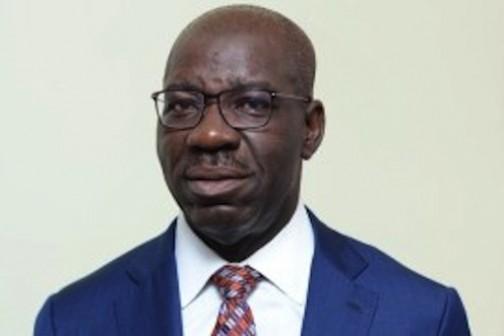
On November 12, 2016, the day he formally took over the mantle of Edo State leadership from Adams Oshiomhole following his victory at the September 28 gubernatorial poll, Godwin Obaseki of the All Progressives Congress (APC) promised to fulfil all promises made while campaigning for the position.
Indeed, while he traversed the 192 wards in the 18 local government areas of the state canvassing for votes from the over 1.9 million eligible voters, Obaseki made many mouth-watering promises, drawing joyful cheers from citizens who saw in him a man of the people who would wipe away their tears.
But in what many have termed “backtracking”, Governor Obaseki, barely a week after he took office, announced that he was taking stock and reviewing his electoral promises to see whether the resources available would be enough to meet them.
“I want to use this opportunity to inform you that since we took over government last week, what we are trying to do is stock-taking to understand how things are in the Government House, to understand what is going on in each ministry, to review the promises we made during our election and to see whether the resources we have are enough to meet those promises,” he said during a meeting with the state APC leadership and executive members in Benin, the state capital.
In order to put issues in proper perspective, BDSUNDAY has rummaged through the governor’s campaign speeches, social media comments, personal manifesto, inaugural speech and comments he made on his first day on the job to extract some of these promises.
The 37 promises
(1) Construct thousands of kilometres of roads into rural communities and farms. He said this in his campaign inauguration speech.
(2) In his manifesto tagged “Achieving Economic Prosperity for Edo State”, Obaseki promised to create over 200,000 new jobs in four years.
(3) “Within the first year in office, we will restructure and resolve all outstanding debt obligations with Bendel Brewery, Edo Line and any other State-Owned Enterprise”.
(4) “We will attract private capital into all State-Owned Enterprises under privatization”.
(5) “We will conclude ongoing efforts to complete and commission industries initiated by the PDP government but abandoned before commissioning including Uromi Cassava Factory and Fertilizer Factory in Auchi”.
(6) “We will extend road networks to connect new areas not previously linked with the road infrastructure grid to facilitate the movement of people and produce to markets”.
(7) “We will identify the most disadvantaged neighbourhoods in the state and those at the greatest risk of flooding and channel resources into building necessary infrastructure to cater for their needs”.
(8) “We will determine the most accident-prone areas and provide adequate safety and traffic management solutions”.
(9) “In pursuit of our collective desire to develop a competitive knowledge economy, we will introduce the development of broadband infrastructure into our road infrastructure and transportation network”.
(10) “We will redevelop the Ikpoba River valley projects not only to generate electricity but also as a source of water supply for industrial and domestic user”.
(11) “We will provide the enabling environment for women to achieve their highest potential by taking our initiative beyond the phase of empowering women to empowering society as a whole through the women-in-business”.
(12) “We will invest in our eight technical vocational education and training institutions”.
(13) “We will create direct jobs for our youth through skills in engineering, building technology, agriculture, food sciences, and hospitality under entrepreneurship schemes or industry employment”.
(14) “We will support at least 20,000 entrepreneurs over the next four years to stimulate the economy through Micro, Small and Medium Enterprises (MSMEs) development creating no less than 50,000 additional jobs”.
(15) “Healthcare infrastructure will receive a boost by focusing government financing at the Primary Health Care level across the state and, where there is the business case, a mix of public and private capital at the tertiary levels”.
(16) “Visual and dental health will be integrated into the healthcare policy and master plan”.
(17) “We will complete the renovation of school infrastructure already commenced”.
(18) “We will introduce a continuous maintenance culture to ensure the sustainability of the education infrastructure”.
(19) “We will turn the Civil Service into a world-class work environment powered by information and communication Technology (ICT)”.
(20) “Taxation is a major source of government revenue but we will ensure a pocket-friendly tax regime in our drive for Internally Generated Revenues (IGR)”.
(21) “We will strengthen the Criminal Justice System to expedite the interpretation of laws, determination of disputes, restitution for victims and punishment of offenders”.
(22) “We will re-introduce mobile and assize courts to expedite dispensation of justice”.
(23) “We will reduce the strain on our courts of superior record”.
(24) “We will support the police and other state-sponsored agents in various capacities including the infrastructure that supports them in the work they do”.
(25) “We will restore Edo State as the Number One state in sports in Nigeria, especially in football where we once held sway as a talent ground”.
(26) “We will publish a template to be jointly used by the public and the civil society to track the achievement of this objective”.
(27) “We will give loans to SME at single digit interest rates”.
(28) “We will build a more virile and mobile business and learning environment”.
(29) During the campaign in Ekpoma on August 3, 2016, Obaseki promised to re-introduce scholarship and payment of bursary in all state-owned higher institutions.
(30) He pledged to collaborate with the new investor who acquired the Ewu Flour Mill to boost the economy.
(31) “We will reduce the cost of governance”.
(32) “We will not sack workers”.
(33) “Many Edo people will generate wealth by keying into our value chain development of oil palm, cassava, cocoa, grains, rubber, fruits and vegetables”.
(34) “We will create over 150,000 jobs within the next four years under a farm ownership and management model or out-growers’ scheme”.
(35) In his acceptance speech, he promised to work tirelessly to transform the state.
(36) “We build a state which will be anchored on a productive economy that will transform and empower our citizens to the best level”.
(37) He promised that his administration would strive to deliver on all the promises.
Promises under review
With these promises now under review, Edo residents are raising questions on whether Governor Obaseki’s predecessor, who ensured his victory at both the primary and main elections, did not inform the new governor about the true financial position of the state when he was making the promises. Some, however, say it is not surprising that Obaseki would undertake to review his electoral promises, arguing that the governor may have inherited more liabilities than assets.
A concerned Edo citizen, who pleaded anonymity, said: “When you are blindfolded, you cannot see anything. Godwin Obaseki was blindfolded by his ambition to become governor that he chose not to see what was glaring to everyone – that the state has been raped and left desolate.”
“The allure of power was so strong, otherwise Obaseki would have seen through the shenanigans that were shown to him as the true picture of things about Edo State. I have no sorry to tell him. I am only sorry for the masses of the state who are in it again,” said a member of the opposition PDP.
For Adesuwa Glory, a female student of the College of Education, Ekiadolor, Okaka, near Benin City, the governor’s decision to review his electoral promises after assuming office was ill-advised as it has created the perception that the new government has started on the wrong footing. She argued that the governor was an integral part of the Adams Oshiomhole administration and thus was privy to relevant information on the state’s finances.
She further said students of the state-owned higher institutions and their parents are eagerly waiting for the governor’s promise to pay bursary to students in all state-owned higher institutions and the promise to create 200,000 jobs in his first term in office.
“Oshiomhole was on the stage with him when he was making all the promises, so why the sudden review? If Oshiomhole could not stop him from making the promises because there is no money, then they knew what they were saying to the people of Edo State,” she said.
“The current position to review all the promises betrays the governor and the APC leaders as agents of deception who deceived the people by making unrealistic promises to them,” she added.
But Obasuyi Imuentiyan, a staunch supporter of Obaseki, told BDSUNDAY that reviewing of electoral promises after assumption of office was now a global phenomenon by politicians. He cited the example of United States President-Elect, Donald Trump, who has dropped some of his policies considered controversial by a section of American public even while he is yet to take oath of office.
According to Imuentiyan, it was possible that Adams Oshiomhole, who handed over to Godwin Obaseki, may not have told the new governor the entire truth regarding the state’s finances for political reasons, adding that if the ongoing review was in the interest of the state, the electorates should be carried along.
“Donald Trump said he would investigate Hillary Clinton if elected president, but you and I know his new position on the matter. There are other promises he made during campaign which he has backed down from,” he said.
“If Obaseki gets to office and finds that what is on ground does not match his projection, he is free to review; that is not to say he is cancelling promises. Review would help him to prioritise. As far as I am concerned, he has not done anything wrong by saying he is reviewing electoral promises. It is better to review and perform than to pretend all is well,” he said.
Committed to fulfilling promises
John Mayaki, Governor Obaseki’s chief press secretary, told BDSUNDAY that the review of electoral promises by the governor was mainly to refresh himself with all promises made and better position his government to intelligently utilise available resources, adding that Governor Obaseki has already mandated some people to search for all the promises made during campaign in the 18 local governments.
“By saying he needed to review electoral promises, it is to get people who can help fulfil them into government. The governor is ready to fulfil all the promises he made to the people of Edo State. He is not cancelling any of them. He will create jobs as he promised, and other promises. He will not renege on his promises. He just needs time to settle down, know what is available, where to appoint people, and reorganise the system to meet the present challenges,” Mayaki said.
“By January, appointments would be made, but for now he needs time to settle down and clean up a lot of issues. Governor Obaseki has asked somebody to put down everything he said while campaigning for office in each of the wards and local governments so that he can match them with the budget. That is what he meant by reviewing electoral promises,” he said.
IDRIS UMAR MOMOH & NATHANIEL AKHIGBE