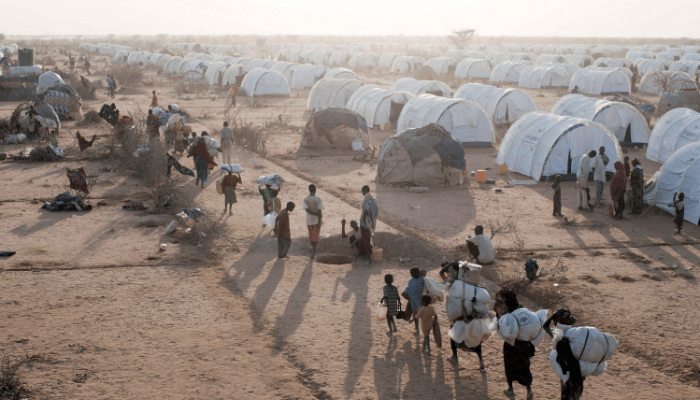
Hundreds of Nigerians who fled escalating violence and insecurity at home are now living in the Niamey city’s largest public cemetery, in the Republic, a stark symbol of the deepening humanitarian crisis Nigeria is confronted with.
The displaced families, largely from Katsina, Zamfara and Borno states, say they were driven to the graveyard after repeated evictions from informal settlements and growing hostility from nearby communities. With no access to formal shelters, they have pitched makeshift living spaces among tombstones, battling hunger, exposure to extreme weather and severe psychological distress.
Many of the refugees described their plight as one of neglect and social exclusion, saying they feel unwanted and abandoned.
A recent report by Germany’s international broadcaster, Deutsche Welle (DW), monitored by BusinessDay, Tuesday, revealed that the graveyard became their final refuge after security operatives forced them out of urban areas across Niamey.

Read also: Over 21,800 unregistered refugees, asylum seekers stranded in Nigeria — UN
“We are truly in need of help because our families are in serious crisis,” said Shamsuddeen Maman, one of the displaced persons. “Whenever we try to enter towns, we are chased away. Since the graveyard belongs to no one, we can stay here. The only relief we get is when a stranger decides to pity us.”
Conditions in the cemetery are harsh. Most families sleep in the open, with no shelter from cold nights or extreme heat, and little access to food or clean water. Fatima Sani, who fled persistent bandit attacks in Katsina State, said children are bearing the brunt of the suffering.
“The police threw us out of our earlier settlement,” she said. “We need urgent help, especially for our children who are sleeping outside in this weather.”
The displacement has also been accompanied by violence. Na’ima Abubakar recounted an attack on a previous camp where makeshift shelters were destroyed, and food supplies provided by the International Committee of the Red Cross (ICRC) were burned.

“The place was set on fire; we were beaten and chased away,” she said. “Some children were burned in the attack. All the food we received from the Red Cross was reduced to ashes. We are appealing to the Nigerian Ambassador to Niger to rescue us. Returning home to a safe environment would be the best solution.”
Beyond immediate survival concerns, the crisis is eroding hopes for the future, particularly among children and young people. Yusuf Ibrahim, a displaced youth, said his dream of education has been crushed.
“I really wanted to go to school,” he said softly. “Now we cannot even feed ourselves. I am just hungry.”
Among those sheltering in the cemetery are survivors of Nigeria’s decade-long Boko Haram insurgency. Fatima Hassan, from Chibok in Borno State, said she fled to Niamey after losing her husband and parents to the conflict.
Read also: Otu decries worsening influx of refugees into Cross River
The situation has also stirred frustration over the historically close ties between Nigeria and Niger. Zaharadden Lawan Yusuf lamented what he described as a loss of dignity for Nigerians living abroad.
“We have become unwanted people,” he said. “Everyone knows Niger and Nigeria are like brothers, but that brotherhood is not reflected in our reality today.”
Addressing allegations by some locals that the refugees are involved in petty crime, Abubakar Ali rejected the claims, calling them unfair and stigmatising.
“It is not true that we steal,” he said. “A few bad elements take advantage of our desperation, and then everyone blames us.”
The displaced Nigerians are now appealing to the Nigerian Ministry of Foreign Affairs, the Nigerian Embassy in Niger, and international humanitarian agencies for urgent intervention, either through immediate life-saving assistance or support for a safe and dignified return home.