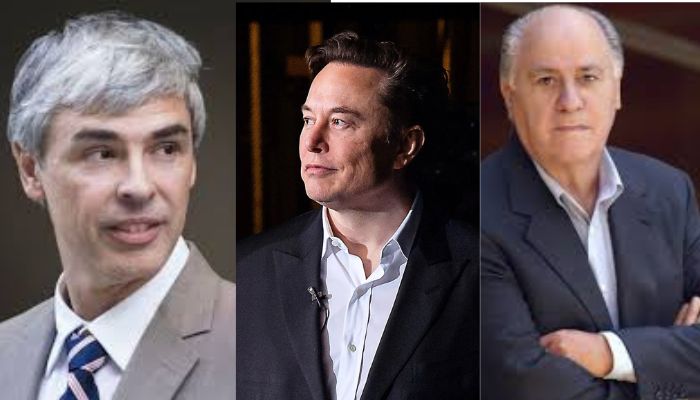
The surge in global billionaire wealth has accelerated dramatically since 2020, reshaping the rankings at the very top. Elon Musk now stands as the world’s richest individual, with an estimated net worth of $714 billion, largely driven by his $366 billion stake in SpaceX, which is valued at about $800 billion.
Another standout is Nvidia CEO Jensen Huang, whose fortune has climbed from $4.7 billion in 2020 to $162.5 billion, placing him among the world’s wealthiest individuals.
The pace of this growth highlights how technology and innovation have rapidly created unprecedented wealth. In 2020, Jeff Bezos led the global rankings with $145 billion, a figure that now appears modest compared to today’s soaring fortunes.
According to Forbes, these are the world’s top 10 billionaires in 2026

Elon Musk
Elon Musk remains the wealthiest person on the planet, with his fortune skyrocketing primarily due to the massive valuation of SpaceX and the continued expansion of Starlink’s global satellite internet. His net worth reached a historic high of $714.2 billion in 2026, a staggering increase from his $24.6 billion standing in 2020 before the Tesla stock explosion. The primary driver for this 2026 peak is SpaceX’s dominance in the private space sector and the highly anticipated “mega IPO” of its satellite division. Musk’s wealth is rooted in his significant ownership stakes in Tesla, SpaceX, and his newer ventures in neurotechnology and artificial intelligence. This unprecedented growth makes him the first person in history to cross the $700 billion threshold.
Read also: Meet the top 15 black billionaires for the first quarter of 2025
Larry Page
Larry Page’s surge to $257.7 billion is largely credited to Alphabet’s “Gemini 3” ecosystem, which achieved the industry’s first “Platform First” AI status in 2025. This innovation allowed Google to move beyond search into proactive AI agents that handle complex human logistics, such as travel and financial management, autonomously. Page has also invested heavily in “Other Bets” that have matured, specifically in nuclear fusion energy projects intended to power the massive data centers required for AI. His wealth increase stems from Alphabet’s record-breaking $100 billion revenue quarters, driven by AI-integrated cloud services and YouTube’s generative content tools. Page remains a silent architect of the AI era, focusing his capital on the energy and intelligence needs of the next decade.
Read also: Meet the top 25 billionaires who made the most money in 2024
Jeff Bezos
Jeff Bezos reached $251.4 billion in 2026 following Amazon’s aggressive deployment of its “Project Kuiper” satellite constellation, which now competes directly with Musk for global broadband dominance. His recent focus has been on Blue Origin’s “Orbital Reef,” a commercial space station that saw its first private research modules become operational late last year. In the retail sector, Bezos oversaw Amazon’s total automation of its middle-mile logistics, utilising a massive fleet of Rivian-made electric autonomous delivery trucks and AI-managed warehouses. His wealth continues to be bolstered by AWS’s sovereign AI cloud initiatives, which provide secure, localised data processing for national governments. Bezos is increasingly positioning himself as a “sovereign innovator,” building the physical and digital rails for global trade and space tourism.

Larry Ellison
Larry Ellison’s net worth of $242.6 billion is the result of Oracle’s transformation into the “infrastructure backbone” for the world’s most powerful AI models, including xAI and OpenAI. In 2025, Ellison co-announced “Stargate,” a $500 billion AI supercomputer initiative designed to house millions of GPUs in a single facility. His recent innovations include “AI-Reasoning” databases that allow corporations to run complex simulations on private data without risking public exposure. Ellison’s wealth is also tied to his “AI Greenhouses” project, a series of vertical farms that use machine learning to optimise crop yields and combat global food insecurity. By providing the hardware and high-security cloud environments that the AI revolution requires, Ellison has secured Oracle’s most profitable era in its 50-year history.
Sergey Brin
Sergey Brin’s wealth of $237.8 billion mirrors the success of Alphabet’s AI pivot, but his personal focus has shifted toward “physical AI” and autonomous robotics through his involvement with Waymo. In 2026, Waymo became the first autonomous ride-hailing service to operate in 50 major global cities, a milestone that significantly increased the valuation of Alphabet’s transportation division. Brin has also pioneered investments in high-altitude research via the “Lighter Than Air” (LTA) flight project, aiming to revolutionise zero-emission global cargo transport. His fortune is a product of his founding Alphabet shares and a series of private venture capital wins in the fields of longevity science and carbon capture technology. Brin remains a key visionary in ensuring that Google’s intelligence is translated into tangible, real-world mechanical applications.
Mark Zuckerberg
Mark Zuckerberg has hit a new peak of $226.5 billion due to the unexpected mass-market success of Meta’s “Orion” holographic AR glasses and the Llama 4 open-source AI. By 2026, Meta’s smart glasses have begun to replace smartphones for a significant portion of its user base, creating a new hardware revenue stream the company previously lacked. Zuckerberg’s innovation in “context-aware” wearable AI has transformed how users interact with their environments, allowing for real-time translation and object recognition. His wealth has also benefited from a lean business model that uses AI to automate content moderation and ad placement with near-perfect efficiency. Zuckerberg has successfully transitioned Meta from a social media company into a hardware and intelligence powerhouse.
Bernard Arnault & family
Bernard Arnault maintains a fortune of $193.9 billion by integrating “Digital Luxury” into the LVMH portfolio, including blockchain-based authentication for every Louis Vuitton and Dior product. His most recent innovation involves the “LVMH Dreamscape,” a high-end virtual boutique experience that uses generative AI to design custom couture for elite clients. While tech has outpaced him in ranking, his wealth remains stable due to his strategic acquisition of several high-growth lab-grown diamond and sustainable textile startups. Arnault’s investment in the “Formula 1 x LVMH” ten-year partnership has also boosted global brand visibility among younger, tech-savvy audiences. He remains the gold standard for traditional wealth preservation in an increasingly digital world.
Jensen Huang
Jensen Huang’s $162.5 billion net worth is the direct result of Nvidia’s “Rubin” chip architecture, which launched in 2026 to power the next generation of humanoid robots. Huang has pivoted Nvidia from being just a chipmaker to a “Robotics Foundry,” providing the software and hardware for companies to build autonomous industrial machines. His recent innovation, “Context Memory Storage,” solved the problem of AI “forgetting” long-term interactions, making virtual assistants much more human-like. Huang’s wealth has exploded as Nvidia’s market cap hit historic highs, fueled by the fact that nearly every other billionaire on this list relies on his hardware. He is arguably the most critical individual in the global supply chain, controlling the processing power that runs the modern world.
Warren Buffett
Warren Buffett’s net worth of $147.5 billion comes from his disciplined entry into the “New Energy” sector, with Berkshire Hathaway Energy becoming a leader in lithium extraction for EV batteries. His recent major acquisition of a majority stake in a leading modular nuclear reactor firm highlights his belief in the long-term energy needs of AI data centers. While he avoids high-risk tech startups, his increased stake in Apple and his move into healthcare via UnitedHealth Group have provided massive dividends. Buffett’s innovation is purely financial: he has built a “cash fortress” of over $340 billion, allowing him to act as the ultimate lender of last resort in volatile markets. His wealth continues to grow as he bets on the fundamental utilities—power, insurance, and transport—that support all other industries.
Amancio Ortega
Amancio Ortega’s $147.0 billion fortune is supported by his total overhaul of Inditex’s logistics, using AI-driven demand forecasting to reduce waste to near zero. His most recent innovation is a “Hyper-Local” production model where 3D-knitting machines in major city hubs produce Zara garments on-demand, significantly cutting shipping costs and carbon footprints. Ortega has also diversified his wealth by selling off older commercial real estate to reinvest in “Green” logistics centers and luxury residential tech-hubs in Vancouver and London. His fortune is a mix of his 59% stake in Inditex and a real estate portfolio that has transitioned from retail spaces to essential infrastructure. Ortega remains the world’s most efficient merchant, proving that even “old” industries can be revolutionised with the right technology.