Economists have called on the National Assembly to subject the 2026 budget to rigorous and uncompromising scrutiny as ministries, departments and agencies (MDAs) prepare to defend their spending proposals, warning that weak oversight would unfairly burden Nigerians who are now expected to fund government largely through taxation.
The call comes amid mounting concerns over questionable allocations already identified in the N58.47 trillion 2026 Appropriation Bill presented by President Bola Tinubu on December 19, 2025, as well as the government’s growing reliance on tax revenue and borrowing to finance expenditure.
With Nigeria entering a new fiscal phase in which oil revenues play a diminished role, analysts say legislative diligence during budget defence sessions is no longer optional but central to fiscal credibility.
Read also: How the National Assembly keeps breaking Nigeria’s budget cycle

Speaking to Businessday on the commencement of the budget defense, Yemi Adaramodu, the Senate spokesperson, said screening sessions would resume after the legislature returns from recess on January 26, 2026.
According to him, having passed second reading and with the Appropriations Committee already having reviewed the bill’s principles, the groundwork is set for the budget defence phase, where MDAs formally justify their expenditure requests.
“When we resume, the ministries will come for the defence of their budgets,” Adaramodu said.
He also noted that existing appropriation laws permit MDAs to continue spending on recurrent obligations such as salaries and overheads, even before the passage of a new budget, reducing immediate operational disruptions.
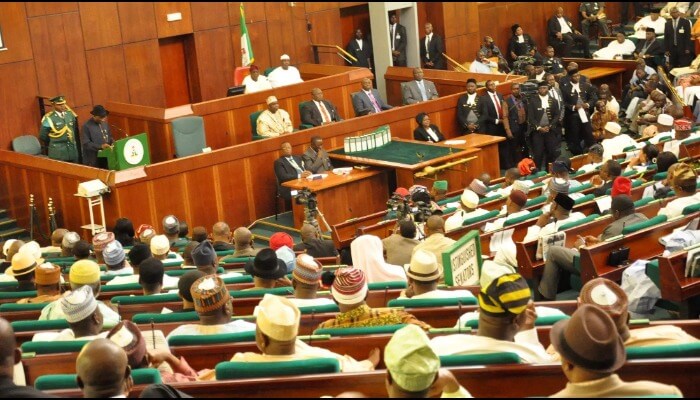
President Tinubu, while presenting the budget to a joint session of the National Assembly, described it as a framework anchored on fiscal consolidation, revenue expansion and disciplined spending. The proposal outlines total expenditure of about N58.47 trillion against projected revenue of roughly N34.3 trillion, leaving a deficit estimated at over N23 trillion.

The President said the budget prioritises security, infrastructure, education, health and social protection, while reaffirming his administration’s commitment to reducing waste and improving execution.
However, beyond the headline priorities, the financing structure of the budget has drawn closer scrutiny.
The Medium-Term Fiscal Framework underpinning the proposal shows a significant dependence on non-oil revenue, particularly taxes, alongside sustained borrowing.
Paul Alaje, chief economist at SPM Professionals, said the 2026 budget is most likely to be funded largely by tax revenue, and borrowings.
He warned that while the government has expressed optimism around tax reforms, Nigeria’s fiscal history suggests borrowing will still play a dominant role.
“Perhaps the government expects taxes to deliver the 2026 budget, but if that does not happen, borrowing will finance the gap. The framework already shows borrowing above 30 percent of financing needs, and that could rise,” Alaje said.
Read also: Governors lift 2025 education budgets to ₦3.6trn
The pressure for stricter oversight is amplified by the new tax framework that took effect on January 1, 2026, which expanded the tax base, tightened compliance and strengthened digital revenue collection.
The reforms, aimed at boosting non-oil revenue and stabilising public finances, effectively shift a larger share of government funding responsibility to individuals and businesses.
Fiscal analysts say this transition alters the social contract.
Prof Akpan Ekpo explained that the National Assembly must ensure proper scrutiny and ensure accountability of taxpayers’ money.
He said, “When government funding comes directly from citizens through taxes rather than volatile oil income, accountability expectations increase sharply.
“Poor oversight becomes harder to justify because citizens can directly link their tax payments to budget outcomes.”
Early reviews of the 2026 budget have already revealed allocations that raise concerns about prioritisation and value for money, reinforcing calls for strict legislative examination.
Recent reports show that the Federal Ministry of Works proposed over N500 million for items including training for hairdressers, make-up artists and the procurement of grinding machines, expenditures analysts say sit uneasily with the ministry’s core mandate.
Other analyses of the budget documents indicate that vehicles, travel, and sundry administrative expenses account for significant portions of MDAs’ allocations, even as revenue uncertainty persists.
There are also concerns over the injection of about N3.5 trillion worth of new projects by MDAs, despite an earlier federal government directive freezing new projects due to revenue constraints.
Additionally, the budget earmarks roughly N1.7 trillion for unpaid contractor obligations, reflecting longstanding implementation backlogs.
Separate reports have highlighted large provisions for travel, feeding and logistics for the President and Kasshim Shettima, the Vice-President, further fuelling public debate about spending discipline.
“These are exactly the kinds of issues that budget defence sessions are meant to expose,” Ekpo added.
“If the legislature fails to interrogate these items, then it is complicit in weak fiscal governance.”
Also Professor Sherifeddeen Tella, a development economist, noted that the 2026 budget defence will be a critical test of the National Assembly’s role in Nigeria’s evolving fiscal landscape.
“With higher taxes, rising debt service and limited fiscal space, the margin for error is thin.
“Legislators must move beyond routine approvals and focus on efficiency, relevance and measurable outcomes.”
Read also: Nigeria’s 2026 Budget: When borrowing becomes the plan, not the problem
Sherifdeen Tella, professor of economics at Olabisi Onabanjo University, said weak legislative scrutiny of borrowing has become a recurring feature of Nigeria’s budget process, with serious implications for a tax-dependent fiscal framework.
“It is unfortunate that the National Assembly keeps approving new loans without cautioning the government to halt this pattern,” Tella said, arguing that lawmakers should first demand full accountability for previously approved borrowings before considering fresh requests.
He questioned the logic of repeated loan approvals when earlier budgets, in many cases, were either poorly implemented or not implemented at all.
“They keep asking for loan upon loan and they keep getting it. So what did they use the earlier loans for, that they are now requesting another one?” he asked.
According to Tella, Nigeria continues to service legacy debts without clear evidence that the projects those loans were meant to finance delivered measurable economic or social returns.
He also criticised the speed with which National Assembly approved requests from the executive rather than subjected to rigorous scrutiny.
“It is unfortunate that the National Assembly keeps passing these budgets without cautioning the government to rein in its spending,” Tella said, arguing that lawmakers should demand full accountability for previously approved budgets before endorsing fresh expenditure plans.
He questioned the logic of repeatedly approving large budgets when earlier appropriations, dominated by salaries, overheads and debt service, were either poorly implemented.
“They keep passing budget after budget, and yet we do not see clear outcomes from the previous ones.”
According to Tella, Nigeria continues to allocate significant portions of its annual budgets to recurrent obligations without corresponding improvements in productivity, service delivery or infrastructure, raising concerns about sustainability, especially as the government leans more heavily on taxes to fund spending.
He also criticised the speed with which budgets are often considered and passed, saying the legislature appears to have normalised rapid approvals without thorough interrogation of expenditure lines, particularly those related to salaries, overheads and administrative costs.
Citing recent fiscal patterns, Tella said it was troubling that fresh budgetary provisions were being advanced even as implementation of previous budgets remained incomplete.
“What have they done with the last budget that they are now presenting another one? They are passing budgets even when the previous ones have not been properly implemented,” he said.
Read also: FG seeks private capital for airports, slashes 2026 aviation budget
Tella warned that this reflects a deeper oversight gap, where budget approvals are granted without robust post-implementation reviews, performance tracking or sanctions for poor execution.”
Without stronger legislative scrutiny, he said, Nigeria risks remaining trapped in a cycle where tax revenues are increasingly used to fund routine government operations, while capital investment and growth-enhancing spending remain constrained.