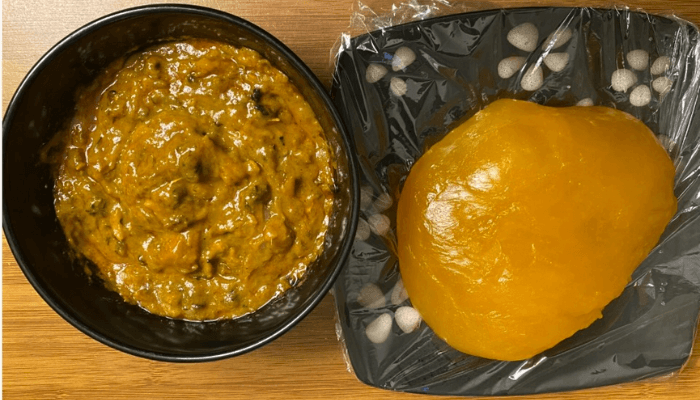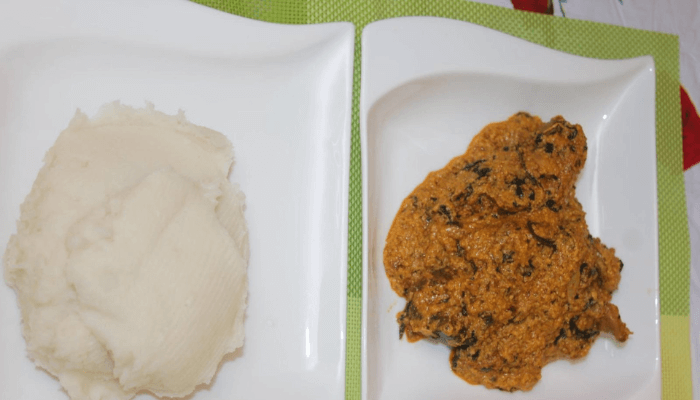
Also described in local South Eastern parlance as Mixayaaemixiaa, Egusi–Ogbono Mix is a unique Nigerian culinary expression that blends two iconic indigenous soup bases into one pot. Beyond taste, it carries nutritional strength, cultural symbolism, and intergenerational knowledge, making it a strong candidate for UNESCO’s Intangible Cultural Heritage (ICH) recognition.
This soup reminds how a couple of years ago, one of my beautiful ‘foodicious’ school friend of over two decades, Jane Azuibike, invited me to Surulere, Lagos, to feature as a guest on the then popular Tasty Cubes Nigeria Family Food show. She called me to use my food journalism skill to prepare the sumptuous soup.
Showing up at the kitchen, we settled down to prepare Egusi and Ogbono soup, mixed together, which I know is always tagged as ‘Mixayaaemixiaaa’.
This kind of soup is very common amongst South Eastern Igbos, especially those from Abia, Enugu, Ebonyi, Imo and Anambra States. Any swallow like fufu, popularly known as ‘six to six’, pounded yam, eba, semo, and any other swallow is always a good companion. This blend is not just about taste; it tells a story of cultural fusion, resilience, and shared heritage across Nigeria’s diverse ethnic landscape, especially the South-East, the South-South and some parts of the South-West.

The variations of egusi and ogbono soups are staples of daily life. This is because this unique soup is very common across many local eateries also known as Bukas and many local restaurants. The food vendors as well as caterers are usually urged to mix egusi with ogbono as the foodies order their swallows, and trust me, the swallows are usually fufu or ‘six -to -six’. Most times, everyday foodies go to eat or buy or even take the food away to eat at home, at work or at business places.
The unique feature of this soup is the combination of two key ingredients – egusi and ogbono. The combination, however, gives a deep draw, slippery, and slimy, look, texture, flavour and taste that stands the soup as a unique culinary phenomenon.
Egusi, made from ground melon seeds, and ogbono, derived from the wild African mango seed (Irvingia gabonensis), are each powerful on their own. But when combined, they create a soup that is both creamy and elastic, thick yet smooth, hearty yet comforting.
In the same vein, the decision to mix the soup is often born from creativity, family preference, or local tradition. In many households, especially during celebrations, communal cooking, or festive seasons, the egusi–ogbono mix is prepared as a “special soup,” reserved for moments that matter.
Nutritionally, the dish is a powerhouse. Egusi seeds are rich in plant-based protein, healthy fats, and essential minerals such as magnesium, phosphorus, and zinc. Ogbono contributes dietary fiber, calcium, iron, and beneficial fats known to support digestion and heart health.

When cooked with palm oil, which is naturally high in vitamin A and vitamin E, alongside leafy vegetables like ugu or bitterleaf and proteins such as fish, meat, or snails, the soup becomes a balanced meal that supports immunity, muscle repair, bone strength, and long-lasting satisfaction.
For generations, Nigerian mothers from the South have intuitively understood what modern nutrition now confirms that egusi–ogbono soup is sustaining. It is often recommended in postpartum care, valued for its richness and ability to restore strength. Its fiber content supports digestion, while its healthy fats help regulate cholesterol when eaten in moderation.
Served with traditional swallows like pounded yam, fufu, or eba, it offers both physical nourishment and emotional comfort.
Beyond nutrition, however, the true value of egusi–ogbono mix lies in its cultural meaning. The recipe is rarely written down. Knowledge is passed orally from mother to daughter, aunt to niece, elder to younger cook, through observation, experience, practice, and storytelling. Measurements are usually guided by experience rather than scales; timing is learned by sight, smell, and instinct. In this way, the soup becomes a classroom without walls, preserving indigenous knowledge through everyday practice.
The dish also represents unity. Egusi is widely cultivated and used across Nigeria, while ogbono is harvested from forest ecosystems, particularly in the South-East and South-South, South West as well as some parts of the North.
Their combination reflects a culinary harmony between agriculture and the wild, between different regions and food cultures. In a single pot, one finds a metaphor for Nigeria itself, diverse elements coming together to create something richer and more complete.
It is this depth of meaning that places egusi–ogbono mix firmly within conversations about Intangible Cultural Heritage (ICH). UNESCO defines intangible cultural heritage as living traditions, expressions, and knowledge passed from generation to generation and recognized by communities as part of their cultural identity. Egusi–ogbono mix fits this definition seamlessly. It is a living tradition, actively practiced today; it is community-based, sustained by families and local cooks; and it is deeply tied to cultural identity, hospitality, and social life.
The soup also highlights traditional knowledge of biodiversity and sustainable food systems. Ogbono seeds come from indigenous African trees, linking cuisine to environmental stewardship.
As fast-food culture, urbanization, and changing lifestyles threaten traditional cooking practices, dishes like egusi–ogbono mix face the risk of being simplified, forgotten, or disconnected from their cultural roots. Documenting, celebrating, and safeguarding them is therefore not a nostalgic exercise, but an urgent cultural responsibility.
In a global era increasingly interested in plant Infused and
forward diets, sustainable food systems, and cultural authenticity, egusi–ogbono mix has much to offer the world. This is because it represents Africa’s contribution to global gastronomy, rooted in nature, guided by tradition, and rich in meaning. It speaks of family, community, and continuity. It reminds us that heritage does not only live in monuments and museums, but also in pots simmering gently on Nigerian stoves.
Egusi–ogbono mix is more than a soup. It is a story, a memory, a living heritage, one that deserves to be told, preserved, and recognized, not just as Nigerian food, but as part of humanity’s shared cultural wealth.
Let’s go to the kitchen to relish this Egusi and ogbono mix.
Recipe for 5 servings
• 1 derica of ground egusi
• 1 cup of ground ogbono
• 5 tablespoons ground crayfish
• 6 fresh cameroon peppers [crushed]
• 2 large onion [washed and shredded]
• 1-kilogramme goat meat
• 1 kilogramme chicken
• 1 kilogramme cowleg [bokoto]
• 4 large smoked or dried fish
• 2 tablespoons ground ogiri [locust beans]
• 2 cooking spoons palm oil
• salt and seasoning to taste
• 1 small bunch of vegetable ugu or bitter leaves [shredded]
• 5 pieces fleshy stockfish
Method
• Wash the meat, chicken and bokoto as well as ponmo together and boil until tender.
• Add some salt, seasoning and onions while it is boiling.
• Wash the fish and stockfish with warm water and add to the boiling pot, when the proteins are tender.
• Cover the pot and continue to cook for 10 minutes.
• Uncover, stir and add the ogiri, and crayfish.
• Since frying is not encouraged and not too healthy, just pour the palm oil into the pot and allow it to cook until it is well mixed.
• Cover again and simmer.
• Uncover and sprinkle the ground egusi over the meat stock.
• Stir and simmer for few minutes.
• You will notice that the oil is still all over the pot.
• Just gradually sprinkle the ground ogbono into the pot, stir and simmer for three minutes.
• Wash the vegetables, add to the pot, stir and taste for salt and seasonings.
• Remove from heat immediately and serve alongside pounded yam or any other swallow.
• The food is ready.