The State of Books and the Book Ecosystem in Nigeria, 2026
Nigeria’s book ecosystem in 2026 is defined by four intersecting realities: a decisive shift toward digital formats, punishing cost structures for physical publishing, remarkable creative vitality among writers, and consequential policy interventions in educational publishing.
Together, these forces are reshaping how books are produced, distributed, consumed, and valued.
This assessment draws on multiple industry reports, publishing databases, and sectoral analyses to outline key developments and outlooks for the year ahead.

A Major Policy Intervention: The Reusable Textbook Initiative
One of the most consequential developments in 2026 is the Federal Government’s reusable textbook policy. The initiative mandates the production of durable, standardised textbooks designed to remain in circulation for four to six years.
The policy seeks to:
• Reduce the financial burden on families by eliminating annual textbook purchases.
• Cut educational waste and environmental impact.

• End frequent cosmetic revisions that lead to unnecessary repurchases.
• Introduce predictability and sustainability into textbook provisioning.
Although the initiative disrupts traditional educational publishing cycles—especially revenue models relying on frequent reprints—experts generally agree that, if effectively implemented, it could bring long-term benefits for households, schools, and the public purse. Its success will depend on quality control, nationwide implementation, and publisher adaptation.
Publishing Economics and Market Realities
Nigeria’s publishing industry continues to face significant economic challenges. Limited disposable income and a small number of active readers restrict sales volumes. Industry data indicate that many titles struggle to sell more than 2,000 copies nationally.
Cost pressures are severe. By 2026, professionally producing a typical 150-page paperback can cost over ₦1.4–₦1.5 million for a modest print run of 500 copies, including printing, design, and distribution. These expenses have made traditional print-first models increasingly unviable for many authors and small publishers.
Market Size, Distribution, and Digital Momentum
The Nigerian book market generated an estimated US$26.6 million in revenue in 2025, with forecasts indicating a modest long-term decline through 2030. However, this headline figure masks an important shift: digital formats are steadily expanding access and readership.
Distribution continues to be a structural weakness. Poor road infrastructure elevates logistics costs, while large formal bookstores remain mainly in Lagos and Abuja.
Consequently, publishers and authors depend heavily on informal and hybrid channels, including:
• Schools and academic institutions
• Churches and community organisations
• Book festivals and fairs
• Direct online sales and social media commerce
The Digital Push—and Its Constraints
Digital adoption is rising, driven by Nigeria’s youthful demographics, growing smartphone penetration, and the convenience of e-books.
The e-book segment is projected to grow steadily, with revenues forecast to reach approximately US$146.8 million by 2033.
Yet the digital transition is not frictionless. High print production costs—such as ₦1.5 million for 500 copies of a paperback—continue to shape author behaviour. Increasingly, writers are:
• Launching titles as e-books first
• Using crowdfunding and pre-order campaigns to finance print runs
• Engaging readers directly via newsletters, WhatsApp, and social platforms
These approaches are becoming survival strategies rather than experiments.
A Resilient and Globally Visible Creative Scene
Despite economic headwinds, Nigeria’s literary output remains vibrant and internationally recognised.
Key creative trends include:
• Genre diversity: Children’s literature, fantasy, crime, romance, and short stories are thriving.
Titles such as A Song of Legends Lost and Nearly All the Men in Lagos Are Mad demonstrate strong local and diasporic appeal.
• Publisher dynamism: Indigenous houses such as Masobe Books and Cassava Republic Press continue to publish new voices while exporting Nigerian stories to global markets.
Libraries: Gradual but Uneven Modernisation
Academic and tertiary institution libraries are slowly adopting “smart” technologies to improve access and efficiency. Commonly deployed tools include:
• Mobile applications and remote self-service systems
• Automation and cloud-based cataloguing
More advanced technologies—AI chatbots, IoT systems, and AR/VR—remain rare, largely due to funding limitations and skills gaps.
Reading Culture and Literacy Promotion Persistent Challenges
Nigeria continues to struggle with a weak culture of leisure reading. Book purchases are still largely utilitarian, focused on academic and professional needs, which limits the growth of general fiction and nonfiction markets.
Advocacy and Campaigns
The National Library of Nigeria and civil society groups are intensifying advocacy through initiatives such as Book City events, reading competitions, and community outreach programmes.
In 2025, a grassroots group attempted a 431-hour nonstop reading marathon in pursuit of a Guinness World Record, symbolising growing popular engagement with reading advocacy, even if structural challenges persist.
Literary Events and Platforms
Several festivals and fairs continue to anchor Nigeria’s literary ecosystem:
• Nigeria International Book Fair (NIBF): The country’s flagship industry convening for publishers, educators, policymakers, and readers.
• Aké Arts and Book Festival: One of Africa’s most prominent literary gatherings, connecting Nigerian writers to global audiences.
• Lagos Book and Art Festival (LABAF): A long-running cultural platform promoting reading through interdisciplinary arts.
• Things Fall Apart Festival: A newer, internationally noted event celebrating literary heritage, particularly Chinua Achebe’s legacy.
Prognosis for Nigerian Literature in 2026
The literary outlook for 2026 is both vibrant and complex, shaped by new releases, cross-genre experimentation, and the ongoing negotiation between local rootedness and global reach.
Defining Trends
• Poetry in focus: The 2026 Nigeria Prize for Literature cycle centres on poetry, elevating both emerging and established voices.
• Genre expansion: Writers are increasingly embracing young adult thrillers and children’s literature, broadening their readership. There is also a notable trend of Nigerian authors being republished locally after their initial overseas releases.
• Cultural preservation and scholarship: Literature continues to preserve language and heritage, while critical works—such as Ainehi Edoro’s Forest Imaginaries—add intellectual depth to the ecosystem.
Notable New Titles (Q1 Releases)
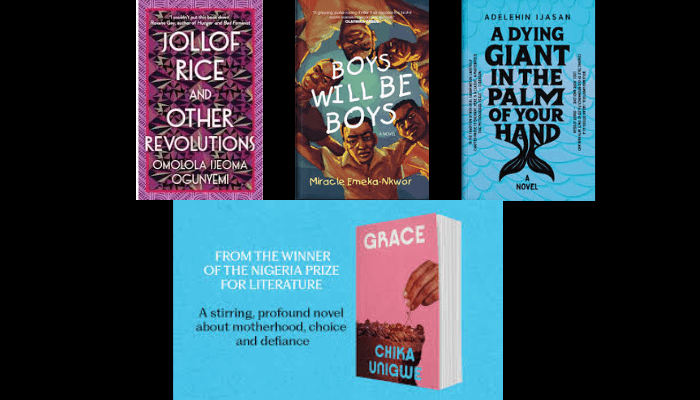
• Grace — Chika Unigwe
• Jollof Rice and Other Revolutions — Omolola Ijeoma Ogunyemi (African edition)
• A Dying Giant in the Palm of Your Hand — Adelehin Ijasan (debut novel)
• Forest Imaginaries: How African Novels Think — Ainehi Edoro
• Boys Will Be Boys — Miracle Emeka-Nkwor (YA thriller)
The Broader Literary Context
Nigeria’s contemporary literary moment builds on a deep tradition:
• Foundations: From Achebe and Soyinka’s anti-colonial narratives
• Evolution: Through the politically charged Second Generation
• Global acclaim: With Third Generation writers such as Chimamanda Ngozi Adichie
• The Fourth Generation: Today’s writers fluidly blend myth, spirituality, social realism, and genre fiction, producing one of the most diverse literary landscapes on the continent.
Looking Ahead
The sustainability of Nigeria’s book ecosystem will hinge on:
• The health and capitalisation of local publishers
• Expanded digital infrastructure, electricity reliability, and anti-piracy enforcement
• Effective implementation of education policy reforms
• Strategic investment in library modernisation and professional training
In sum, Nigeria’s book ecosystem in 2026 faces challenges—but remains dynamic. It is adaptive, inventive, and growing more self-aware, managing scarcity with creativity and policy with persistence.