Nigeria’s bronze medal finish at the Africa Cup of Nations should not be treated as consolation. It should be recognised for what it truly represents: another chapter in by far the most consistently successful football story on the African continent—perhaps even the most consistent on any continent.
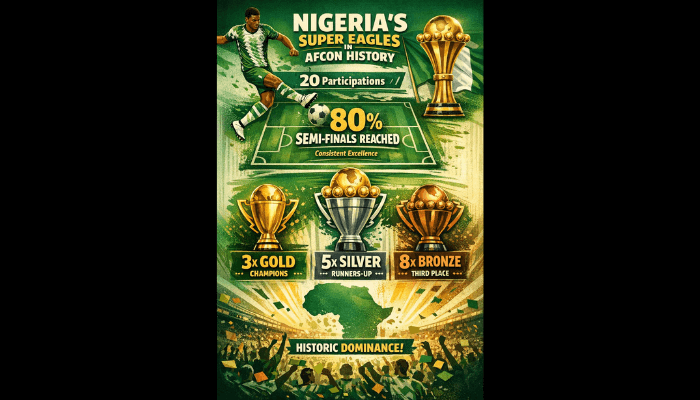
Out of 20 AFCON appearances, Nigeria has finished on the podium 16 times—an 80% success rate that no other African nation comes close to matching. Gold, silver, or bronze, Nigeria almost always leaves the tournament among the elite. That level of consistency is not luck; it is excellence sustained over generations.
This latest tournament was no exception. A young Nigerian side navigated a difficult draw, intense pressure, and a highly charged atmosphere, ultimately falling to the host nation on penalties in the semi-finals—a scenario Nigerian fans know all too well. Losing to hosts, especially on penalties, is one of the crueller traditions of AFCON football. But it is also a measure of how often Nigeria finds itself competing deep into tournaments.
Read also: AFCON 2025: Stanley Nwabali hails team effort in Super Eagles’ bronze win

I was in the stadium in Rabat that night, and the experience captured both the challenge and the privilege of following this team. The infrastructure was impressive—modern, efficient, and clearly the product of years of sustained investment. The atmosphere, as expected, heavily favoured the hosts, with limited ticket availability for Nigerian fans, and Nigerian supporters that were there dispersed throughout the stadium and a crowd that was relentless and emotionally invested. The officiating, as is often the case in such environments, became part of the broader theatre. Many readers may have seen a viral image of an oyinbo Super Eagles supporter speaking in Hausa amid the noise; that was me.

Earlier that day, however, the tournament felt very different. My 11-year-old son, raised in Nigeria like I was, and I had the chance to meet several of the players before the match. What struck us was how young and unassuming they were—far removed from the weight of expectation they carry for a nation of over 200 million people. In a quiet, human moment, Alex Iwobi, one of the team’s most senior and most recognized stars, noticed my son hesitating nearby and stepped in to help him take a selfie. It was a small gesture, but a powerful reminder that behind the pressure and the noise are young men carrying extraordinary responsibility with humility.
A bronze medal, earned the hard way in such circumstances, is not failure. It is confirmation of enduring competitiveness—and of a football culture that continues to deliver, generation after generation.
A country that doesn’t “emerge”—it dominates

Nigeria’s football narrative is often framed as one of unrealised potential. That framing is misleading.
Nigeria has reached 8 AFCON finals and won the tournament three times. We have lost finals to host nations on three occasions and have been eliminated by hosts at the semi-final stage multiple times as well. That is not underperformance; it is the cost of always being present at the sharp end of competition.
Beyond AFCON, Nigeria’s record is staggering:
• 10 Women’s AFCON titles, an unmatched run of dominance by the Super Falcons.
• Olympic gold in men’s football.
• Multiple U-17 World Cups, strong U-20 performances, and repeated global podium finishes at age-grade level.
• A reputation as one of the most reliable producers of elite football talent in the world.
Nigeria is not a football nation trying to arrive. Nigeria has been here for decades.
Read also: President Tinubu applauds Super Eagles after AFCON 2025 bronze win
What Morocco got right—and why it matters beyond football
That truth does not diminish what Morocco has achieved. On the contrary, Morocco’s journey deserves respect precisely because it has been deliberate.
Morocco has invested patiently in football infrastructure, academies, coaching education, governance, data systems, and long-term national planning. That investment has taken decades. The result? Global relevance, a transformed footballing identity, and now the cusp of what may still be only their second AFCON title and just their third AFCON final.
This is not dominance yet—but it is intentional progress.
Crucially, Morocco has approached football the way serious investors approach energy, banking, or infrastructure: as a long-term national asset. The return on investment is not measured only in trophies. It shows up in:
• Increased global visibility and tourism
• Stronger national branding
• Expanded business confidence and foreign engagement
• A redefined image of Morocco as modern, organised, and globally competitive
AFCON 2025 branding captured this perfectly. From airports to city streets to stadiums, Morocco presented the tournament as premium, confident, and world-class. Moroccan stars were front and centre. The image was cohesive and powerful.
Football, here, is not just sport. It is nation branding.
Even Morocco left money on the table
Yet even Morocco showed that ambition alone does not guarantee full value capture.
For a tournament of this scale, the absence of visible, accessible, and diverse official merchandising was striking. Airports, stadiums, and fan zones offered limited options—often focused narrowly on minimal Moroccan gear, with little to no representation of other African teams. Even teams with globally celebrated jersey designs—such as Mali, Senegal, Cameroon, and Nigeria—were largely absent from the merchandising landscape. While these kits became powerful vehicles for brand building, with designs drawing on local art, heritage, and identity, the opportunity to translate that visibility into meaningful commercial monetisation was notably limited.
This was a missed opportunity for CAF, the host federation, and participating countries alike. AFCON is emotionally charged, globally followed, and culturally rich. Merchandise should have been everywhere—jerseys, scarves, collaborations, collectibles—turning passion into revenue and extending the tournament’s brand long after the final whistle.
The image was nailed. The commercial upside was not—yet.
Read also: AFCON 2025: Super Eagles clinch bronze after penalty win over Egypt
What Nigeria should learn—without forgetting who we are
Here is where Nigeria’s conversation must evolve.
What if Nigeria applied Morocco’s long-term, infrastructure- and data-driven football strategy, but at Nigerian scale?
What if we invested systematically in:
• grassroots and elite academies,
• coaching education,
• sports science and analytics,
• domestic league quality,
• facilities, governance, and commercial structures?
The women have already shown what sustained excellence looks like.
The men continue to show what natural dominance produces—even without optimal systems.
One important shift must also be acknowledged. Over the past two decades, Nigerian talent is still largely born, raised, and discovered at home, but increasingly fully developed abroad. European clubs now do much of the final value creation. The pipeline works—but Nigeria captures less of the downstream benefit.
That is not a failure. It is an opportunity.
Bronze today, blueprint for tomorrow
Nigeria’s bronze medal is not a step back. It is another data point in a long record of excellence. It should inspire confidence, not anxiety.
Nigeria is already Africa’s greatest football nation. With deliberate long-term investment—matched to our scale, population, and talent base—we could be as dominant in men’s football as we already are in women’s football. And beyond that, we could translate football success into global influence, commercial value, and national pride.
Another reminder that Nigeria is already great.
And with the right long-term choices, we can be even greater.