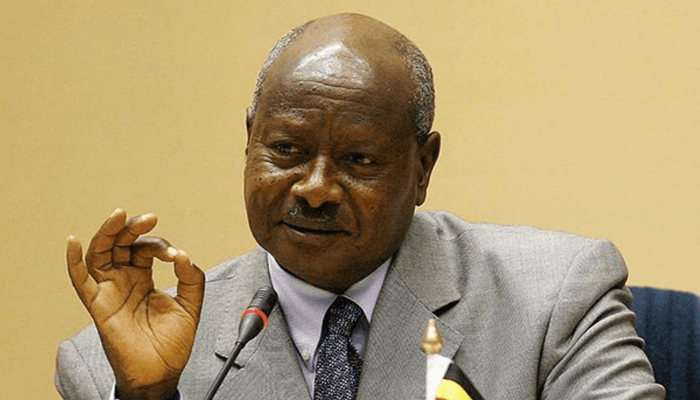
President Yoweri Museveni has secured a seventh term in office, extending his 40-year rule over Uganda after an election clouded by accusations of repression, intimidation, and an internet blackout.
Uganda’s electoral commission announced on Saturday that Museveni, 81, won 71.65 per cent of the vote in Thursday’s presidential election. His closest challenger, Bobi Wine, the 43-year-old opposition leader and former pop star whose real name is Robert Kyagulanyi, received 24.72 per cent.
Read also: Uganda votes amid delays, security clampdown and internet blackout
The result cements Museveni’s position as one of Africa’s longest-serving leaders. He first came to power in 1986 as a rebel commander and has since won seven elections. Over the years, he has twice overseen constitutional changes to remove presidential age and term limits.

The campaign and vote were heavily criticised by international observers. The United Nations said the election was marked by “widespread repression and intimidation”, pointing to a crackdown on opposition rallies and activists. Authorities also imposed a nationwide internet shutdown during the vote, a move that drew strong criticism at home and abroad.
Bobi Wine rejected the result, calling it fraudulent and urging Ugandans to protest peacefully.
“These are fake results. What is happening is massive ballot stuffing,” he wrote on social media, without providing evidence.
Read also: Museveni set to extend 40 years in power as Uganda votes under cloud of violence
Election observers said they did not see proof of ballot stuffing but raised alarm about the wider political climate. Former Nigerian President Goodluck Jonathan, who led a joint African Union observation mission, said reports of arrests and abductions of opposition supporters had damaged confidence in the process.

“That instilled fear and eroded public trust in the electoral process,” Jonathan told reporters. He added that the internet shutdown “disrupted effective observation and increased suspicion”, even though voting day itself was largely peaceful.
Tensions remained high after the polls. Heavy police deployments were reported across the capital, Kampala, as authorities moved to deter possible protests. Bobi Wine said he narrowly escaped a night time raid on his home and was in hiding. Police denied abducting him but said his movements were restricted because his neighbourhood was a “security interest”.
Read also: AFRICA IN BRIEF: Africa’s Iran trade at risk, Uganda vote in tense poll, other stories
“We have controlled access to areas which are security hotspots,” police spokesman Kituuma Rusoke was quoted as saying. “We cannot allow people to use some places to gather and cause chaos.”
The opposition also alleged that at least 10 people were killed by security forces during an incident at the home of a local lawmaker in Butambala, southwest of Kampala. The government has not confirmed the claim.
Museveni defended his record during the campaign, presenting himself as the guarantor of stability in a country with a troubled past. Bobi Wine, who draws strong support from young voters in a nation where most people are under 30, ran on a platform of fighting corruption and delivering sweeping reforms.
Six other candidates took part in the election, none securing more than two per cent of the vote. Voter turnout was reported at 52.5 percent. Museveni’s ruling National Resistance Movement also took a commanding lead in parliamentary races, according to provisional results.