Air France, a global airline and a member of the Air France-KLM Group has marked 80 years of operations in Nigeria, reflecting how the air travel market has expanded in scale, connectivity and economic importance.
From propeller aircraft to today’s high-capacity jet services, rising passenger demand and deeper economic links with Europe, highlights the long-term importance of the country’s aviation industry.
Data from the Federal Airports Authority of Nigeria (FAAN) showed that the international sector presents a much more optimistic trend for airport revenue and global connectivity, stating that international traffic rose from 3,752,746 to 4,070,833, a 8.4 percent increase from 2022 to 2023.
The data also showed that the traffic climbed to 4,334,665 in 2024, indicating a 6.4 percent increase.

The total 3-year impact showed that since 2022, international travel has grown by 15.5 percent, adding over 580,000 annual passengers.
Air France’s presence in Nigeria dates back to July 20, 1946, with the launch of its first regular service between Paris and Lagos. The Paris Orly–Algiers–Kano–Lagos–Brazzaville route was initially operated by a DC-4 every two weeks, with the journey lasting over 20 hours.
Service rapidly expanded to weekly flights, operated first by DC-4s and then DC-3s, with several regional stopovers including Port Harcourt.
Throughout the 1950s and 1960s, the fleet was modernised with the introduction of Constellation, Super Starliner, and later Boeing aircraft, significantly reducing travel times and increasing flight frequency. From 1962, Lagos benefitted from service operated by Boeing aircraft, providing substantial time savings on the Africa–Europe route.
In 1963, service to Lagos was transferred to Union de Transports Aériens (UTA), which operated several weekly flights, notably with DC-8 and DC-10 aircraft, establishing a vital air bridge supporting Nigeria’s growing industry.
The 1970s saw further intensification of air links between France and Nigeria, with the arrival of wide-body aircraft such as the DC-10 and Boeing 747. UTA continued to strengthen the connection between France and Nigeria until its merger with Air France in 1993.
Following this merger, Air France resumed services to Lagos and Port Harcourt, enriched by the expertise and network of the former UTA.
Since then, Air France has continued to innovate and adapt its services, modernising its fleet (Boeing 747, Airbus A310, Boeing 767, Airbus A340, Airbus A330, Boeing 777, and Airbus A350), opening a lounge at Lagos airport in 2003, and increasing flight frequencies and extending routes to Abuja and Port Harcourt
In October 2025, the Air France lounge at Lagos airport was completely renovated, upgrading customer services and facilities.
today, Air France operates daily flights between Lagos and Paris with Boeing 777-200 aircraft, and three weekly flights between Abuja and Paris with Airbus A350s. Service to Port Harcourt is provided in cooperation with Afrijet, underscoring how Nigeria’s air travel industry has improved, driven by trade, migration, tourism and expanding business ties over the past eight decades.
Read also: 248 passengers, 12 crew rescued after aircraft makes emergency landing at MMIA
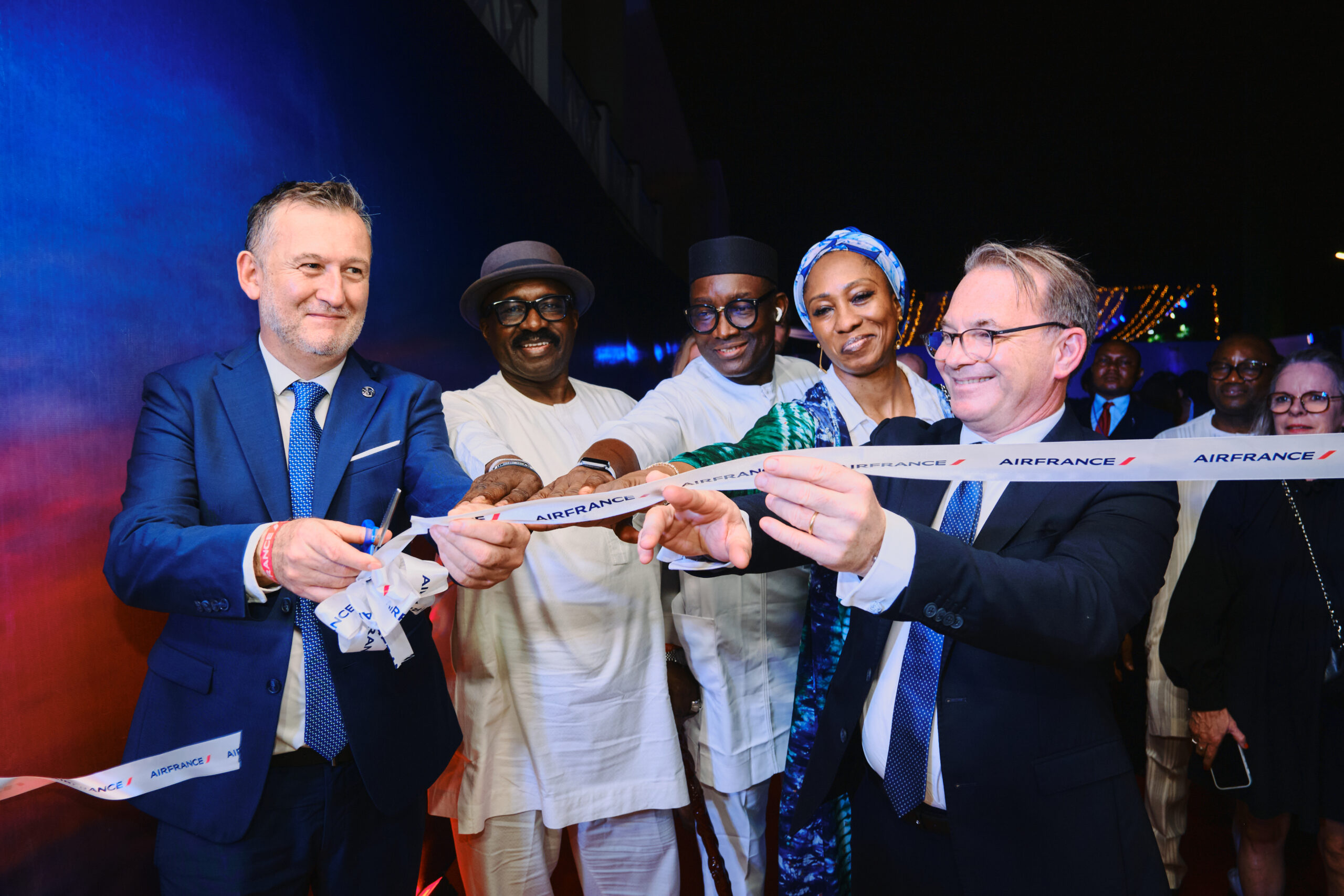
As part of the airline’s anniversary celebration, Air France in partnership with the Alliance Française Lagos, hosted a gallery exhibition titled, “Bridging Cultures – The Nigerian- French Connection,” tracing its operations in Nigeria since 1946 through archival photographs, historical crew uniforms, and aviation memorabilia from the early days of propeller aircraft to the cutting-edge Airbus fleet serving Nigerian travelers today.
The exhibition showcased not only technical advancements in flight, but also the vibrant cultural exchanges and mutual development that have unfolded in the skies and on the ground between the two nations.
Speaking on Franco-Nigerian Relations, Laurent Favier, Consul General of France in Lagos said that Air France’s long presence in Nigeria is part of a broader Franco-Nigerian relationship spanning diplomacy, trade, mobility and cultural exchange.
Favier described the airline’s operations as running parallel to sustained engagement by French diplomatic institutions in Nigeria, while pointing to growing passenger flows, economic ties and people-to-people connections as evidence of a relationship that has expanded steadily over decades.
“This is a very important symbol as far as the relationship between France and Nigeria is concerned. It’s a strong one, a strategic, economic, political and security-wise one as well.
“The increasing relationship between France and Nigeria is a fact. It is an act as an ambassador of French culture worldwide,” he said.
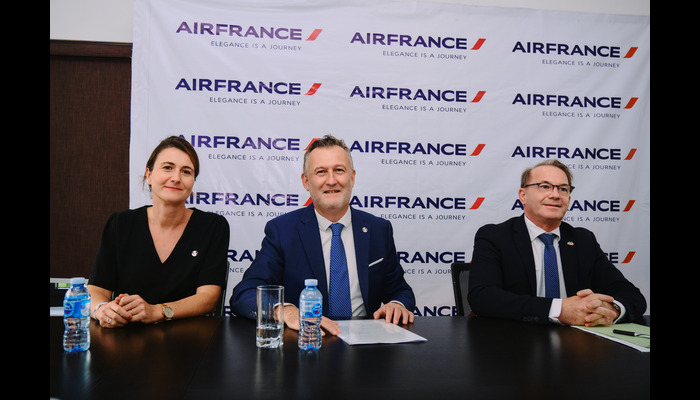
Jean-Luc Mevellec, general manager, Air France Nigeria, said that the exhibition is a testament to France’s longstanding partnership with Nigeria.
“We are proud to share our journey and to celebrate the cultural and economic ties that have connected our two countries for 80 years. Air France remains committed to strengthening these bonds and investing in the future of aviation in Nigeria,” Mevellec said.