Nigeria can leverage on the global energy transition that will create 4.7 million new clean energy construction and technical jobs by 2035, across emerging markets and developing economies (EMDEs).
These findings are drawn from the International Energy Agency’s (IEA’s) World Energy Employment report which also notes that women account for only around one in five jobs in the energy sector, as welders, electricians and line workers. Against this backdrop, it highlights gaps in technical training aligned with labour market needs which by implication Nigeria can leverage on.
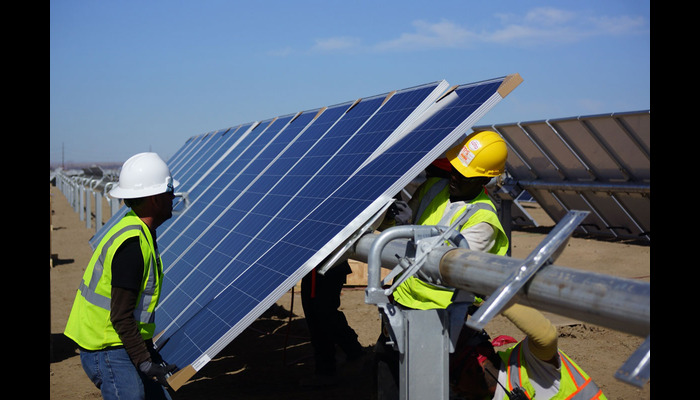
This projected growth in the sector is being driven by the global shift towards cleaner and more resilient energy systems, which is reshaping labour demand across both advanced economies and emerging markets. As a result, construction and technical occupations are emerging as major sources of new employment, with rising demand for skilled workers in power transmission infrastructure, renewable energy plants, manufacturing, installation and ongoing maintenance.
As the report notes “4.7 million new jobs in the energy sector will be created by 2035, the majority of which will be medium- and high-skilled roles requiring vocational or tertiary education.”

Read also: AU moves to back African-made aircrafts, shipping lines, driving job creation
Opportunities created for women
A combination of social, institutional and economic factors continues to limit access to energy construction and technical careers for women.
The report identifies “negative perceptions of women in certain occupations, workplace cultures, and limited exposure to vocational pathways” as key obstacles.
In emerging markets and developing economies such as Nigeria, these issues are intensified by informality and weak school-to-work transitions. “Even when women complete training, they face difficulties transitioning into formal employment,” the report warns, pointing to the need for stronger alignment between training systems and labour market demand.

According to Doris Mbadiwe, CEO of Inter-Bau foundation, a construction training nonprofit for females, “The energy transition in Nigeria is creating a historic window of opportunity to reshape our industrial workforce. I see us continue to bridge the skills and gender gap, with TVET (Technical and Vocational Education and Training) as the vital bridge between current labour shortages and a sustainable future”.
“By providing women with formal certification and hands-on competence, these skills catalyse economic independence, allowing women to rise from artisans to contractor, business owners or skilled employees. Ultimately, we are ensuring that Nigeria’s economy is built on a foundation of diverse talent and shared prosperity.”
Despite low participation at technical levels, the report highlights encouraging progress in leadership. Women’s representation in senior energy sector roles has increased from 13 percent in 2015 to 18 percent today, rising faster than the economy-wide average.
“Renewables and nuclear have seen particularly strong progress,” the report notes, while oil and gas supply recorded marginal gains and coal experienced declines. Even so, women’s share of leadership roles in energy still trails the economy-wide average of 25 percent.
Read also: Job creation for artisans gets boost as i-Serv app debuts in Nigeria
What Nigeria can do to position itself
The report highlights country best practices which Nigeria can adopt. It notes that in Canada, the country has a Sustainable Jobs Training Fund that allocated $70 million between 2024 and 2028 to help workers gain skills for low-carbon energy jobs, including green buildings. Over 10,000 workers will be trained at subsidised or no cost.
In the United Kingdom, the National Skills Fund committed over $260 million to Skills Bootcamps in areas such as solar installation, heat pumps and electric vehicle maintenance, training more than 40,000 people in a single year.
For Nigeria, similar blended funding models, combining public resources, private-sector contributions and development finance, could significantly reduce the cost burden on households.
Reskilling and upskilling are also critical as energy systems evolve. The report notes that “around two-thirds of oil and gas supply workers have the base skills needed to move into other parts of energy,” suggesting significant potential for workforce redeployment.
Short-cycle training, micro-credentials and on-the-job instruction can help electricians transition into solar roles or welders specialise in energy infrastructure. Importantly, such pathways can also be designed to attract women, particularly where clear job outcomes and safe working conditions are guaranteed.
Read also: World bank reveals 5 key sectors to drive job creation next decade
Nigeria already has early building blocks in place, but the report suggests that scale, coordination and visibility are now critical.
Over the years, Nigeria introduced specialised postgraduate courses for the renewable energy sector and embedded solar modules within electrical engineering curricula, alongside specialised short courses. These initiatives align with recommended policy measures such as “modular, stackable certifications that allow learners to progress from short-term credentials to full degrees.”
In addition is the government-led Technical and Vocational Education and Training (TVET) initiative. Dr Tunji Alausa, minister of Education reiterated it as a pathway to youth empowerment and job creation.
Speaking on its success, he disclosed that more than 1.3 million applications were received within ten days of launching the programme in 2025, out of which 960,000 young people were selected. The first cohorts of 250,000 trainees are currently undergoing training across 2,600 centres in the 36 states and the FCT.
The initiative is structured to be 90 per cent practical and 10 per cent theoretical, covering 28 priority trades aimed at equipping young Nigerians with sustainable income-generating skills. Some of the selected trades includes plumbing and electrical works, relevant in the energy sub-sectors.