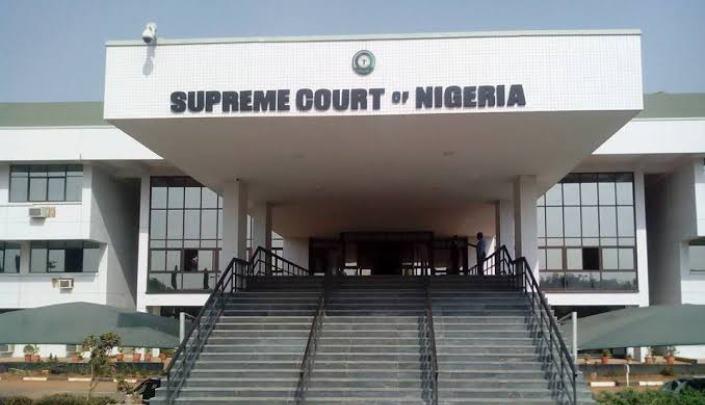
The Supreme Court of Nigeria, on Friday, affirmed the forfeiture of $40,000 to the federal government by Aminu Sule Lamido, son of Sule Lamido, former Governor of Jigawa State.
The apex court upheld earlier rulings by the Federal High Court in Kano and the Court of Appeal in Kaduna, which had convicted Lamido for failing to declare the sum while attempting to travel abroad.
Aminu Lamido was arrested by the Economic and Financial Crimes Commission (EFCC) on December 11, 2012, at Aminu Kano International Airport while en route to Cairo, Egypt.
Operatives discovered that he was carrying $50,000, but he had falsely declared only $10,000 to the Nigeria Customs Service (NCS).
Following his arrest, Lamido was arraigned before Fatun Riman, Justice of the Federal High Court, Kano, on February 4, 2013.

According to a statement by Dele Oyewale, Head, Media & Publicity, Economic and Financial Crimes Commission, he faced a one-count charge of money laundering and false declaration of foreign exchange.
The charge stated that he “on or about December 11, 2012, while transporting in cash the sum of $50,000 from Nigeria to Cairo, Egypt, falsely declared to the Nigeria Customs Service the sum of $10,000, contrary to the provisions of the Foreign Exchange (Monitoring and Miscellaneous Provisions) Act and the Money Laundering (Prohibition) Act 2011.”
Lamido pleaded not guilty but was convicted on July 12, 2013, with Justice Riman ordering the forfeiture of $40,000 to the federal government.
Dissatisfied, Lamido appealed to the Court of Appeal, Kaduna Division, on January 5, 2016.
The appellate court, in a judgment delivered by Habeeb Abiru (Justice) upheld his conviction and the forfeiture order, affirming the trial court’s decision.

He subsequently took the matter to the Supreme Court under suit number SC201/2016. On Friday, the apex court ruled in favour of the EFCC.
The EFCC hailed the judgment as a significant victory for anti-corruption efforts, emphasising its commitment to ensuring compliance with foreign exchange regulations and curbing money laundering in Nigeria.