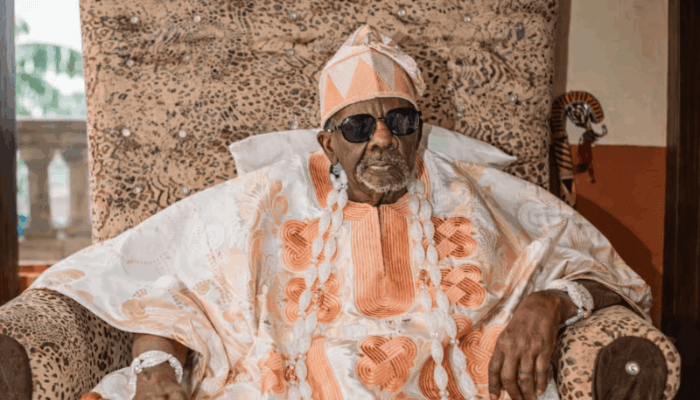
For nearly half a century, Oba Babatunde Akran sat at the centre of Badagry not as a distant royal figure, but as a listener, a mediator, and a steady hand in an ancient town balancing history and change. Long before his death at 89, the Wheno Aholu Menu Toyi I had already secured his place as one of the most influential traditional rulers Lagos State has known.
Oba Akran’s story was never just about royalty. Born on September 18, 1936, his path to the throne was shaped by classrooms and newsrooms rather than palace walls. He began his working life as a teacher in schools across the Badagry Division, an experience that grounded him in the everyday struggles of families and young people. From there, he transitioned into journalism, working with respected national newspapers such as the West African Pilot, Daily Sketch, and New Nigeria, where he rose to become the Acting News Editor for the South.
Read also: Oba of Badagry Babatunde Akran dies at 89
When he ascended the throne on April 23, 1977, Oba Akran brought with him a journalist’s instinct to ask questions and a teacher’s patience to explain. Those close to him often described a ruler who preferred dialogue to force and consensus to confrontation. Over 48 years on the throne, his reign was marked by relative peace, unity, and gradual development across Badagry and its surrounding communities.

Badagry, a town deeply woven into Nigeria’s history through the transatlantic slave trade and early Christian missions, has long carried the weight of the past. Oba Akran saw his role as protecting that heritage while pushing for progress. He was a strong advocate for cultural preservation, as well as for infrastructure, education, and greater attention to the town from state authorities.
Read also: Sanwo-Olu opens new roads to boost tourism in Badagry
His influence extended well beyond Badagry. As Permanent Vice Chairman of the Lagos State Council of Obas and Chiefs, Oba Akran became a key voice in traditional governance across the state. His counsel carried weight, earned through years of consistency and a reputation for balance. He also served on the Lagos State Judicial Service Commission, reflecting the trust placed in his judgment beyond cultural matters.
Read also: FG to connect Lagos-Calabar, Sokoto-Badagry highways with Africa’s first underwater tunnel
In recognition of his national service, he was awarded the Officer of the Order of the Federal Republic, OFR, in 1981, alongside honorary degrees, including a Doctor of Laws. Those honours never seemed to define him as much as his accessibility. Residents recall a monarch who remained approachable, attentive, and deeply connected to his people.
Babajide Sanwo Olu, Lagos governor, captured that sentiment in a tribute, describing Oba Akran as “a custodian of culture and a leader whose reign was defined by wisdom, peace, and service.”

Until his final days, Oba Babatunde Akran remained in office, making him one of the longest-serving monarchs in Lagos State history. He is survived by his wives and many children, but his larger legacy lies in a town that remained largely stable through decades of political and social change.