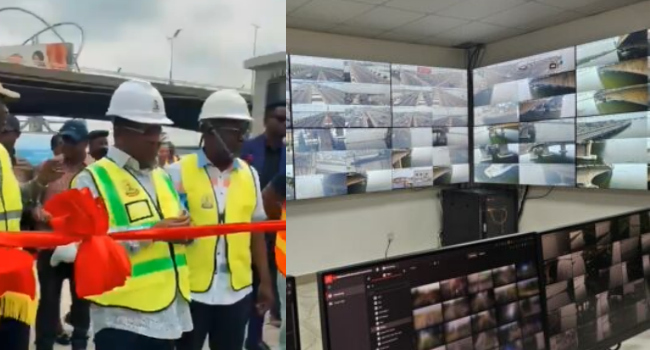
The Federal Government has inaugurated a N40 billion Closed Circuit Television (CCTV) Monitoring Centre dedicated to the Third Mainland Bridge in Lagos, marking what officials describe as a first-of-its-kind bridge surveillance system in Nigeria.
Here are the key things to know about the project:
What is the CCTV Centre?
The CCTV Centre is a high-tech surveillance and control hub designed to monitor activities on and around the Third Mainland Bridge in real time. It covers not only traffic and movement on the bridge deck but also infrastructure above and below the water.
Why was it built?
According to Dave Umahi, the minister of works, the current administration inherited the Third Mainland Bridge, alongside Carter and Iddo bridges, in a severely deteriorated condition in 2023. President Bola Tinubu ordered a comprehensive re-evaluation and rehabilitation of the bridges, including surface repairs and replacement of expansion joints.

The CCTV Centre is intended to protect that investment by improving security, monitoring structural integrity, and discouraging reckless driving, especially speeding.
How much did it cost?
The contract sum for the project is N40.17 billion. The Federal Government has so far paid about N36 billion to the contractor, China Civil Engineering Construction Corporation (CCECC).
What makes it unique?
Olufemi Dare, federal controller of works in Lagos, said no other bridge in Nigeria currently has this level of monitoring. The facility includes:
CCTV coverage of the bridge and underwater areas
A dedicated surveillance boat for water patrol
Two Hilux vans for on-ground monitoring

Monitoring screens and a fully air-conditioned control centre
How is it powered?
The centre relies heavily on renewable and backup power systems. It has:
- About 240 solar panels (with plans for more)
- 10 inverters
- A 300 KVA transformer
- A standby generating plant
- In addition, the broader project includes about 1,268 solar-powered streetlights installed along the bridge corridor.
Who will operate it?
The Ministry of Works will hand over surveillance assets, including the boat and vehicles, to the Nigeria Police for day-to-day monitoring. Other security agencies may be integrated into operations if required.
What comes next?
The inauguration marks the first phase of commissioning. Authorities say further work, including an extension aspect of the bridge project, is nearing completion and will be commissioned later.
Why it matters
The Third Mainland Bridge is Africa’s second-longest bridge and a critical transport artery in Lagos. The CCTV Centre is expected to enhance safety, improve traffic management, deter crime, and ensure early detection of structural or security threats, helping to prolong the lifespan of one of Nigeria’s most important infrastructure assets.