Africa’s startup ecosystem staged a notable recovery in 2025, ending a two-year funding slump as venture capital flows rebounded on the back of stronger company fundamentals, improved macroeconomic stability in key markets, and growing participation from Africa-based investors anchoring larger, more durable rounds.
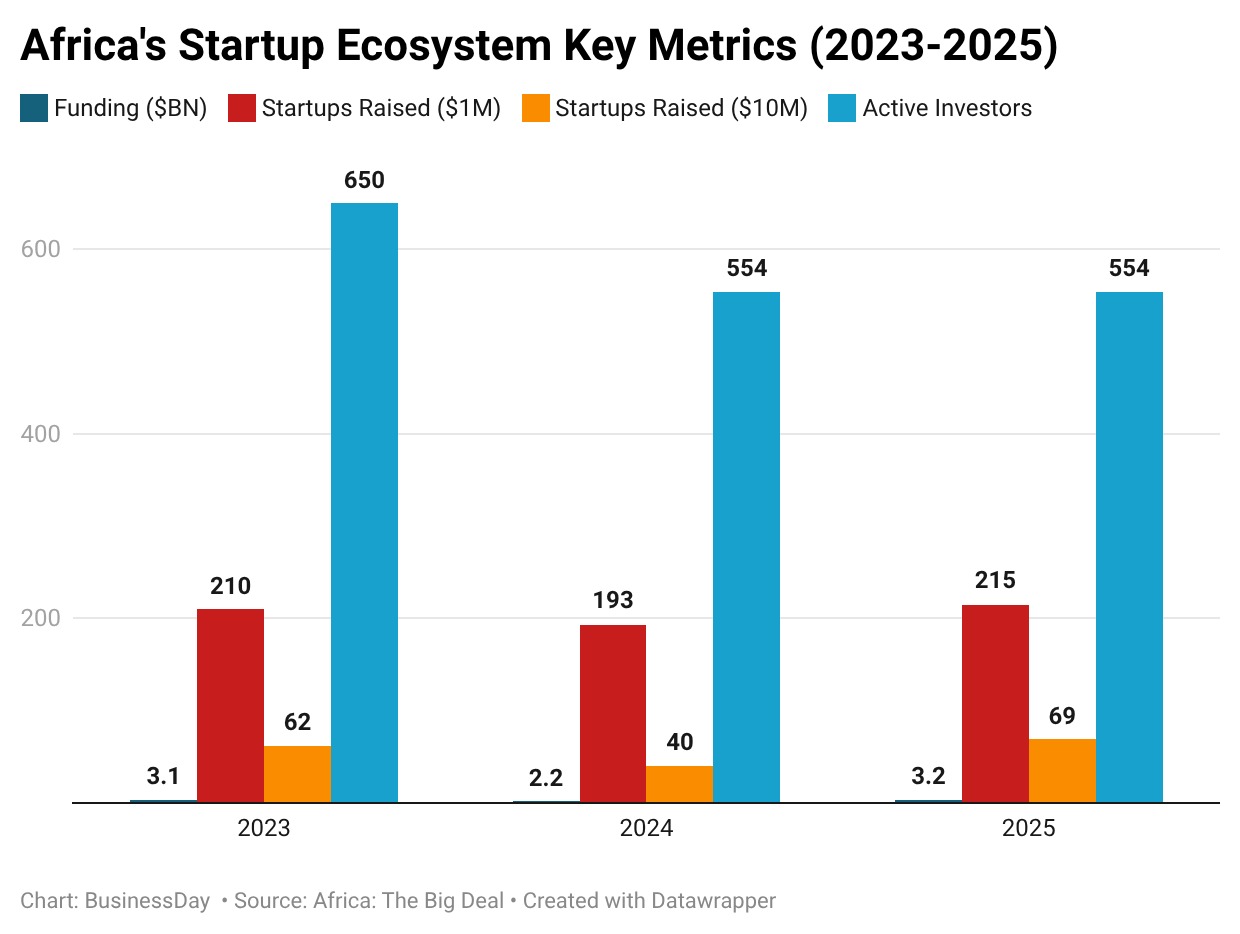
According to the latest report by Africa: The Big Deal, total startup funding across equity, debt and grants (excluding exits) rose to $3.2 billion in 2025, representing a 40 percent increase from $2.2 billion in 2024.
The rebound reverses consecutive declines after funding fell from about $3.1 billion in 2023, amid global monetary tightening and valuation corrections.
Read also: Nigeria’s promising startups to watch in 2026

Crucially, the recovery was not driven by a surge in deal volume, but by a concentration of capital into fewer, larger and more mature companies.
The report shows that 69 African startups raised $10 million or more in 2025, a 70 percent jump from 2024, marking the second-highest year on record for large funding rounds after the 2022 global boom.
Stronger fundamentals, steadier macro backdrop
Commenting on the findings, Andreata Muforo, partner at TLcom Capital, told BusinessDay that the rebound reflects a structural shift toward durability rather than a cyclical bounce.
“Capital flows into African startups stabilised as a result of strengthened company fundamentals, marking a more durable phase of market recovery, as well as improved macroeconomic stability in the large markets,” Muforo said.

She noted that Africa-based investors are playing a more prominent role in the current cycle. “We are seeing Africa-based investors increasingly anchoring and pricing sizable rounds, reflecting deeper local conviction, improved underwriting, and closer alignment with on-the-ground operating realities,” she said.
This trend, she added, is contributing to a more resilient capital market. “Funding is also concentrating into fewer, larger rounds, signalling a shift toward durability over volume. Investors are backing businesses with clearer paths to scale, stronger governance, and more predictable economics.”
Debt financing signals operating maturity
One of the clearest markers of the ecosystem’s maturation in 2025 has been the rise of debt and blended financing, particularly among startups with stable revenues.
“The rise in debt funding reinforces this trend. Debt only follows businesses with predictable revenues, credible governance, and balance sheets capable of supporting leverage. We are seeing more companies reach that level of operating maturity,” Muforo said.
Africa: The Big Deal estimates that debt financing exceeded $1 billion in early-stage funding during the year, supported largely by development finance institutions and commercial lenders targeting sectors with steady cash flows such as fintech, energy and payments infrastructure.
Conviction capital replaces exuberance
For Kola Aina, founding partner at Ventures Platform, the 2025 rebound should not be mistaken for a return to the exuberant funding environment of 2020–2021.
“When we talk about the funding rebound in 2025, it is important not to misread it as a return to the exuberance of earlier cycles. With valuations corrected, capital flowed more decisively into fewer companies that had demonstrated resilience, clearer unit economics, and relevance to real structural needs” Aina told BusinessDay.
He said larger rounds returned primarily because investors had greater confidence in the maturity of target companies. “This wasn’t speculative capital chasing hype; it was conviction capital backing businesses that had survived a correction and proven they could scale responsibly.”
Energy access, fintech infrastructure and other sectors tied to essential services attracted some of the largest cheques, reflecting investor preference for companies solving foundational problems with long-term demand.
Read also: Africa needs $120m annually in pre-seed capital to fix its startup pipeline
Local capital anchors the recovery
Another defining feature of the 2025 rebound was the growing role of Africa-focused general partners and local limited partners, which helped stabilise funding flows even as offshore risk appetite fluctuated.
“Over the past year, we have seen greater participation from investors embedded in these markets and who understand the operating realities firsthand.That local capital didn’t replace global capital; it complemented it,” Aina stated.
According to him, local investors increasingly anchored rounds, provided continuity and reinforced long-term company-building discipline. “This combination, disciplined global capital alongside increasingly confident local investors, is what made the 2025 rebound more durable,” he said.
Fewer deals, bigger cheques
Africa: The Big Deal data shows that while the number of active investors in 2025, about 554, was broadly flat compared to 2024, capital was deployed more selectively. Eight startups closed $100 million-plus mega-rounds, largely in fintech and energy, while 215 startups raised at least $1 million, indicating a healthy but disciplined pipeline.
Since tracking began in 2019, nearly 2,500 unique investors have participated in African startup deals, underscoring the depth of the capital pool supporting the ecosystem.
A more durable growth phase
BusinessDay analysis suggests that the 2025 funding recovery marks a transition from post-boom correction to a more sustainable phase of growth. With improved governance, clearer revenue models and stronger local participation, capital is flowing back into African startups in ways that appear better aligned with long-term value creation.
Rather than signalling a return to excess, the rebound points to an ecosystem that is maturing, one where investment decisions are increasingly grounded in fundamentals, operating discipline and confidence built on survival through a difficult cycle.