
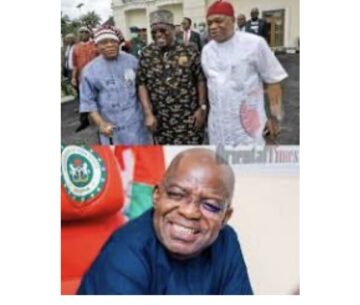
1. Incumbent and former governors clash over Abia State’s future
The political conflict between Governor Alex Otti and his predecessors has escalated, with three former governors now publicly uniting to challenge his administration and oppose his 2027 re-election.
The incumbent’s conflict with previous governors is essentially a struggle over narratives and perceptions.
Otti’s performance and the popular narrative say that the three former governors moved the state backwards rather than forward. Kalu, Orji, and Ikpeazu resent the description and find it aggravating.

The key parties and recent developments are as follows:
Incumbent Governor Dr Alex Otti urged the public to dismiss the opposition’s claim that he is merely “painting” projects they had carried out while in office. He described their meetings and antics as “noise.”
Sen. Orji Uzor Kalu, Former Governor (1999-2007), Current Senator (APC), is the lead organiser of the opposition coalition. He stated that their main purpose is to unseat Otti in 2027.
Sen. Theodore A. Orji, former Governor (2007-2015), is a key coalition member with Senator Kalu.
Dr Okezie Ikpeazu is the Immediate Past Governor (2015-2023) and recently got Senate approval as an ambassadorial nominee.

The Two Sides of the Argument
The core of the dispute is the assessment of governance in Abia State, past and present.
• The Coalition’s Position: Led by Sen. Orji Uzor Kalu, the group argues that they contributed significantly to the state’s development during their consecutive tenures (1999-2023), which he describes as a “relay race”. They view the current administration’s criticism of past performance as dismissive of their relevance and are forming a bipartisan “Team” to reclaim political control. They are also reportedly considering legal action against Governor Otti for operating from his private residence.
• The Otti Administration’s Response: Governor Otti’s aide has dismissed the opposition as “chasing shadows” and driven by “selfishness and bitterness.” The defence argues that politicians who left a legacy of “infrastructural deficits” and delayed salaries lack the moral credibility to challenge an administration being praised for performance. They accuse the coalition of relying on “borrowed federal influence” (President Tinubu’s name) rather than its own track record.
Notably, the Abia State Government announced the abolition of the law granting lifetime pensions to former governors. The announcement amidst this dispute makes it more political.
The cancellation of pensions for former governors in Abia State is a significant move, representing a major shift in governance priorities, public resource allocation, and political ethics in Nigeria. It covers
Fiscal Responsibility & Equity. Prioritises payment of long-standing pension arrears to retired civil servants over benefits for former leaders. Gov. Otti initiated a phased payment plan for over ₦60 billion in pension and gratuity arrears owed to retirees since 2001.
Political Accountability. Challenges the culture of self-reward in political office and redirects funds to public welfare. Otti argued it was unjust for ex-governors with 8-year terms to get lifelong benefits while career civil servants struggled. The ABSG frames the move as leadership by sacrifice rather than self-interest.
Public Trust & Social Justice. It tackles public anger over elite privilege and seeks to restore confidence in government. Public reaction on social media has been overwhelmingly positive, with calls for the federal government and other states to follow suit.
What This Means for Abia’s Politics
• Redefined Political Battle: The contest no longer follows traditional party divisions. It is now a direct confrontation between Governor Otti’s performance-driven governance and a coalition of former state leaders aiming to regain power.
• A Litmus Test for Voters: The 2027 election will assess whether voters prioritise loyalty to established political figures or reward the incumbent’s perceived performance and new style of leadership.
Governor Alex Otti is winning the perception battle on social media. Citizens post images, messages and memes mocking the former governors.
2. The death of Adichie’s son raises concerns over the quality of medical care
The death of Nkanu Nnamdi, the 21-month-old son of renowned author Chimamanda Adichie and her husband Dr Ivara Esege, has attracted both national and international attention, highlighting concerns about patient safety and the standards of care in Nigeria’s healthcare system and sparking discussions on accountability and systemic healthcare challenges.
The tragedy happened on 7 January 2026 when the family was in Nigeria for the Christmas holiday. Their son, who had initially shown signs of a mild illness, became seriously ill and was referred for further diagnostic tests.
Allegations of medical negligence against Euracare Hospital
Adichie and her legal team allege that Euracare Multi-Specialist Hospital failed to deliver adequate medical care, leading to their son’s death. Specific allegations include:
• Improper or excessive sedation with propofol and a lack of appropriate monitoring of the child under anaesthesia.
• Transferring a sedated child between clinical areas without continuous physiological monitoring, supplemental oxygen, or adequate medical supervision.
• Failures in airway protection, prompt medical response, and availability of resuscitation equipment.
• Failure to fully disclose risks associated with the anaesthetic agents raises issues about informed consent.
The family’s solicitors have formally served a legal notice to Euracare, accusing the hospital, its anaesthetist, and other staff of breaching their duty of care. They requested certified copies of all relevant medical records, CCTV footage, monitoring data, and other evidence within seven days, and warned against the destruction of evidence.
3. Euracare Hospital’s response
Euracare Hospital issued a public response by:
• Extending sympathy and condolences to the family, describing the loss as “profound and heartbreaking.”
• Denying allegations of negligence, asserting that the child was already critically ill upon arrival and that care was provided in accordance with established clinical protocols and internationally accepted medical standards.
• Confirming that it has initiated an internal investigation in line with clinical governance standards and is cooperating with regulatory authorities.
4. Official and public developments
• The Lagos State Government has launched an independent investigation into the incident to establish the immediate and underlying causes of the child’s death and evaluate compliance with clinical standards.
• Reports indicate that the anaesthesiologist involved in the case has been suspended pending the outcome of investigations.
3. Tough Love Tragedy
Dr Dokun Adedeji, a mental health specialist, shared a message that netizens have trended across platforms.
It is a first-person account of a father who confuses his son’s quiet struggle with economic hardship and untreated depression for laziness and entitlement. Set against a generational backdrop, the story shows how “tough love,” rooted in outdated ideas about work, housing, and opportunity, becomes a fatal misjudgement. After dismissing his son Leo’s exhaustion as weakness, the father learns too late that Leo was working tirelessly, applying for hundreds of jobs, managing debt, and rationing mental health care after losing insurance. Leo’s suicide forces the narrator to confront how structural economic decline, the gig economy, and digital isolation have changed adulthood—and how parental judgment, mixed with nostalgia, can silence cries for help. The piece ends with a plea: listen when young people say they are tired, because fatigue may be despair, not laziness.
I Told My Son to “Man Up.” I Didn’t Know He Was Drowning.
I told my son to “man up” and stop making excuses.
I didn’t realise I was shouting at a drowning man until his bed was empty and the silence in his room became permanent.
My son, Leo, was twenty-three. To the outside world—and, painfully, to me at the time—he appeared to be a failure.
I was brought up in an era when sweat equity meant something real. I bought my first home at twenty-four while working in a manufacturing plant. I drove a battered pickup, fixed it myself, and never complained. That was the promise we were sold: work hard, get ahead. Simple maths.
When I looked at Leo, I didn’t see struggle. I saw laziness.
He had a university degree gathering dust. He delivered food for a gig app, slept odd hours, lived in my basement, and wore the same oversized hoodie every day. I stayed on his case. “The world doesn’t owe you a living,” I’d say. “Get a proper job. Build some character.”
One Tuesday evening, I came home from work and found him in the kitchen staring at a bowl of cereal. It was 6 p.m.
“You just waking up?” I snapped.
“No, Dad. Just got back. Did some deliveries.”
I scoffed. “That’s not a career. When I was your age, I had a mortgage and a baby on the way.”
He looked thinner than I remembered.
“The market’s rough,” he said. “Nobody hires entry-level without years of experience. Rent for a studio is two thousand a month. I can’t make the maths work.”
“The maths works if you work,” I replied. “Stop blaming the economy. We didn’t have safe spaces. We just got on with it.”
He looked at me with eyes that were heavy—not sleepy, but burdened.
“I’m trying, Dad,” he said. “I’m just… tired.”
I rolled my eyes. Tired of what? He had food, electricity, and a roof. I was the one working ten-hour days.
He nodded quietly.
“You’re right,” he said. “I’m sorry, I’m not who you were at my age.”
He hugged me before going to bed. I thought I’d finally broken through. Tough love, I told myself. I went to sleep believing I’d been a good father.
The next morning, the house was too quiet.
His room was immaculate. On the bed lay his phone and a folded note.
He had applied for over 400 jobs. He was working 14-hour days, delivering food, just to pay the interest on his student loans. He had stopped taking his medication when his insurance expired because he didn’t want to ask me for money again. That was why he was tired.
The note ended with one line I will never forget:
“I’m taking the truck to the old bridge.”
By the time I reached the river, it was too late.
People tell me it wasn’t my fault. That depression is an illness. They are right.
But I can’t stop thinking about the maths.
Leo wasn’t lazy. He was working while I slept. Fighting a battle I refused to see because I measured his life with a ruler from 1990 and punished him for not measuring up.
We tell our children, “When I was your age, I had a house.”
We forget to say it costs two years’ salary, not twenty.
We forget we had pensions, not gig contracts.
We forget we had a future that felt attainable.
Today’s young people are not weak. They are navigating an economy that offers insecurity rather than careers, debt rather than opportunity, and isolation rather than community. They are working harder than we ever did for a fraction of the reward.
When they say, “I’m tired,” they don’t always mean they need sleep. Sometimes it means they are running out of reasons to stay.
If your child seems stuck, listen.
If they seem exhausted, believe them.
Put down your judgment. Retire your “back in my day” stories.
Don’t tell them to man up. Tell them you are there. Tell them they matter beyond their paycheque or productivity.
I would give everything I own—my house, my pension, my pride—just to see my son sleeping “lazily” on that couch one more time.
A perfect dead child is not a legacy; it is merely regret.