…World’s second-steepest fall globally
…Down 27 places to 89th on Henley Passport Index 2026
…Sierra Leone, Mali, Gambia record Africa’s next-biggest drops
Nigeria has recorded the steepest decline in passport power in Africa over the past two decades, highlighting how limited visa liberalisation, tightening global mobility rules, and weak reciprocal agreements have steadily eroded travel access for Africa’s most populous nation.

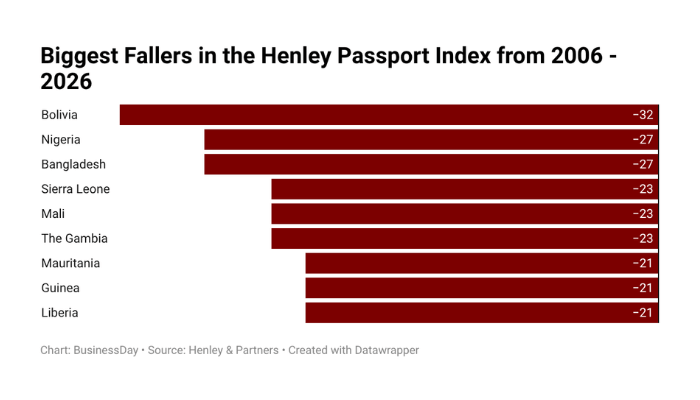
Analysis of the Henley Passport Index (HPI) for January 2026, released on Tuesday, shows that the country’s passport has fallen 27 places over 20 years, sliding to 89th out of 199 countries from 62 at the launch of the index in 2006. Globally, it posted the second biggest long term decline, behind Bolivia, which dropped 32 places.
The fall is particularly striking given Nigeria’s recent, short-term improvement. From the January 2025 edition of the index, Nigeria climbed five places from 94th, underscoring a modest rebound that nonetheless fails to offset two decades of relative underperformance.
Falling behind, not falling out
Created 20 years ago, the Index ranks passports based on the number of destinations holders can access visa-free or with visa-on-arrival, using exclusive Timatic data from the International Air Transport Association (IATA). While the top of the rankings has become increasingly crowded, countries at the bottom have grown more isolated, widening the global mobility gap.
According to Henley & Partners, Nigeria’s long-term decline reflects stagnation rather than outright loss of access.
“Nigeria has seen a fall in its ranking over the last 20 years because it has only added nine destinations to its visa-free score over this time,” analysts at the London-based immigration investment consulting firm said in an email to BusinessDay.

“The main reason for the loss in ranking is that other passports have extended their visa-free access much more significantly. It is more a case of not keeping up than losing access.”
Read also: Nigeria’s biggest companies double down on assets as inflation, FX risks bite
In 2006, the average passport worldwide offered visa-free access to 58 destinations. By 2026, that figure had risen to 108, leaving countries that failed to expand access rapidly pushed down the rankings.
“A record number of people are expected to travel in 2026, amplifying the economic and social benefits of mobility,” said Willie Walsh, director general at IATA. “Yet for many nationalities, a passport alone is no longer enough. As governments tighten borders, policymakers must not overlook technologies such as digital ID and digital passports, which can enable both secure borders and seamless travel.”
The global contrast
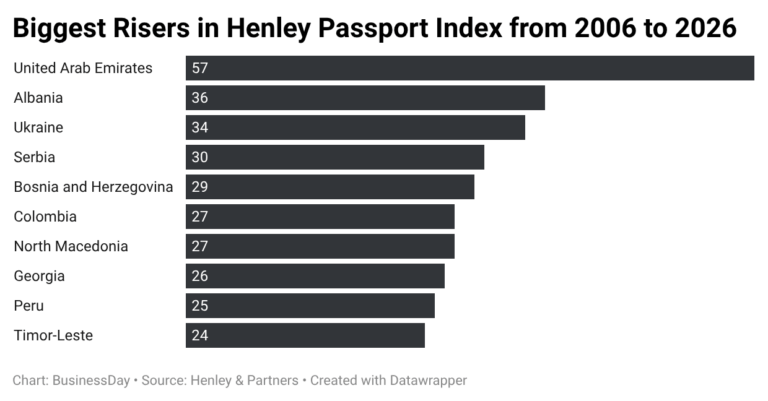
The divergence is stark when set against top performers. The United Arab Emirates is the strongest climber on the index over the past 20 years, adding 149 visa-free destinations and jumping 57 places to 5th globally, with access to 184 destinations.
Its rise has been driven by sustained diplomatic engagement, aggressive visa liberalisation, and bilateral agreements.
Passports at the top of the ranking have added 50 to nearly 150 destinations over two decades. As consolidation intensifies at the top, countries that do not continuously expand visa-free access are increasingly overtaken.
Nigeria’s uneven trajectory
Nigeria’s passport performance has fluctuated over the years, mirroring broader diplomatic and global mobility trends. In the mid-2000s, it ranked around the 60s, but gradually slipped as visa restrictions tightened and reciprocal agreements stalled.
By 2021, Nigeria had sunk to an all-time low of 103rd, signalling severely constrained travel freedom. It then staged a partial recovery—98th in 2022 and 97th in 2023—before settling at 89th in the 2026 ranking.
Africa’s fourth biggest economy was not alone as Sierra Leone, Mali, and Gambia recorded the second-largest declines in Africa over the 20-year period, each falling 23 places, ranking 74th, 82nd and 68th respectively. Mauritania, Guinea and Liberia followed, each dropping 21 places to 79th, 81st and 86th.
Read also: NBS projects artificial inflation spike ahead December data release
Henley & Partners noted that recent shifts to eVisa systems in countries such as Malawi, Mauritania, Somalia and Bolivia led several African passports to lose visa-free or visa-on-arrival access.
“Nigeria, Sierra Leone, Mali, Gambia, Guinea and Liberia all lost access to some of these destinations,” the firm said. “More broadly, they are simultaneously losing access due to visa policy changes and not proactively working regionally or globally to secure additional visa-free access for their citizens.”
A contrasting African story
While no African country featured among the biggest global risers over the past 20 years—a list dominated by the UAE and countries in the Western Balkans and Eastern Europe—Rwanda emerged as a standout over the past decade. The East African country climbed 19 places to 70th, placing it among the top 10 global risers in the last 10 years.
Rwanda’s progress reflects a deliberate strategy. Tourism is a key economic pillar, and the country has consistently pursued visa openness and bilateral agreements.
“In just the past year, while many passports lost visa-free or VOA access to Somalia and Malawi, Rwanda gained or maintained access to both,” Henley & Partners said.“Rwanda also implemented bilateral agreements with Liberia and Qatar, showing it works hard both regionally and globally to establish and maintain visa-free ties.”
The bigger lesson
The firm argues that Africa has significant untapped potential to boost passport power through regional openness, stronger visa processes and credible due diligence frameworks that support bilateral agreements.
“Ultimately, the data show that passport power is not driven by history or democratic status alone. Instead, it is shaped by a mix of stability, peace, openness, economic strength, sustained diplomacy and reciprocal mobility policies—areas where Nigeria and several of its peers have struggled to keep pace over the past two decades.”