As we step into 2026, it is again timely to share some perspectives to help navigate the evolving investment landscape. The year ahead is expected to be shaped by a delicate interplay between moderating global inflation, a gradual normalization of monetary policy across major economies, persistent geopolitical risks, and accelerating structural shifts including energy transition, digitalization, and capital market deepening. These forces will continue to influence asset allocation decisions globally and locally.
Before turning to the outlook for 2026, a brief reflection on the Nigerian market in 2025.
In 2025, the Nigerian economy showed early signs of stabilization after a turbulent adjustment phase. Inflation began to ease from 2024 highs, decelerating toward 15% by year end, while exchange rate volatility moderated meaningfully within a narrower band. Economic growth remained modest but resilient, supported by services, agriculture, and early recovery in oil sector activity.
Monetary policy remained restrictive for most of the year, but the long-anticipated pivot finally materialized in the second half, as the CBN initiated a cautious easing cycle. This marked an important inflection point for domestic financial markets. Fixed income investors benefited from elevated yields for much of the year, while the equity market once again surprised on the upside, extending its multi-year rally despite lingering macro headwinds. The key lesson from 2025 was clear: disciplined diversification and timely positioning continued to outperform defensive inertia.

The Macro Outlook for 2026
Looking ahead, we expect 2026 to be a year of gradual normalization rather than dramatic shifts. Nigeria’s GDP growth is projected to strengthen modestly into the 4.0%–4.5% range, supported by improving macro stability, increased private sector confidence, and the lagged benefits of structural reforms. Inflation is expected to continue its downward trajectory, albeit at a measured pace, settling closer to 10% by year end.
The exchange rate environment should remain relatively stable, supported by improved FX liquidity, tighter policy coordination, and decent capital flows, though episodic volatility cannot be ruled out. With inflation easing and growth still fragile, we expect monetary policy to continue an easing path in 2026 (we anticipate big cuts to policy rates), creating a more constructive backdrop for risk assets while rewarding investors who position ahead of the curve.
Where to Invest?
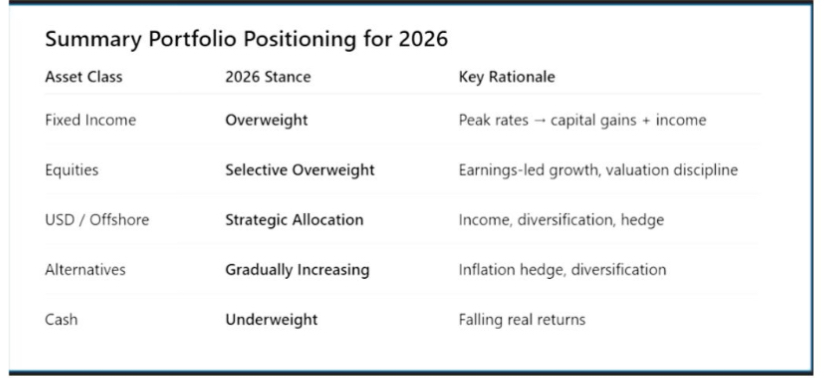
The investment environment in 2026 calls for selectivity, forward-looking positioning, and active diversification. As markets transition from peak tightening to normalization, opportunities will increasingly favour investors who anticipate, rather than react to, policy and market inflection points. Our views are as follows:

Fixed Income – From peak yields to capital appreciation
While nominal yields remain attractive, the era of peak rates is likely behind us. As inflation continues to cool and policy rates trend lower, longer-dated fixed income instruments should benefit from both carry and capital gains. Our recommendation is to remain invested across the yield curve, with an increased bias toward medium-to-long tenor bonds to lock in real yields and participate in price appreciation as rates decline further.
Point to Note!
In 2025, the Securities & Exchange Commission (SEC) mandated fund managers to mark-to-market (fair value) their fixed income funds in line with global best practice. Full compliance is expected to be achieved in 2 years but from announcement point on, all new investments should follow the new rule. Why is this important?
With the SEC directive, it means it is no longer business as usual for many fund managers that had become all too comfortable adopting a “passive” fund management strategy of buy and hold. Now real skill will be required to manage Fixed Income portfolios – calling interest rate direction, taking duration bets, understanding convexity and yield curve positioning.
This new regime will no doubt introduce some measure of volatility in fixed income mutual funds but does not in any way take away the return possibilities that they provide.
Norrenberger Fixed Income Funds are positioned to actively manage duration and optimize returns through this transition. For liquidity-focused investors, the Norrenberger Money Market Fund and Classic Investment Products continue to offer competitive risk-adjusted yields while preserving capital.
Equities – Earnings, not exuberance
After several strong years, equity returns in 2026 are expected to be more earnings-driven and selective rather than broad-based. Companies with strong balance sheets, pricing power, and exposure to structural growth themes will stand out. Valuation discipline and fundamental analysis will be critical.
Building on the strong performance and proven methodology of the Norrenberger Equity Portfolio Model (EPM) which returned +80% in 2025 (NGX ASI: +51%), we remain constructive on equities as a long-term wealth-building asset, particularly for investors willing to ride short-term volatility in pursuit of superior real returns.
USD Exposure – Strategic, not tactical
Although macro stability has improved, inflation differentials and global uncertainties mean that USD exposure remains an essential portfolio hedge in 2026. However, the focus now shifts from pure currency protection to income-generating dollar assets. With global rate cuts well underway, selectively locking in yields on high-quality USD instruments remains attractive.
The Norrenberger Dollar Fund continues to provide access to investment-grade dollar bonds with competitive yields, while our FX-linked products offer diversification and stability within multi-asset portfolios.
In 2025, we broadened our USD investment exposure to include global equities, commodities, ETFs and a “toe-dip” in digital assets. We will continue to explore additional offshore opportunities to enhance dollar and alternative returns across asset classes.
Alternative Investments – Maturing opportunities
Alternative assets are steadily moving from concept to core allocation. Infrastructure, private credit, ESG-aligned investments, and Sharia-compliant opportunities are deepening in both scale and sophistication. Regulatory clarity around digital assets and alternative structures continues to improve, broadening the opportunity set for institutional-grade participation.
At Norrenberger, we are actively developing alternative investment strategies designed to provide inflation protection, portfolio diversification, and enhanced long-term returns. More on this in the months ahead.
If you would like to review your investment strategy for 2026, our team of seasoned investment professionals is available to engage. Please reach out to your relationship manager to schedule a discussion.
At Norrenberger, we remain committed to disciplined investing, innovation, and delivering solutions that enable you to build and preserve wealth across market cycles.