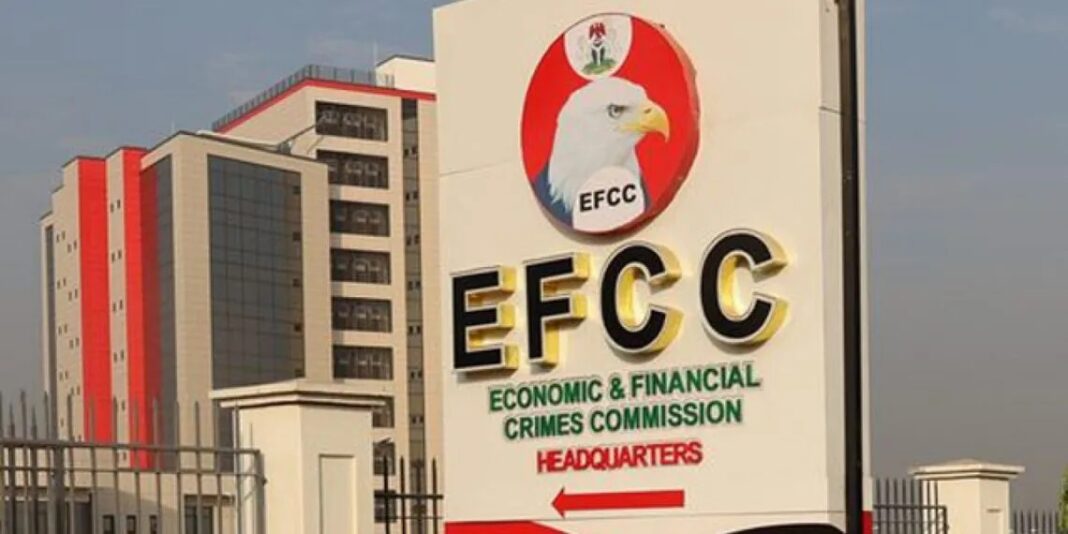
Human Rights Writers Association of Nigeria (HURIWA) has mobilised civil society organisations across the country to throw their weight behind the Economic and Financial Crimes Commission (EFCC).
This, followed a Federal High Court order temporarily forfeiting 57 properties allegedly linked to Abubakar Malami, a former Attorney-General of the Federation and Minister of Justice, in a corruption and money-laundering probe valued at over N213 billion.
HURIWA, in a statement issued on Tuesday by Emmanuel Onwubiko, its National Coordinator, said the EFCC’s handling of the Malami case so far has followed due process and constitutional safeguards, urging Nigerians to resist what it described as “misplaced political attacks” on the anti-graft agency.
The rights group also challenged the Federal Government to build public confidence by ensuring that all recovered assets and funds are transparently deployed for public good, warning that re-looting of recovered proceeds would be a national tragedy.

Read also: Court orders interim forfeiture of 57 properties worth N213.2bn linked to Malami, two sons
“As it is, the people want the government to demonstrate accountability and openness in the deployment of the recovered looted funds and assets regained back from corrupt public office holders and politically exposed persons by both the ICPC and, importantly, the EFCC. Public good must be served”, HURIWA said.
HURIWA said it and over 65 CSOs affiliated with it were satisfied with the “constitutionally permitted steps” adopted by the EFCC in the investigation and prosecution of Malami, stressing that the former chief law officer of the federation was not above the law.
“The EFCC invited Abubakar Malami in a humane fashion and has so far abided systematically by the precepts of the laws of Nigeria,” the group said, rejecting claims by some opposition figures that the case was driven by political vendetta.
Citing the interim forfeiture of dozens of properties linked to Malami, his wife and his sons, HURIWA said the EFCC had won public trust by approaching the courts and obtaining lawful orders rather than acting arbitrarily.

“Trust is the one thing that makes or breaks a leader,” the group quoted American author Les Csorba as saying, adding that the anti-graft agency had demonstrated trustworthiness by relying on court orders in its actions.
HURIWA’s intervention comes against the backdrop of orders made by the Federal High Court in Abuja on the alleged assets of the former AGF.
Emeka Nwite (Justice) last week ordered the interim forfeiture of 57 properties allegedly linked to Malami and two of his sons, Abdulaziz and Abiru-Rahman Malami, to the Federal Government following an ex parte application by the EFCC, filed through its counsel, Ekele Iheanacho.
According to a statement by Dele Oyewale, EFCC spokesperson, the properties, estimated at about N213.2 billion, are suspected to be proceeds of unlawful activities.
They are spread across the Federal Capital Territory (FCT), Kebbi, Kano and Kaduna states, and include hotels, university buildings, plazas, filling stations, warehouses, residential estates, factories, shops and vast parcels of land.
In his ruling, Nwite ordered that all the listed properties be temporarily forfeited to the Federal Government and directed the EFCC to publish the order in a national newspaper, giving interested parties 14 days to show cause why the assets should not be permanently forfeited. The case was adjourned to January 27, 2026, for a compliance report.
Among the Abuja assets listed by the EFCC is a luxury duplex on Amazon Street, Maitama, allegedly bought in December 2022 for N500 million and now valued at about N5.95 billion. Another is a two-winged storey building at No. 3 Onitsha Crescent, Area 11, Garki, formerly Harmonia Hotels, acquired in December 2018 for N7 billion.
Also listed is a five-storey hotel complex on Plot 683, Jabi District, now operating as Meethaq Hotels Limited, purchased in 2020 and currently valued at N8.4 billion, as well as Meethaq Hotels Limited in Maitama, now valued at N12.95 billion.
Other Abuja properties include terraces in Asokoro, multiple shops in Wuse II and Vegas Mall, warehouse shops at Wuse Market, and several high-value residential properties in Gwarimpa, Apo Legislative Quarters and Wuse II.
Outside the FCT, the EFCC listed properties in Kano’s Nasarawa GRA, Kaduna’s Abakpa GRA, and Birnin Kebbi, including bungalows, plazas, warehouses, 100 hectares of land along the Birnin Kebbi–Jega Road and housing units linked to Khadimiyya for Justice & Development Initiative.
Malami, his wife, Bashir Asabe, and their son, Abdulaziz, are currently standing trial before Nwite over alleged N8.7 billion to N9 billion money laundering offences.
They were arraigned on 16 counts filed by the EFCC and admitted to bail in the sum of N500 million each, with stringent conditions, including the provision of two sureties with properties in Maitama, Asokoro or Gwarimpa, the deposit of Malami’s passport, and restrictions on foreign travel. Pending the perfection of their bail conditions, Malami was ordered to be remanded at the Kuje Correctional Centre.
The court has fixed February 17, 2026, for the commencement of trial.
During the proceedings, Nwite issued a warning to lawyers and litigants against any attempt to improperly influence the court, stressing that the law would not be bent for anyone.
Reacting to public debate around the case, HURIWA said Malami has every opportunity under the law to prove his innocence and explain the ownership of the seized assets.
“The onus is on the immediate past chief law officer of the federation to offer credible proof of legal ownership of the properties temporarily seized,” the group said.
It added that Malami, as a senior advocate of Nigeria, has the capacity to engage the best defence lawyers to argue his case.
HURIWA urged Nigerians and political actors to allow the EFCC and the courts to do their work without interference, insisting that the allegations against a former justice minister were too serious to be dismissed as mere politics.
“We are not drawing any conclusions yet. But the EFCC and the court must be allowed to bring the prosecution to a lawful conclusion so that justice can be done and be seen to be done”, the group said.