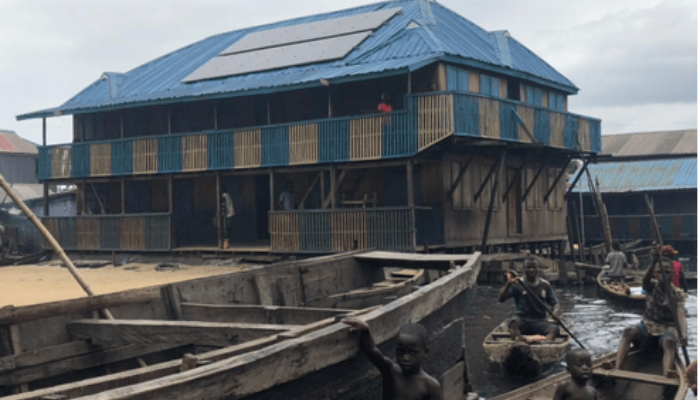
Civil society organisations (CSOs) have joined forces with residents of informal settlements to fault the Lagos State government over what they called “forced mass eviction” of Makoko, Oko Agbon, and Sogunro communities by the Lagos State government.
The action, according to them, threatens tens of thousands of people with displacement without any form of resettlement in violation of subsisting court orders and Nigerian and international law.
The people, in a statement signed by Megan Chapman of Justice & Empowerment Initiatives, and Jude Ojo, Bisola Akinmuyiwa & Kunnu Paul of Nigerian Slum/Informal Settlement Federation, recalled that two days before Christmas, the first phase of demolition began to clear a 30-metre setback from the high-tension powerline.
This powerline passes between the iconic waterfront communities and the Third Mainland Bridge. Despite the resulting hardship, the community organized to peacefully cooperate with this exercise.

“This action was based on the understanding that the Building Control Regulations of Lagos State prescribe a maximum setback of 30 metres from the highest voltage powerline, and with assurances from community leaders that the state government would provide some form of compensation for those affected,” the statement noted.
It noted further that this first phase continued until 3 January 2026, stopping only on Christmas Day itself, displacing thousands and leaving them with no option but to crowd into other people’s homes or sleep in open canoes.
Read also: NGOs warn of humanitarian crisis as Lagos evicts Makoko waterfront residents
“The good faith effort of the communities to cooperate, despite massive human suffering for those affected, with the demolition of the 30-metre setback was based on assurances from the state government that this would be a protection for the rest of the community,” Chapman revealed.
Continuing, she said, “thus, the communities were shocked on January 4, 2026 when suddenly the swamp buggies (a.k.a. amphibious excavators) turned and began unexpectedly destroying buildings further into the community, pushing far beyond the 30-meter setback prescribed by the law.”

Community members rose up in urgent protest from January 4-5, 2026, but were met on January 5, 2026 by a violent show of force by the police officers protecting the demolition squad. Teargas was released across the community and houses were set ablaze.
While this was ongoing, community leaders rushed to Alausa to meet with officials of the Lagos State Ministry of Physical Planning and Urban Development and were told that the government would be clearing an additional setback, threatening up to 100 meters or more, even though such a large setback is nowhere provided for in the law and reverses prior assurances.
“As of January 9, 2025, the demolition has started to pass 100 meters’ setback and is still ongoing. The demolition has already displaced thousands, and tens of thousands are at risk,” Chapman noted.
She recalled that house numbering conducted by Makoko community youth with support from the Nigerian Slum/Informal Settlement Federation and Justice & Empowerment Initiatives in 2020-2021 put the entire population of the four villages of Makoko over 80,000, with tens of thousands more in the neighboring villages of Oko Agbon and Sogunro.