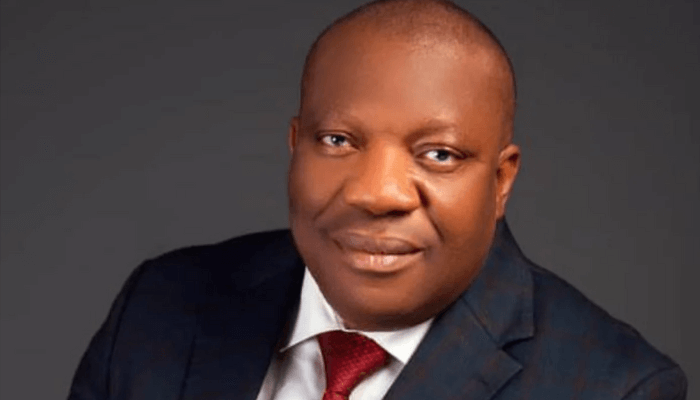
Ekong Sampson, a senator representing Akwa Ibom South, has urged Nigerian journalists to see themselves as key players in defence of democracy and not as bystanders.
Sampson, who is a former member of the Akwa Ibom State House of Assembly and former member of the State Executive Council, said in doing so, journalists should focus on truth, accuracy and objectivity to promote democratic principles.
Speaking at a one-day media training organised by the Nigerian Press Council (NPC) and facilitated by his office which had as its theme ‘ICT, Strategic Media Engagements and Sustainable Development,’ held in Uyo, the Akwa Ibom State capital, he described the media as “central pillars of the democratic process, not peripheral observers.”
He said: “The media play a key role in our society and are part of the electoral framework.”

Ekong, who chairs the Senate Committee on Solid Minerals, pledged his continuous engagement with journalists to create the needed space for reflection and learning in a rapidly evolving information landscape.
He assured participants that such interactions would be sustained throughout his tenure in the National Assembly.
“The media can build empires, and the media can also bring down empires. I therefore, want to use this medium to urge media practitioners to prioritise truth, objectivity, and bridge-building.”
Ekong warned against irresponsible journalism, saying it harms the society while also urging journalists to examine global political developments, such as the Venezuelan crisis, as part of broader debates on sovereignty and global governance.
He announced plans to establish a Trust Fund for journalists in Akwa Ibom State to support the welfare, training, and professional development of media professionals saying the initiative would institutionalize support and strengthen professionalism in the sector.

Earlier, Edet Okpo, chairman of association of Akwa Ibom Senatorial District Media Professionals described the programme as being designed to equip journalists with skills that would empower them with digital skills.
“This is not about sharing rice. This is intellectual empowerment. This is an innovation,” he said.
Okpo said the training would equip journalists with skills on ICT, strategic communication, and sustainable development principles as well as strengthen their mandate to promote transparency, accountability, and impact in governance.
In his keynote address, Peter Esuh, Dean, Faculty of Communication and Media Studies, University of Uyo, noted that digital technology could erode traditional gatekeeping while amplifying ethical risks.
He urged journalists to balance digital competence with research, critical thinking, and ethical judgment to curb misinformation.
Papers were presented on ‘Maximizing the Power of Digital Media Platforms in Shaping Public Views About Leadership and Representation in Akwa Ibom South Senatorial District,’ by Herbert Batta, head of the Department of Information and Media Studies, University of Uyo, and on ‘X-Raying Public Interest and Expectations in Good Governance Through Legislation and Engagements,’ by Idongesit Ashameri, a journalist/Public Relations and Media consultant.