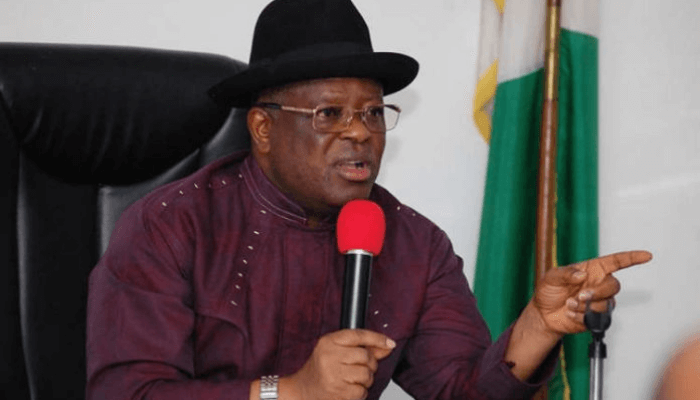
David Umahi, the Minister of Works, on Saturday led an inspection tour of Section 2 of the Lagos-Calabar Coastal Highway and the 7th Axial Road Project, giving a mix of optimism and stern warnings as the federal government pushes to accelerate work on two of its most ambitious transport corridors.
The inspection covered the coastal road and the 7th Axial road linking Lekki to Shagamu and Ijebu Ode, a corridor designed to serve the Lekki Deep Sea Port, Dangote Refinery, and logistics routes across 17 southern states.
At the coastal highway, Umahi said the project was already showing visible progress, though he acknowledged that difficult terrain and realignment challenges had slowed sections of the work.
Read also: Tinubu applauds $1.2bn financing for Lagos-Calabar coastal highway phase 1

“We are very happy that the coastal road is serving its purpose,” the minister said. “Out of about 47 kilometres, excluding bridges, we have roughly 15 kilometres where settlement has reached about 95 percent, and I have agreed with the contractor that concrete work should commence as quickly as possible,” he added.
The Lagos-Calabar Coastal Highway, long discussed before construction began, has faced deep soil challenges, including pits as deep as 25 metres in some sections. Umahi said those conditions were being managed through dredging, sand filling and continuous monitoring.
The managing director of HITECH, the contractor handling the coastal road, said dredging was nearing completion.
“What we have left is a maximum of 1.5 kilometres of water to be dredged,” he said. “We are removing additional pit areas and pushing sand above the water level. We are looking towards the end of this month to finalise everything,” the managing director said.
Umahi praised the contractor’s handling of the terrain and said the government was targeting full completion of section one by April, alongside commissioning a significant portion of section two.

“I will visit this project every month; the President wants this fully commissioned by the end of April, and we must meet that timetable,” Umahi said.
From the coastal highway, the minister moved to the 7th Axial Road Project, where his tone shifted noticeably from satisfaction to pressure. The 25-kilometre dual carriageway is a proposed evacuation route for the Lekki port and a planned Lagos State international airport.
Read also: Coastal Highway has underground drainage, critics spreading misinformation—Umahi
While clearing work has started, Umahi said the project was still at an early stage and warned that contractors must move faster.
“What is going on now is not work. It is just clearing,” he said. “This is kindergarten-level take off. Serious work must begin immediately,” he charged the contractor
The federal government, he said, has already paid about N266 billion as mobilisation funds for the project, representing 30 percent counterpart funding for lots one and two. Contractors are expected to raise the remaining 70 percent through foreign loans under an EPC plus F arrangement, with the road to be tolled on completion.
Wang Chi, project manager with China Harbour Engineering Company, said equipment deployment would increase significantly in the coming weeks.
“We have 33 equipment units on site now, but the total will be more than 120,” he said. “We are also securing environmental and community approvals before lagoon sand dredging begins,” he added.
Environmental consultants confirmed that interim approval had been secured from the Federal Ministry of Environment, with community consultations ongoing and modelling underway for lagoon crossings.
Umahi directed that sand filling must be completed before the onset of heavy rains, warning that delays would not be tolerated.
“Within the next two weeks, I want to see 90 percent of the equipment specified in the bid documents on site,” he said. “I do not subscribe to contractors bidding with equipment they do not deploy.”
Read also: Coastal highway: FG approves additional 100km to pass through Edo
He added that concrete pavement work would begin later in the year, after sand-filled sections had passed through the rainy season, while drainage structures would proceed earlier.
The minister also instructed officials to secure land for development along the corridor to ensure the project generates returns once tolled, and ordered immediate work to begin at the Epe and Shagamu axis, where conditions allow faster construction.
Despite his criticism, Umahi said he remained confident that the project could be delivered if timelines were respected.
“This is a serious project on a challenging terrain,” he said. “If attention is given to it, it will be delivered.”