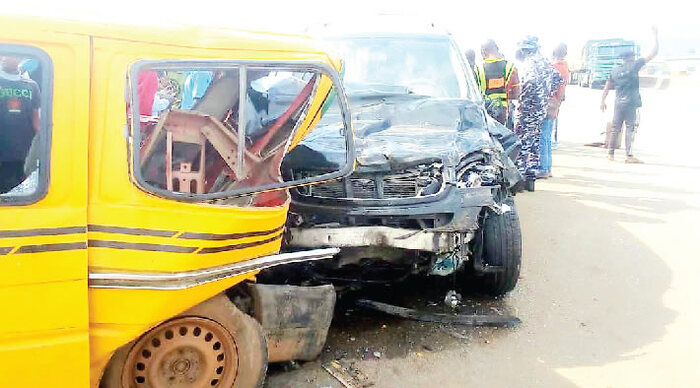
December 20, 2025, was black Saturday for Nneka Akudo (not her full name), who was involved in a car accident with a hit-and-run driver at the Ogba bus stop in Lagos State at about 9 pm.
The driver sped off, leaving the victim lying unconscious by the roadside without any emergency health response.
Luckily for her, Udeson JohnFrancis, a concerned fellow who witnessed the incident, offered to help the victim, as he rushed her to Chygor-Cole Specialist hospital somewhere in Abulegba, where she was resuscitated and operated upon. That singular, timely response saved Nneka’s life.
With rising road accidents on Nigerian roads, victims frequently wait long periods for an ambulance or help to come due to bad roads, traffic congestion, and other factors, leading to deaths that happen after impact and not instantly.

Many see this as a gap in both Nigeria’s transport and health sectors, as accidents leading to deaths of victims that could have been prevented, due to poor road conditions, speed violations, and untimely response to critical incidents.
“I couldn’t spend Christmas with my family because of a decision I took to help this accident victim. She was knocked down by a hit-and-run driver, left unconscious by the roadside, bleeding on her forehead for hours until I got to the scene,” JohnFrancis shared with BusinessDay.
“I had to call the Lagos ambulance services, who came all the way from Victoria Island, before we rushed her to the hospital, where she was operated upon and is currently recovering,” he explained.
Read also: Road accidents surge by 9.4% in Q2 2025
Despite suffering multiple facial lacerations and immobility of the upper left, according to hospital reports, Nneka was fortunate to at least make it out alive based on a timely healthcare response, thanks to the good samaritan.

However, the case was not the same for Joseph Cane (not his real name), who was involved in a fatal car accident and rushed to a general hospital at Ile Epo, Lagos State, by an eyewitness.
He, however, couldn’t make it as there was no emergency response team on the ground to help the victim at the hospital at the time of the incident.
“There were no emergency response team on ground to help the victim. I was asked to go get some medical supplies while the victim battled for his life,” an eyewitness shared with this reporter.
“By the time I returned, Cane had passed on. I haven’t recovered from the trauma since then,” the source added.
These incidents highlight the importance of timely emergency healthcare responses in saving lives.
Emmanuel Oziuwa-John, chief executive of Salvus Emergency, highlighted the poor state of emergency healthcare responses in public hospitals across the country.
“I can tell you for a fact that, based on the data we have, majority of public hospitals in the country lack efficient and well-equipped emergency healthcare response services,” he stated.
“I have witnessed firsthand how this response works efficiently in the UK and other countries. In emergency care, every minute counts,” he added.
According to reports, countries in Africa such as Ethiopia, South Africa, Rwanda, Kenya, and Namibia already have effective emergency financing mechanisms, strong political will, and investments in these systems in case of any accident or disaster.
Effective emergency response can also be seen in other countries like Australia, Japan, the UK, Canada, Germany, and the Netherlands, among others. Their emergency services, including the ambulance system, infrastructure built, and highly trained personnel, are considered among the best in the world, with technologically advanced equipment and rapid response capabilities.
A recent report titled ‘Bridging the Gap Between Policy and Practice in Nigeria’s Emergency Response System’ showed that Nigeria’s health system is not built to handle emergencies.
The report stated that when it comes to illnesses with a predictable course, there’s usually enough time and space for treatment, but when a sudden emergency occurs, whether a road accident, a stab wound, or a gunshot from an armed robbery, the outcome is often not care, but death.
Folake Owodunni, CEO, Emergency Response Africa, told BusinessDay that bad roads make it harder and slower for emergency vehicles to reach people, saying, “If the roads are full of potholes, muddy, or flooded, our drivers have to move carefully or find another way. This takes more time and can be dangerous for the patient, especially in serious cases like bleeding, childbirth, or heart problems.”
Owodunni urged the government to provide more responders in the communities, with vehicles that can handle rough roads, a good cellular network so people can call for help easily, and support from government and private partners to help build stronger systems for emergency care in these areas.
The report also urged the government to develop an emergency response system, saying, “In emergencies, the essence of life is time. While transporting victims to the hospital for proper treatment is great, it is now important to have medical personnel attend to emergencies at the site of the casualty.