Trump’s Intervention in Venezuela Shakes Global Politics, Economy
The forced removal of Venezuelan President Nicolás Maduro by the United States marks a significant and tense escalation in international relations with immediate effects on global politics and the economy. The situation remains highly fluid.
Global Political Implications
The action has triggered a significant international crisis, fundamentally challenging established global norms.

• Widespread International Condemnation: The operation has been condemned by members of the UN Security Council, including U.S. allies, as a violation of international law that sets a “dangerous precedent” for state sovereignty. Countries like China, Russia, Mexico, Brazil, and South Africa have sharply criticised the U.S., framing it as unilateral bullying and a revival of imperialism. Regional bodies have reaffirmed Latin America as a “zone of peace” that must be respected.
• A Crisis of International Law and Order: UN Secretary-General António Guterres expressed deep alarm, stating the action undermines the UN Charter and the principles of sovereignty and peaceful dispute resolution. Experts warn that framing military intervention as law enforcement erodes the rule-based international order and makes diplomacy more difficult.
• Heightened Regional Tensions and Uncertainty: The U.S. has issued direct threats to other countries, including Cuba and Colombia, warning their leaders to “watch themselves. Within Venezuela, the political future is unclear. Vice President Delcy Rodríguez has been sworn in as interim leader but has publicly rejected U.S. control. The country faces a power vacuum with risks of internal fragmentation among various armed groups, militias, and criminal networks previously aligned with the Maduro government.
Global Economic & Energy Implications
The economic fallout centres on Venezuela’s collapsing oil industry and the potential for broader market and humanitarian consequences.
• Immediate Threat to Venezuela’s Oil Economy: Even before the operation, a U.S. blockade was paralysing exports. Internal Venezuelan projections suggest that if the blockade continues, oil production could collapse from about 1.2 million barrels per day to under 300,000 barrels per day this year. This would eliminate the government’s primary source of foreign revenue, triggering a deeper humanitarian catastrophe.

• Long Road to Oil Recovery: President Trump’s suggestion that oil revenues will quickly fund U.S. operations is considered unrealistic by energy experts. Venezuela’s oil infrastructure is dilapidated after years of mismanagement. Restoring significant production would require:
o Tens of billions of dollars in investment over many years.
o A stable legal and political environment to attract foreign companies.
o A comprehensive resolution of the country’s massive debt and expropriation claims.
• Limited Short-Term Impact on Global Oil Markets: Venezuela currently represents less than 1% of global oil production. A total production collapse could tighten supply for specific heavy crude oil grades, but is unlikely to shock the well-supplied global market in the short term. The larger risk is prolonged instability, preventing any recovery in output.
Potential Future Scenarios
The path forward is uncertain and could develop in several directions:
• Scenario 1: Protracted Instability and Humanitarian Crisis (Most Likely Short-Term): With a contested interim government, a destroyed economy, and numerous armed factions, Venezuela could descend into greater instability. This would worsen the existing humanitarian disaster, potentially creating 8 million refugees and spreading insecurity across the region.
• Scenario 2: A Managed but Contested Transition: The U.S. may seek to orchestrate a political shift. Success would at a minimum involve unifying the military under civilian oversight, providing substantial humanitarian aid, and organising legitimate elections. This process would be challenging and require extensive international cooperation, which is currently lacking.
• Scenario 3: Escalation and Broader Conflict: If internal resistance increases or other nations decide to provide material support to factions within Venezuela, the situation could escalate into a proxy conflict, further destabilising the region.
What This Means in Brief
• Global Order: This event is a severe blow to the norms of sovereignty and non-intervention, potentially encouraging unilateral actions by other powerful states.
• Regional Stability: Latin America faces a profound crisis that could reverse decades of progress toward peaceful conflict resolution.
• Venezuela’s Future: The country is at a critical juncture, facing either a difficult, externally influenced transition or a descent into greater fragmentation and suffering.
• Energy Markets: Although immediate disruptions in the oil market are limited, the loss of Venezuela’s long-term production capacity contributes to future market uncertainty.
2. Venezuelan VP Delcy Rodrigues walks a tightrope in response to America.
Based on multiple international news reports, Vice President Delcy Rodríguez, now Venezuela’s interim president, has issued a dual-track response to the U.S. intervention, combining a formal legal condemnation with diplomatic outreach.
• Constitutional and Political Response. The Supreme Court swore her in as Interim President on 3 Jan. to ensure “administrative continuity” after Maduro’s capture.
Even so, she declared Maduro the legitimate president. In her initial televised address on Jan. 4, she insisted Nicolás Maduro is “the only president of Venezuela.’
She then launched a commission for Maduro’s release and announced a government panel, co-chaired by the foreign minister and her brother, to seek his release from U.S. detention.
• Diplomatic & Strategic Response. Rodriguez denounced the US action as illegal. She initially called the operation “an atrocity that violates international law” and stated Venezuela would “never again be a colony.
She later shifted to an offer of dialogue and cooperation. On Jan. 5, via social media, she extended an invitation to the U.S. to work on a “cooperative agenda… within the framework of international law.
The Shift in Tone and U.S. Demands
Analysts see Rodríguez’s public shift from condemnation to proposing cooperation as a pragmatic move given the immense pressure from Washington. President Trump has explicitly threatened her with a “very big price, probably bigger than Maduro” if she does not cooperate and has stated the U.S. is “in charge.
Reports indicate that the Trump administration has given Rodríguez a specific list of demands to secure her position.
• Crack down on drug trafficking networks.
• Expel Iranian, Cuban, and other operatives from countries hostile to the U.S.
• Halt oil sales to U.S. adversaries.
• Eventually, facilitate free elections and step aside.
Key Uncertainties and Challenges
Rodríguez’s position is highly precarious and faces significant challenges:
• Legitimacy and Loyalty: She must reconcile U.S. demands with sustaining backing from Venezuela’s military and the ruling socialist party’s supporters, who see her as a Maduro loyalist.
• Political Future: Venezuela’s constitution has provisions for temporary succession, but the Supreme Court did not specify a time limit for her interim presidency, leading to speculation about how long she may remain in power.
• Opposition’s Role: The U. S. and many other nations recognise exiled opposition figures.
Trump, however, has dismissed opposition leader María Corina Machado, creating uncertainty about the U.S. endgame for Venezuela’s political transition.
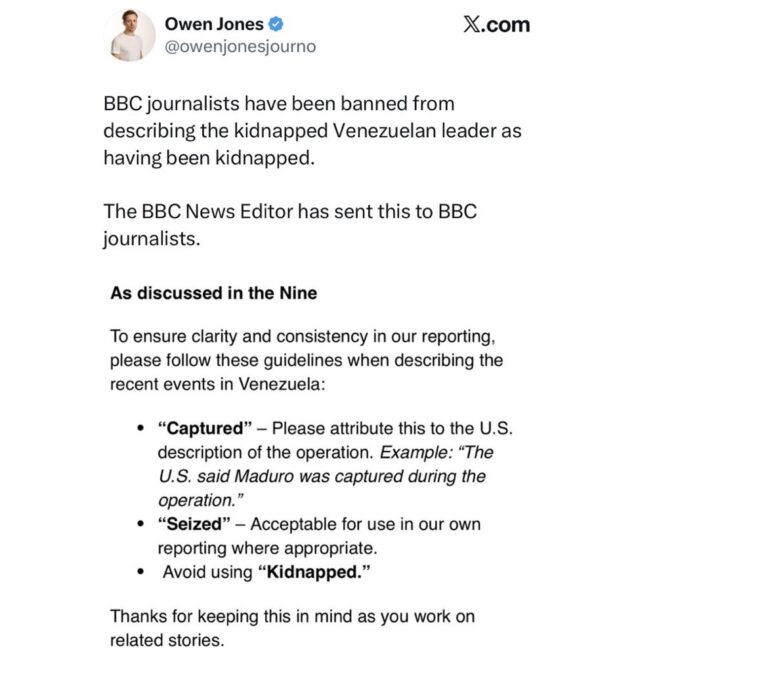
3. BBC bans use of “kidnapped” in reportage of the Venezuela situation
4. Journalists detained and deported in Venezuela.
Venezuelan authorities detained at least 14 journalists on Monday while they reported near the National Assembly in Caracas, the country’s main press union said. All were later released, though one reporter was deported. The detentions occurred during the legislature’s first meeting since a U.S. raid that left dozens dead and removed President Nicolás Maduro for prosecution in the United States. According to the union, officials searched journalists’ cellphones and demanded access codes to inspect their files, accounts, and emails. | New York Times
A history of detentions. This is not the first occasion on which Venezuela has detained journalists for performing their duties. Just last year, journalistic organisations in the country reported the arrest of at least four press workers during the week Nicolas Maduro was sworn in for a third term in office. In 2024, at least nine journalists were arrested across various regions of the country in connection with their reporting, and eight were held on trumped-up charges. As of last year, five of those journalists had been released.
? Go deep:
• Social media users praising U.S. President Donald Trump for capturing Venezuela’s leader Nicolás Maduro are flooding online platforms with AI-generated images and outdated footage, claiming to show the military operation in Caracas. | The Guardian
• News organisations received a rare “thank you” from the Trump administration for not jeopardising its military action in Venezuela by reporting on it before it happened. | ABC
• The BBC has told its reporters not to use the word “kidnapped” when describing the US government’s allegedly illegal abduction of Venezuelan leader Nicolas Maduro. | The National Scotland
From Reuters Institute for the Study of Journalism
5. The Future of News in 2026
How will AI shape the future of news in 2026? This is the question at the centre of a new piece featuring forecasts from 17 experts. As we enter 2026, journalists and media managers are curious about the next frontier for generative AI and the news. We reached out to some of the most prominent voices working in this field and issued an open call to our audience to gauge what the year might hold. We identified five recurring themes:
1️⃣ Audiences will increasingly access news through AI
2️⃣ There will be greater demand for verification work
3️⃣ Automation and agents will transform newsrooms
4️⃣ Newsrooms will upskill and develop AI infrastructure
5️⃣ AI will further empower data journalists.
6. Withdrawal of FG, Senate President Akpabio defamation charges against Senator Natasha Akpoti-Uduaghan.
The withdrawal of defamation charges against Senator Natasha Akpoti-Uduaghan by the Federal Government and Senate President, Godswill Akpabio, results from two important, interconnected legal actions. This was not the decision of a single entity alone.
Key Events Behind the Withdrawal
The Office of the Attorney-General of the Federation (AGF) issued a notice of discontinuance on 12 December 2025. It concerned the Federal Government’s criminal defamation and cyberbullying charges against the Senator. No reason was given except for the AGF’s prosecutorial discretion. Senate President Godswill Akpabio issued a directive to withdraw the defamation and cyberbullying charges against the Senator. These involved civil defamation lawsuits against individuals, including a separate ₦200 billion suit against the Senator. A statement from the Senate President’s press office mentioned that it was a personal decision following a church sermon.
Background of the Cases
Both legal actions originated from complaints made by Senate President Godswill Akpabio and former Kogi State Governor Yahaya Bello. Their petitions followed a televised interview in April 2025, in which Senator Akpoti-Uduaghan alleged conspiracy to eliminate her and implicated the two politicians. In response, she was charged by the state with criminal defamation and cyberbullying.
Analysis of the Broader Context
Based on available information, the withdrawals seem to be a coordinated de-escalation of legal tensions. Analysts view this as a move away from courtroom battles, possibly towards political reconciliation. While no official reasons were given for the AGF’s action, it underscores the broad discretion of that office-5. The case had sparked national debates on freedom of speech, whistleblower protection, and the use of criminal law in defamation cases.